49 works in this view — arrow keys or swipe to move between them.
Dance in Art
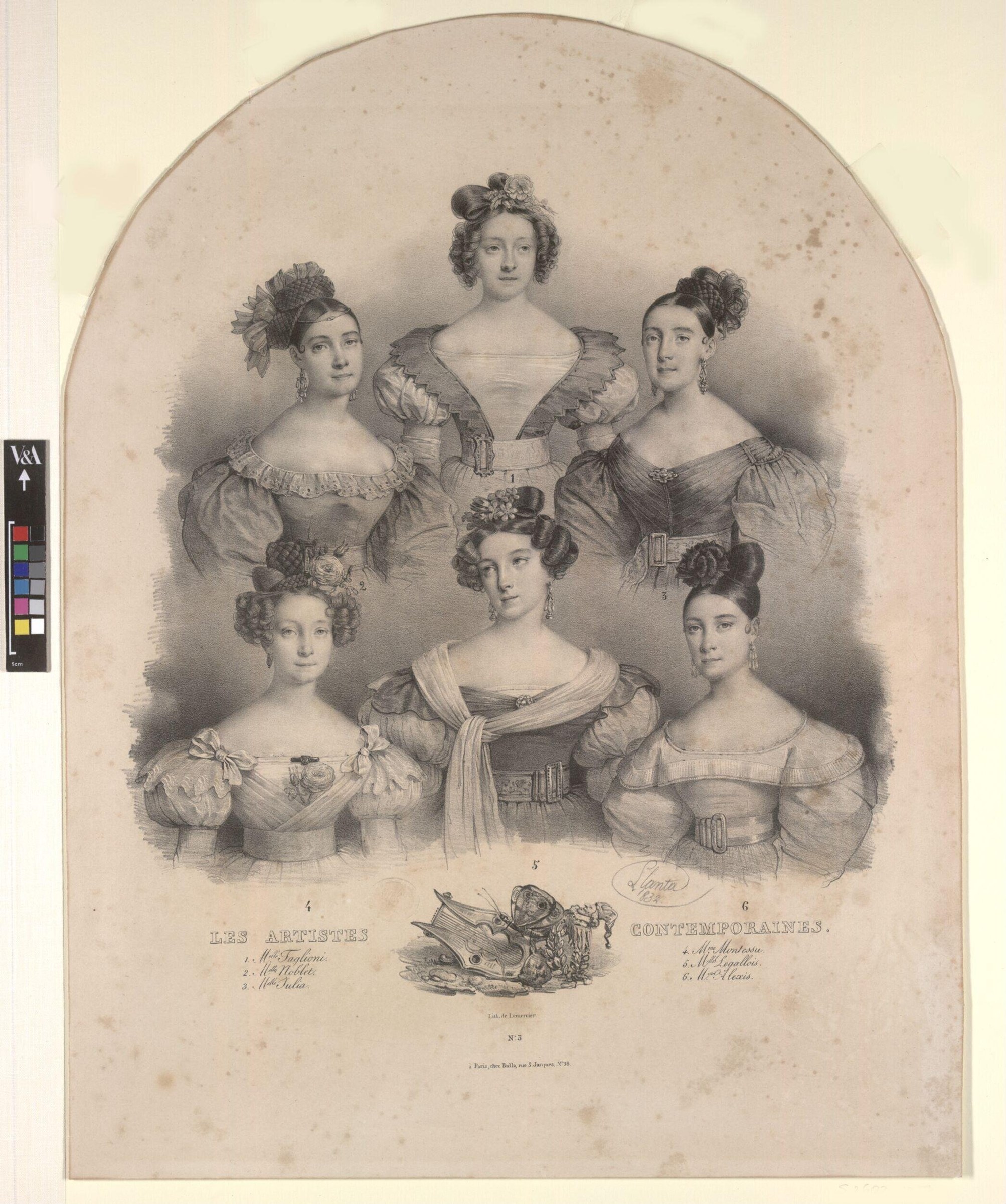
Les Artistes Contemporaines
Llanta
- Collection:
- Source:
- Victoria and Albert Museum
- Rights:
- Rights vary by item — check the source record before reusing this image. Source record ↗
- Recorded as:
- V&A — check rights per item
The work is valuable to historians of fashion, beauty standards, and female public visibility in the 1830s, and may be relevant to studies of particular performers if the six women can be identified. For dance history, it matters primarily as evidence of how women performers were marketed and consumed as images in print culture, rather than as documentation of actual dance practice or movement.
What you are looking at
Six young women are arranged in a formal portrait composition against a neutral background. Three stand in the rear, arranged in a shallow arc, while three sit in the foreground. All are dressed in fashionable 1830s day wear: off-shoulder gowns with puffed sleeves, tight corseted waists, and full skirts. Each woman wears her hair styled up with ringlets and ornamental combs or feathers. Their expressions are composed and dignified, gazes directed outward or into middle distance. The arrangement is symmetrical and hierarchical rather than narrative—this is a group portrait of contemporary notable women, not a scene of action. A small emblematic vignette appears at the base, suggesting this is a printed work meant for display and circulation.
The dancing
The women are posed statically in a formal, presentational arrangement typical of group portraiture. Their bodies are upright and still, with arms positioned naturally at their sides or in lap. There is no bodily interaction between the figures, no partnering, no apparent movement or dance hold. The composition emphasizes social standing and individual presentation rather than physicality or ensemble movement.
The dance depicted
This work does not depict dance or dancers in action. It is a formal group portrait of contemporary women—likely performers, artists, or public figures—rendered in the dignified portrait tradition. The title *Les Artistes Contemporaines* ('The Contemporary Artists') indicates these are women of public note, but nothing in their static, formally posed bodies, their salon dress, or the framing suggests they are being shown dancing or in a dance-related context.
How it was made
This is a hand-colored or tinted engraving or lithograph, evidenced by the fine linear work in the facial features and drapery, the tonal modeling achieved through parallel lines and stippling, and the sepia or grayish tone overall. The technique allowed for multiple impressions and circulation among a middle-class print-buying public. The careful attention to costume detail and the refined execution suggest this was a commercial print of some pretension, likely French.
About this work
This is a formal group portrait of six contemporary women, presented as notable figures worthy of public attention and display. Rendered as a hand-colored engraving in the 1830s, it documents fashion, feminine beauty standards, and social status of its moment. While the sitters may have been dancers, performers, or artists—and the print may have been commissioned to capitalize on public interest in such women—the work itself presents them in a static, non-narrative portrait mode rather than depicting them in performance or dance.
How to look at it
Look at the faces and the dress rather than the bodies. The artist's skill lies in differentiation of the women's features and their costume details—the weave of fabrics, the fall of lace, the ornament in the hair. The formal arrangement emphasizes symmetry and hierarchy. Notice that despite being titled 'Contemporary Artists,' there is nothing in the image that codes them as performers or dancers: they are presented as gentlewomen of fashion and note, not as women of the stage in action or character.
The artist
The artist is credited as 'Llanta' in the catalogue record. Little can be established from the image itself about the artist's identity or practice beyond what the engraving demonstrates: competence in the portrait tradition and familiarity with fashionable dress of the period. The name may be a signature or variant spelling; further research would be required to situate this artist within early 19th-century French print production.
The period
The 1830s saw the rise of mass-produced colored engravings and lithographs as a medium for portrait and fashion imagery. The Romantic era had elevated female performers—particularly dancers in the emerging Romantic ballet—to iconic status, and prints celebrating their beauty and accomplishments found a ready market among middle-class collectors. This work is contemporary with the rise of Romantic ballet in France, a period of intense public fascination with the dancer as a figure of ethereal beauty and social aspiration. However, this particular print presents its subjects in the register of salon portraiture rather than theatrical spectacle.
Where it lives
The work is held in the V&A collection as a print. The inscription at base reads 'Les Artistes Contemporaines' and carries a number (appears to be '5' or similar), suggesting this is one plate in a numbered series. Such series were typical of commercial fashion and celebrity portraiture of the period.
Questions about this work
Were these women actually dancers?
The title 'Contemporary Artists' suggests they held some public profile, and they may have been performers, but the print itself gives no visual evidence of this. A portrait in salon dress is not a documentation of a person's profession. Additional research on the individual women named in the inscription would be necessary to establish their actual roles.
Why is this work in a collection about dance?
It likely entered the collection because it was made during the Romantic ballet era and its subjects may have been associated with theater or performance. However, the work itself is a portrait, not a depiction of dance. It is valuable as context for understanding how female performers were imaged and marketed in the 1830s, rather than as evidence of dance practice or movement.
Can you identify the six women?
The names appear in small text at the base of the print, but this transcription is difficult from the image quality provided. Identification would require reading the caption carefully or consulting the original print or catalogue records of the V&A.
More dance artwork





