49 works in this view — arrow keys or swipe to move between them.
Dance in Art
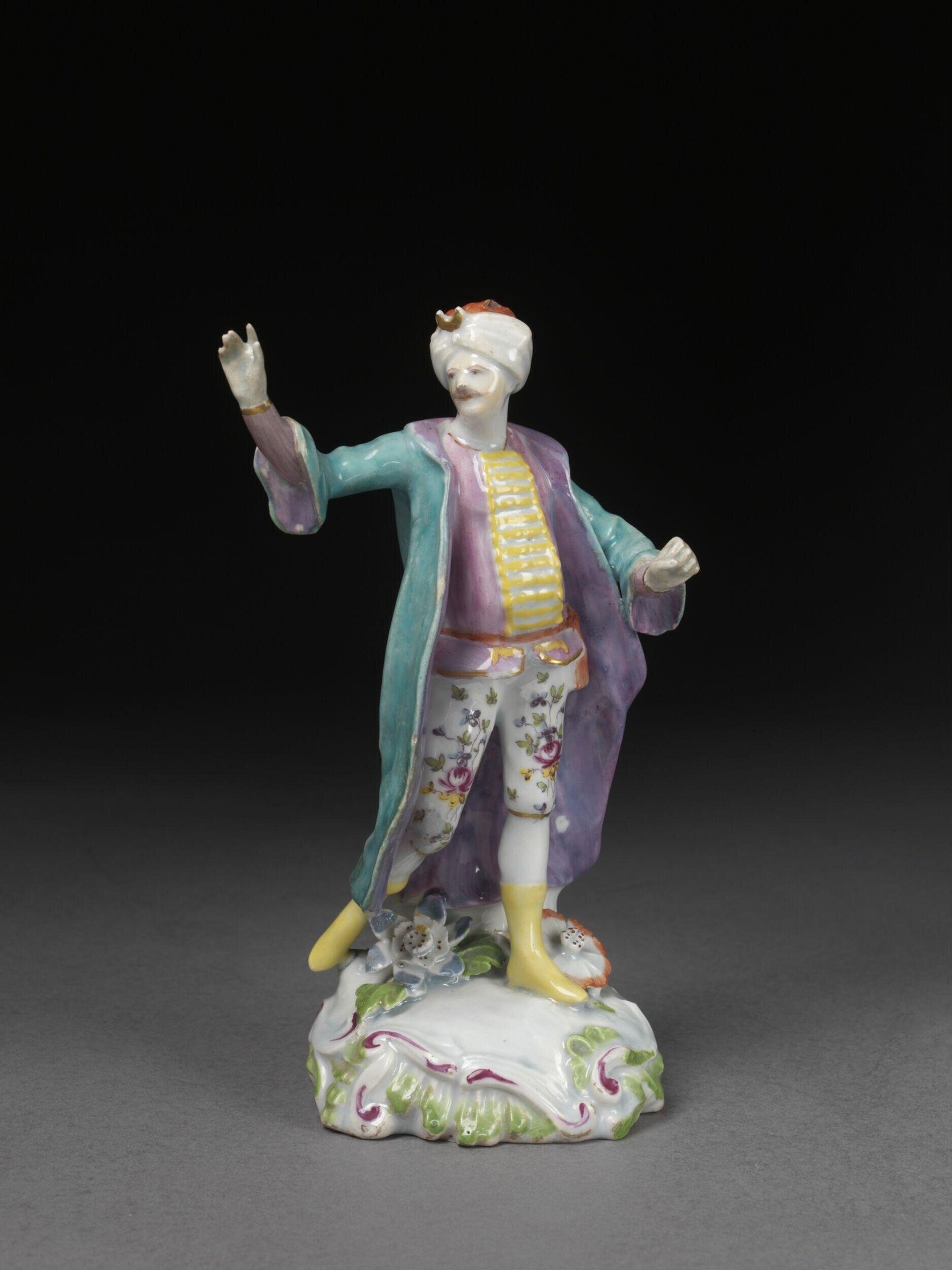
Male Turkish dancer
Derby Porcelain factory
- Collection:
- Figure
- Source:
- Victoria and Albert Museum
- Rights:
- Rights vary by item — check the source record before reusing this image. Source record ↗
- Recorded as:
- V&A — check rights per item
This figure is evidence of how dance and performer imagery entered the decorative arts market and domestic interiors of 18th-century England. It shows that 'Turkish' or Oriental performance held enough appeal to wealthy collectors to warrant factory production, and it reveals the visual vocabulary—costume, gesture, pose—through which Europeans understood and represented performers from outside their own tradition. For dance historians, it documents a moment of cross-cultural representation in material form.
What you are looking at
A porcelain figure of a man in Turkish costume stands on a rococo base decorated with green and purple scrollwork and small flowering plants. He wears a white turban with an orange-brown fold at the crown, and his body is dressed in a coordinated ensemble of teal-green and purple: a long purple coat lined in teal drapes from his shoulders, under which a yellow waistcoat with purple patterning is visible. Fitted white stockings and yellow shoes complete the outfit. The figure's right arm is raised to roughly shoulder height with the hand extended in an open gesture; his left arm hangs at his side with the palm open. His face is rendered with alert, focused features. The pose suggests a moment of animated gesture or address rather than active locomotion—he appears to be gesturing or speaking rather than stepping through a dance phrase. The figure is isolated against a dark background, lit from the front, which emphasizes the brightness and detail of the costume.
The dancing
A single male figure stands in a frontal pose with weight evenly distributed. The raised right arm is extended at roughly 90 degrees with an open hand, while the left arm remains at the side with palm open—a configuration suggesting address, welcome, or emphatic gesture rather than the held frame of a partnered dance. The body is upright and composed; there is no twist, counter-tension, or weight shift visible. The stance and gesture align more with courtly presentation or theatrical declamation than with the dynamic momentum or hold structure characteristic of social dance.
The dance depicted
The figure depicts a Turkish dancer or performer from the perspective of 18th-century European taste, when Ottoman dress and manner were fashionable subjects in porcelain and decorative arts. The pose and costume suggest theatrical or courtly entertainment rather than folk or vernacular dance. The raised-arm gesture and frontal stance are consistent with Turkish and Middle Eastern performance conventions, but the static, balanced posture does not clearly convey specific regional dance vocabulary. The work documents European fascination with 'Turkishness'—a stylized, orientalized aesthetic—rather than ethnographic accuracy. No identifiable elements of technique, footwork, or regional dance tradition are visible.
How it was made
This is a hand-painted porcelain figure, likely from the Derby Porcelain factory's mid-18th-century production. The medium allowed for fine surface modeling, delicate hand-painted costume detail (visible in the turban fold, waistcoat patterning, and base flora), and bright enamel glazes. The porcelain support permitted the unsupported raised arm—an advantage over marble or soft stone. The technique and materials indicate manufacture for the English luxury market; porcelain figures of this type were display objects for collectors and represented a significant investment, circulating among affluent households rather than as theatrical or dance documentation.
About this work
This is a porcelain figure of a Turkish-costumed male performer made by the Derby factory around 1755. It represents a moment of 18th-century European taste for Turkish and Oriental themes in decorative arts—a fashion that extended to porcelain figures, garden architecture, and costume balls. The figure is rendered in fine detail with bright enamel colors and is mounted on a rococo base typical of mid-century English luxury production.
Within dance history, the object documents a visual curiosity—how European artists rendered non-European performance through the filter of available costume knowledge and decorative convention. The figure does not exhibit the formal structure of ballet, social ballroom dance, or any identifiable vernacular tradition. Instead, it captures the period's appetite for exotic visual spectacle as domestic ornament. The raised arm and open gesture may reference Turkish performance traditions, but the porcelain medium and rococo setting place the work firmly in the English drawing room, not the Ottoman court or stage.
How to look at it
Attend to the raised arm and open-handed gesture: this is the artist's chosen moment, and it conveys address or emphatic address rather than the weight-shift and traveling momentum of a dance phrase. Notice how the pose is frontal and self-contained—there is no interaction with another figure, no sense of locomotion or ground-covering. The bright costume detail (the turban fold, the patterned waistcoat, the color blocking) is what draws the eye; the pose itself is secondary to the spectacle of dress. This is a portrait of a costumed performer at rest or in an attitude of presentation, not a study of dance movement.
The artist
The Derby Porcelain factory (established 1756, though this figure is dated 1755, suggesting possible manufacture elsewhere or a production overlap) was among England's leading producers of refined porcelain figures in the mid-to-late 18th century. The factory specialized in hand-painted figures in contemporary dress and allegorical costume, competing with Continental makers. The Turkish or Ottoman-costumed figure was a popular type among English porcelain makers of the period, reflecting broader European taste. Specific attribution to a modeler or painter is not available from the record.
The period
In the 1750s, 'Turkishness' and Oriental themes were fashionable across European arts and design. This taste was partly fed by travel narratives, diplomatic contact with Ottoman representatives, and theatrical productions featuring exotic settings and costumes. Porcelain factories competed to produce figures in contemporary and fantastic dress—shepherdesses, harlequins, oriental merchants and dancers—for elite domestic display. Ballet at court was undergoing formalization (the five positions were codified), but entertainment and spectacle still drew heavily on commedia dell'arte, pantomime, and exotic-costume performances. Turkish costume, in particular, was both visually striking and culturally coded as 'foreign' and therefore suitable for ornamental curiosity.
Where it lives
The figure is held in the VA (Victoria and Albert Museum, London) collections and is catalogued as a porcelain figure from the Derby Porcelain factory, dated 1755. It is a decorative object manufactured for the luxury domestic market rather than a stage prop or pedagogical aid.
Questions about this work
Is this a ballet figure?
No. The pose, costume, and porcelain medium place it in the tradition of 18th-century decorative porcelain figures rather than ballet documentation. The stance and gesture do not align with formal ballet positions or technique, and there is no indication of partnered dance or pointe work.
What dance tradition does the Turkish costume represent?
The costume reflects 18th-century European interpretations of Ottoman dress rather than any specific documented dance tradition. The figure documents how European decorative-arts makers rendered 'Turkishness' as an exotic visual style for collectors, not how Turkish dancers actually performed.
Why would an English porcelain factory make a Turkish dancer figure?
Turkish and Oriental themes were fashionable luxury goods in mid-18th-century England. Porcelain figures in exotic costume appealed to wealthy collectors as display pieces and were manufactured in quantity by Derby and its competitors. They reflected broader European taste for the exotic without necessarily representing accurate cultural knowledge.
What was the porcelain figure used for?
These were decorative objects for affluent domestic interiors—display pieces for mantels, shelves, or cabinets. They were luxury goods and status markers, not functional objects or stage props.
More dance artwork





