49 works in this view — arrow keys or swipe to move between them.
Dance in Art
A Spanish Dancer
Aubrey Beardsley
- Collection:
- Source:
- Victoria and Albert Museum
- Rights:
- Rights vary by item — check the source record before reusing this image. Source record ↗
- Recorded as:
- V&A — check rights per item
This sheet documents Beardsley's approach to figure work and his engagement with theatrical dance as a subject of formal experiment. For historians of dance imagery, it shows how a major graphic artist of the 1890s visualised dance not through narrative or action but through silhouette and decorative line—a mode that influenced poster design and theatrical illustration for decades.
What you are looking at
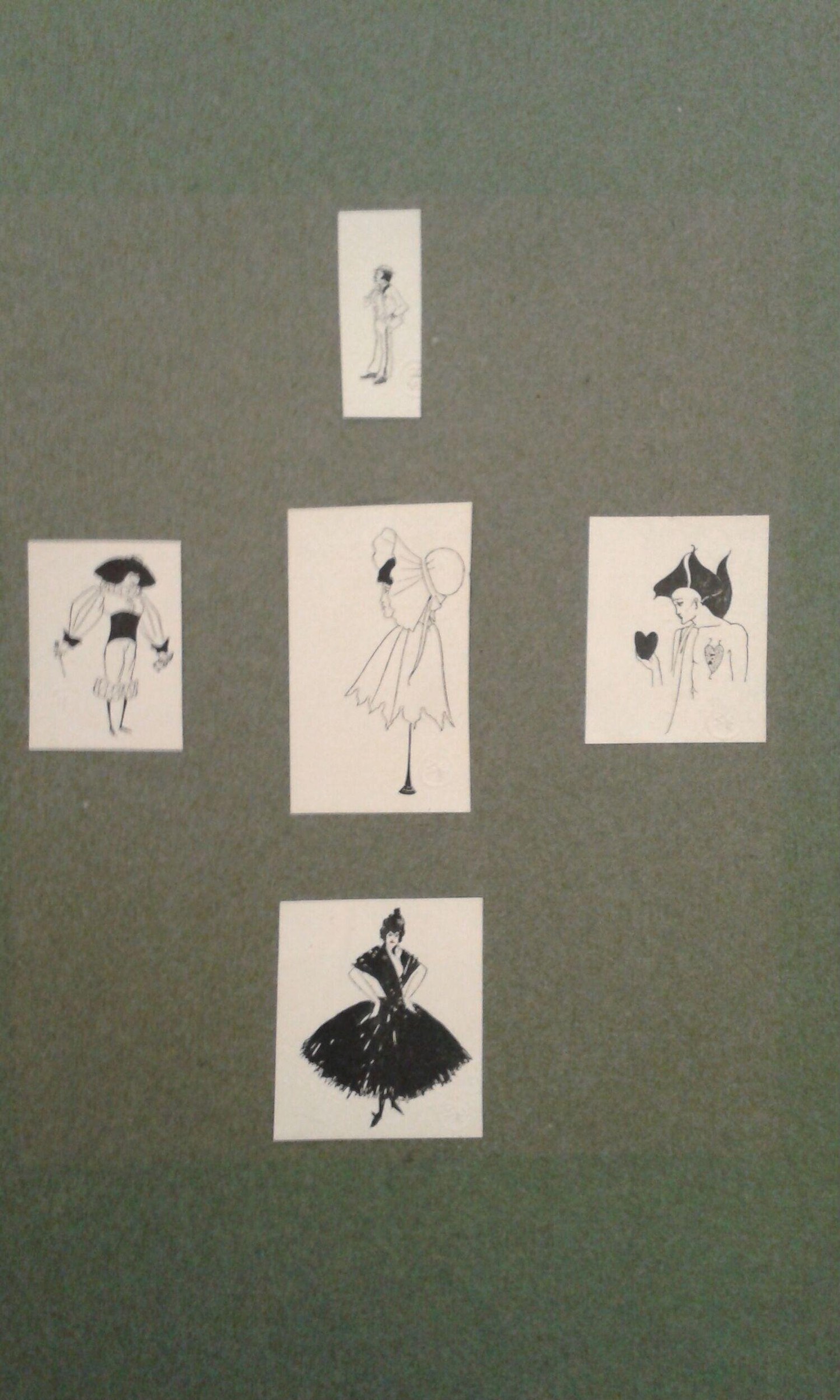
Five ink sketches arranged in a cross pattern on grey-green paper, each a figure study rendered in Beardsley's characteristic linear style. At top, a single standing figure in profile, minimal and elongated. The horizontal row shows three figures: left, a compact figure with exaggerated silhouette and dark hair detail; centre, a profile head study with elaborate headdress and long neck; right, a figure with sharp angular features and distinctive pointed headdress. At bottom, a full-length figure in a dramatic black skirt—the only heavily inked drawing—shown from a three-quarter view with hands planted on hips, the skirt's volume suggested by bold black strokes that dominate the composition. The drawings progress from spare outline to saturated black, as though studying the same subject through increasing intensity.
The dancing
The figures are uniformly attenuated and posed frontally or in profile, the bodies defined by silhouette and sparse internal line rather than modelling. The bottom figure—the most developed—stands with feet apart and torso twisted slightly, arms akimbo, the weight seemingly dropped into the hips. The head studies show elongated necks and stylised facial planes. No two figures occupy the same pose; the composition reads as variations or developmental stages rather than a single narrative moment.
The dance depicted
The catalogue title *A Spanish Dancer* suggests these are studies toward a single dancer, but the sketches show no recognisable Spanish dance posture or costume detail. The elaborate headdresses, the gestural confidence, the silhouette of the fully inked figure—full skirt, narrow bodice, planted stance—are consistent with late 19th-century stage costume and the theatrical dance idiom of the era, but nothing here declares Spain specifically. The title may reflect how the work was catalogued rather than what Beardsley intended; without inscription or context, the dance identity cannot be confirmed from the image alone.
How it was made
These are ink line drawings on paper, almost certainly pen and ink with selective wash or solid black infill. The variation in finish—from spare outline to saturated black—is deliberate, showing Beardsley's exploration of tonal range across a single sheet. This working method was typical of his design practice: multiple studies gathered on one sheet for a patron or publisher to select from, or as development stages toward a finished design. The technique allowed rapid iteration and bold graphic effect without the labour of separate sheets.
About this work
This is a sheet of working studies in the decorative graphic style of Aubrey Beardsley, likely created for theatrical or print use. The five figures, progressing from outline to fully rendered silhouette, are presented as compositional variations on a single dancer. The title assigns them to Spanish dance, but the image shows only the formal conventions of late 19th-century stage costume and theatricalised feminine posture. What we see is Beardsley's method: the study of a silhouette through repetition and increasing tonal control, treating the dancer's body as a shape to be mastered and perfected rather than as a vessel for actual movement.
How to look at it
Notice how the bottom figure, the only one fully rendered in black, dominates the sheet through weight rather than size. Follow the progression from top to bottom: as the figure solidifies, it also becomes more theatrical and monumental. The geometric precision of the poses—feet planted, arms angled, neck stretched—tells you this is the drawing of a pose, not a moment of movement. Compare the spare-lined studies above with the saturated black below: Beardsley is testing how much visual information he can strip away before the figure loses its identity.
The artist
Aubrey Beardsley (1872–1898) was an English illustrator and graphic designer whose bold linear style and high-contrast black-and-white compositions defined the aesthetic of the 1890s Arts and Crafts movement. He worked rapidly and prolifically, producing designs for theatrical productions, books, and periodicals including *The Yellow Book*. His figures are characteristically elongated and stylised, the line economical and the silhouette paramount. Dance and theatre were recurring subjects in his work, often treated as occasions for formal experiment rather than literal representation.
The period
The 1890s saw a surge of interest in Spanish dance in European theatrical and artistic circles, partly through the success of dancers like La Bella Otero and the rise of theatrical exoticism. Simultaneously, the Art Nouveau and Arts and Crafts movements prised graphic design away from realism toward stylisation, silhouette, and decorative flatness. Beardsley worked at the intersection: his dancers are products of this stylised aesthetic, not naturalistic studies. The theatre of the era was a laboratory for experimental costume and movement, and illustrators like Beardsley documented and shaped that visual culture.
Where it lives
The work is listed in the collection as a print, held at the V&A (Victoria and Albert Museum), London. The catalogue record provides minimal detail; the image shows original paper, suggesting this may be the working drawing itself rather than a print, though it may be mounted or photographed for archival purposes.
Questions about this work
Is this a finished work or a study sheet?
It is almost certainly a working sheet—multiple studies on one support, a common format in Beardsley's practice. Whether intended for publication as-is or as reference for a finished design is unclear from the image, but the progression of treatment and the range of poses suggest exploratory intent.
Why is only the bottom figure fully inked?
The increasing saturation across the sheet likely reflects Beardsley's working method: developing the pose and silhouette through outline, then selecting the most successful version for full rendering. It may also show the sheet as it stood at a given moment, with work still in progress.
How do we know this depicts a Spanish dancer?
We don't, from the image alone. The title is from the catalogue record. The costume and pose are consistent with late 19th-century stage dance generally, but nothing in the drawing identifies Spanish dance specifically. The title may reflect how the work was labelled when catalogued rather than an inscription by Beardsley.
What is Beardsley's connection to dance?
Beardsley illustrated theatrical productions and designed for the stage. Dance and dancers appear throughout his work as subjects for formal and decorative experiment. He was fascinated by silhouette, line, and the body as a graphic shape, and the stage provided both subject matter and commercial opportunity.
More dance artwork





