49 works in this view — arrow keys or swipe to move between them.
Dance in Art
Jewish Dancer
Ricketts, Charles
- Collection:
- Theatre design
- Source:
- Victoria and Albert Museum
- Rights:
- Rights vary by item — check the source record before reusing this image. Source record ↗
- Recorded as:
- V&A — check rights per item
This work documents early 20th-century theatre's engagement with Jewish culture and dance at a moment when such representation was politically fraught and aesthetically ambitious. For dance historians, it offers precise evidence of how Edwardian designers understood and staged non-ballroom dance vocabularies, and what movements and costumes they selected as most characteristic or expressive. The study method itself—careful anatomical notation in service of theatrical vision—reveals the labour behind representation.
What you are looking at
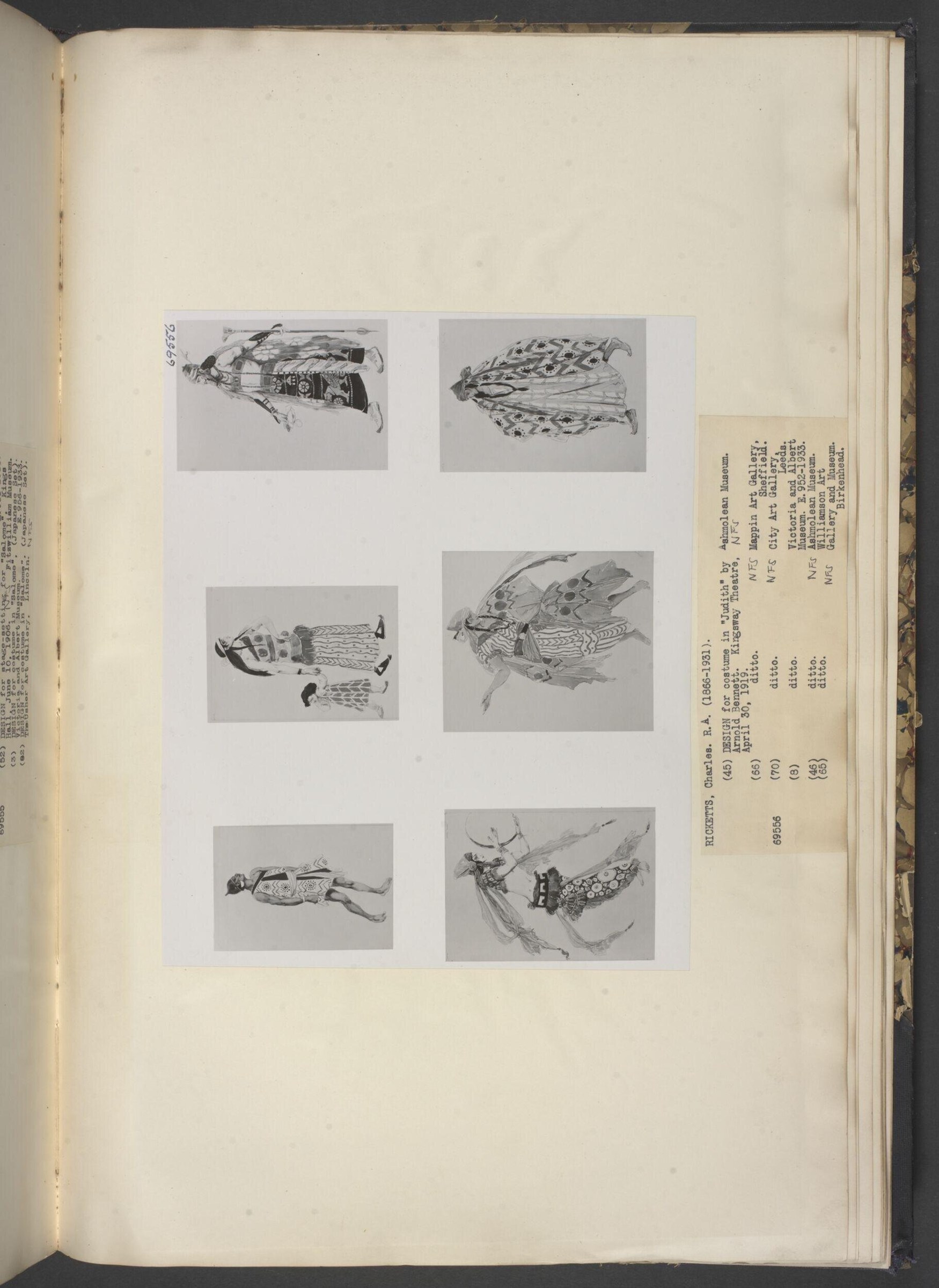
Six figure studies arranged in three rows show dancers in various poses and costumes, rendered in ink or pencil with careful attention to musculature and drapery. The upper left figure wears a patterned garment with geometric designs and is captured mid-leap or jump, torso twisted, limbs extended asymmetrically. The upper right dancer stands in profile in a long decorated dress with intricate patterning, weight settled, arms composed at the sides. The middle left figure wears a sleeveless tunic and is shown in a lunging or striding pose with one leg extended forward and arms raised to frame the body. The middle right shows two figures in close proximity, both elaborately dressed in patterned garments with ornamental details, their bodies angled toward one another. The lower left presents a reclining or resting figure in profile, the body relaxed and elongated along the ground. The lower right depicts a dynamic figure in a decorated dress, one leg raised high, the body in a sharp twist or turn, the pose suggesting rapid movement. The line work is precise and economical throughout, with hatching used to suggest form and shadow rather than full modeling.
The dancing
All six figures are singletons or small groups rather than partnered couples in formal hold. The weight shifts are significant and varied: jumps with suspension, extended lunges with front leg bearing weight, high leg raises in turns, and moments of stillness or repose. Arms frame the body or extend away from it; there is no ballroom frame or closed position evident. The musculature is carefully observed, particularly in the legs and torso, and the artist demonstrates understanding of how the body shifts and stretches during movement rather than settling into a static pose.
The dance depicted
The title identifies this as a Jewish Dancer, and the costuming—patterned garments with geometric and ornamental designs, long skirts, decorative details—is consistent with Eastern European Jewish folk dress of the late 19th or early 20th century. The poses suggest folk or character dance rather than ballroom or classical ballet: high leg extensions, lunging steps, twisted torsos, and dynamic weight shifts are typical of regional folk vocabularies. Without more specific identifying markers (such as particular footwork, hand positions, or dance-partner configurations), the exact dance form cannot be named, but the study captures expressive, energetic movement outside the classical ballet vocabulary.
How it was made
The work is executed in ink or pencil on paper, likely a page from a sketchbook or study album. The line work is controlled and deliberately economical—the artist uses hatching and cross-hatching to suggest musculature, fabric weight, and shadow rather than filling forms solidly. This technique allowed for rapid study and notation, suggesting these are either preparatory studies for a larger theatrical work (set design, costume, or narrative painting) or finished studies in their own right intended for circulation among designers or choreographers. The precision of the anatomical observation and the deliberate arrangement of six studies on a single sheet implies a sustained engagement with the subject—possibly for a theatrical production.
About this work
This is a page of costume and movement studies, likely by Charles Ricketts for a theatrical project involving Jewish dance. Ricketts was a prominent designer working in early 20th-century British theatre, known for meticulous historical and ethnic research in costume and set design. The sheet captures a moment of intensive study: the artist observing or notating how a Jewish dancer moved, how the traditional costume draped and shifted with the body, and which poses and moments of the dance were most visually striking or narratively significant. It sits at the intersection of theatre design, ethnographic interest, and dance documentation—a record of how a modernist designer approached the representation of living tradition.
How to look at it
Attend to the variety of weight shifts and the economy of the artist's line. Notice how the pose changes from figure to figure—how the artist has selected moments of suspension, extension, twist, and repose to demonstrate the full vocabulary of the dance. The hatching is not random; it follows the direction of musculature and the drape of fabric, building form through accumulated marks rather than outline. Look at the costume details: the geometric patterning, the length and weight of the skirts, the placement of ornament. These are not generalized 'folk' costumes but observed details that anchor the work to a specific tradition.
The artist
Charles Ricketts (1866–1931) was a British theatre and graphic designer, painter, and collector known for scholarly historicism and visual precision. He designed sets and costumes for the Ballets Russes and other avant-garde companies, and was influential in establishing a new standard of design research and authenticity in early 20th-century theatre. His work combined aesthetic innovation with meticulous study of historical dress, ornament, and movement. He was also a significant collector of Japanese prints and Renaissance art, which informed his design vocabulary.
The period
In the early 1920s, European modernist theatre was intensely interested in ethnic and folk dance traditions, partly as a reaction against 19th-century ballroom aesthetic and partly as a result of new anthropological interest in non-Western cultures. The Ballets Russes (founded 1909) had made primitivism and exoticism central to avant-garde choreography; Jewish folk culture, while geographically close and historically embedded in European cities, was being 'discovered' by designers and composers as a legitimate source of theatrical material. At the same time, Jewish identity and culture were becoming increasingly politicized in Europe. Ricketts' interest in Jewish dance sits within this broader modernist enthusiasm for authenticity and ethnic particularity, though the specific context of this commission or project is not clear from the image alone.
Where it lives
The work is held in the Theatre design collection at the Victoria & Albert Museum (source: VA). The archival number visible in the upper left (5175) is a V&A accession or catalogue mark. This identifies it as part of the museum's systematic collection of theatrical design and ephemera, a body of material assembled to document stage practice and visual culture in the performing arts.
Dance in this work
Questions about this work
Was this for an actual production?
The work is catalogued as theatre design, which suggests it was made in connection with a staged work rather than as an independent study. However, the specific production is not identified in the available record. It may have been a design proposal, preparatory studies for costumes or choreography, or documentation of a performance that Ricketts attended or consulted.
What dance is depicted?
The title identifies it as Jewish dance, and the costume and poses are consistent with Eastern European Jewish folk traditions. The specific named form—whether this is Yiddish theatre dance, wedding dance, or another variant—cannot be determined from the image alone. The poses suggest expressive, energetic movement outside ballroom vocabulary.
Is this a finished artwork or a sketch?
It appears to be a finished study: the line work is controlled, the arrangement is deliberate, and the anatomical and costume detail is thorough. However, it is presented as a page of studies rather than a single composition, suggesting it was part of a working process or a portfolio of studies meant for consultation or circulation.
More dance artwork





