49 works in this view — arrow keys or swipe to move between them.
Dance in Art
The Truth about the Russian Dancers
Hana Studios - Ltd
- Collection:
- Photograph
- Source:
- Victoria and Albert Museum
- Rights:
- Rights vary by item — check the source record before reusing this image. Source record ↗
- Recorded as:
- V&A — check rights per item
The work offers rare evidence of how Russian dance was staged, framed, and satirized in early 1920s European studio culture. Its ironic title and carefully composed inauthenticity reveal anxiety around the Ballets Russes' exoticism and the gap between marketed image and actual practice—a documentary problem that photography was uniquely positioned to articulate.
What you are looking at
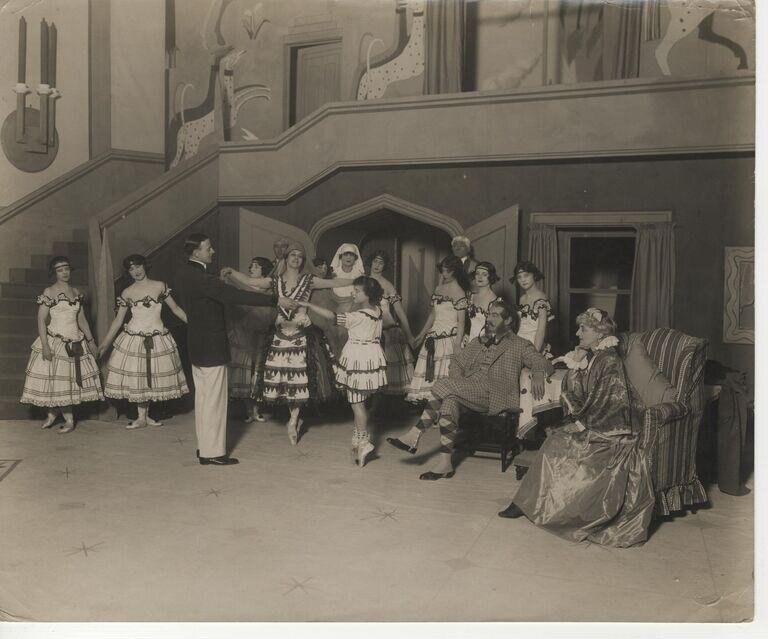
A staged interior painted in muted grays and creams, with stylized Art Deco wall panels and decorative urns, presents a theatrical tableau of roughly a dozen figures. At center, a woman in an ornate costume with a tall headdress and layered skirt stands elevated or posed distinctly from the others, suggesting a featured role. Around her, other performers in various dress—some in pleated skirts with dark stockings, others in patterned fabrics—stand, gesture, and appear to move in loose formation. A man in dark formal wear interacts with the central figure. On the right, a seated woman in rich brocade observes the scene. The composition is static and posed rather than capturing fluid motion; the figures are arranged as if frozen mid-scene, with theatrical lighting creating soft shadows against the stylized interior. The overall effect is of a dress rehearsal or a documentary photograph of a stage production.
The dancing
The bodies are upright and largely frontal or in three-quarter view, without the tight holds or aligned frames of ballroom dancing. Arm positions vary—some figures gesture expressively, others hang at the sides. The central woman's posture is rigid and frontal, emphasizing display over movement. No dancer shows the weight transfer, inclination, or dynamic tension of trained partnered dance; instead, the group reads as actors or performers consciously aware of the camera. The skirts of several dancers are full and relatively still, suggesting posed rather than turning movement.
The dance depicted
The title *The Truth about the Russian Dancers* suggests this is documentary or satirical commentary on Russian ballet performers or a specific Russian dance company. The elaborate costume of the central figure—with its tall headdress and ornamental layering—alludes to Russian imperial or Ballets Russes aesthetics popular in the 1920s. However, the posed, static arrangement and the theatrical interior setting suggest this may be a staged parody, behind-the-scenes photograph, or critique of Russian dance rather than a depiction of actual performance. The lack of dynamic movement or recognizable ballet technique in any figure makes identification as theatrical-ballet difficult; this appears to be a photograph *about* dance rather than *of* dance in execution.
How it was made
This is a photograph, likely a black-and-white print or gelatin silver print from the 1920s. The soft focus and even tonal rendering typical of Hana Studios' work allowed for atmospheric, theatrical imagery suited to publicity and critical commentary. The medium's documentary authority—its claim to capture truth or reality—pairs ironically with the title's promise to reveal the "truth" about Russian dancers; the photograph is in fact a constructed, posed scene. Photography's ability to arrest motion and present a tableau as evidence makes it a powerful tool for satire or critique.
About this work
This 1920 photograph by Hana Studios stages a theatrical interior with a group of performers in costume, centered on an ornately dressed woman in an elevated pose. The title promises revelation—*The Truth about the Russian Dancers*—but the composed, static arrangement suggests irony or skepticism. The work sits at the intersection of dance documentation, theatrical publicity, and visual satire, capturing a moment when the Ballets Russes and Russian dance were culturally dominant in Europe, but also objects of critique, parody, and commercial spectacle. The photograph documents a constructed scene rather than an unmediated dance performance, raising questions about authenticity, performance, and the nature of the "truth" about art.
How to look at it
Attend to the frozen, posed quality of every figure: no one is mid-movement, no weight is transferred, no momentum is visible. Notice the central woman's rigid frontality and the scattered arrangement of others around her—theatrical blocking rather than dance formation. The ornate costume and headdress are the image's richest detail, a site of visual spectacle. The title's irony becomes visible in the contrast between the claim to show "truth" and the photograph's obvious staging, artifice, and theatrical self-consciousness. This is a work asking you to question what a photograph claims to reveal.
The artist
Hana Studios Ltd. was an early 20th-century photographic studio, likely based in London or continental Europe. The studio's practice combined theatrical and society portraiture with documentary and publicity work. The soft-focus, carefully lit style evident here was characteristic of high-end studio practice of the period, in which artistic control over lighting, composition, and print quality allowed photographers to create atmospheric, staged imagery. The studio's engagement with dance and theater reflects the era's culture of theatrical celebrity and the use of photography for both promotion and critique.
The period
The early 1920s saw the zenith of the Ballets Russes under Sergei Diaghilev, which had introduced Russian Imperial ballet, modernist choreography, and avant-garde design to Western Europe since 1909. Russian dance was simultaneously celebrated as artistically revolutionary and viewed with suspicion as foreign, exotic, or financially exploitative. The postwar period brought renewed satire and skepticism toward prewar artistic movements. Simultaneously, photography was establishing itself as a medium for both documentary realism and artistic commentary; the staged photograph—neither pure document nor painting—became a tool for interrogating truth and representation.
Where it lives
The work is held in the collection of the Victoria and Albert Museum (indicated by source code 'va' in the record). It is a photograph, likely a studio print or publication print from the 1920s. Its context within the V&A's collection—which focuses on design, theater, and the decorative arts—suggests it was acquired as a document of theatrical practice and design rather than as fine art photography.
Questions about this work
Is this a real dance performance or a staged photograph?
This is a staged, posed photograph—a constructed scene rather than a documentation of live performance. Every figure is static and aware of the camera; no movement is occurring. The photograph is theatrical in the sense that it stages a scene, but it does not capture dance in execution. The title's irony—promising to reveal the "truth"—may be exactly the point: the photograph critiques the gap between the spectacle of Russian dance and whatever "truth" might lie behind it.
What is the ornate costume the central woman is wearing?
The tall headdress, layered skirt, and ornamental decoration suggest imperial Russian or Ballets Russes aesthetics—the visual language associated with Diaghilev's company and its staging of Russian fairy tales, orientalism, and imperial fantasy. Whether this is a genuine historical costume or a studio invention is unclear, but its visual authority and prominence in the composition mark it as a site of spectacle and, potentially, satire.
Why would this photograph be titled 'The Truth about the Russian Dancers'?
The title likely contains irony. Russian dance in the 1920s was commercially dominant and exotically marketed in the West; the Ballets Russes was celebrated but also criticized as spectacle or artifice. Titling a patently artificial, studio-constructed scene as an unveiling of "truth" may be a comment on the impossibility of transparency in theatrical promotion, or a critique of how Russian dance was packaged and sold to Western audiences. The photograph's construction ironizes its own claim to truth.
Who danced at Hana Studios?
Hana Studios was a photographic studio, not a dance venue. This photograph represents a staged scene created for the camera, likely as publicity material, artistic commentary, or a satirical print. The performers posed for this image may have been dancers, actors, or studio assistants; without further documentation, their identities and backgrounds are unknown.
More dance artwork





