49 works in this view — arrow keys or swipe to move between them.
Dance in Art
Concerto for Dancers
Stone, Alix
- Collection:
- Set design
- Source:
- Victoria and Albert Museum
- Rights:
- Rights vary by item — check the source record before reusing this image. Source record ↗
- Recorded as:
- V&A — check rights per item
This drawing is evidence of how choreographic works were realized as total theatrical experiences, not merely movement. The design suggests a specific historical and geographical context—likely colonial or postcolonial—that shaped the work's narrative or symbolic content, and shows how mid-century modernist designers used simplified, symbolic environments to support dance rather than to compete with it.
What you are looking at
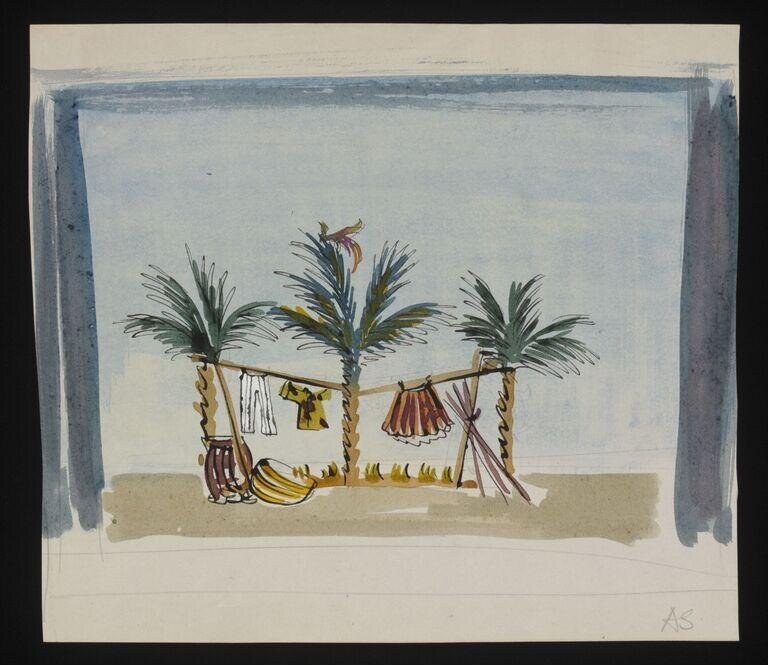
A tropical stage set depicts three palm trees arranged in a shallow interior space, their fronds rendered in dark green with careful botanical detail. Between and around the palms hang garments in muted earth tones—striped skirts or wraps in rust and cream, draped fabric lengths suggesting clothing or drying laundry. Below are clustered bunches of yellow bananas. The setting is spare and schematic, framed by a simple rectangular border in blue-grey wash that suggests a proscenium or set design drawing. The light is even and cool, typical of design rendering. The image reads as a preliminary design sketch or study: precise enough to communicate the visual idea to a production team, but economical in detail and execution.
The dancing
No human figures are present in this image. The composition is entirely architectural and still-life: an arrangement of botanical forms (palms), fabric elements (garments, wraps), and produce (bananas) that together suggest a scene or environment rather than a choreographic moment.
The dance depicted
This is set design rather than a depiction of dance itself. The work is titled *Concerto for Dancers*, which indicates it was created for a theatrical dance production, but the image shows only the stage environment intended to support that performance. The arrangement suggests a tropical or colonial setting—the palms, draped textiles, and bananas evoke a plantation or colonial-era domestic space. Without costume details, performer bodies, or movement frozen in the image, we cannot identify a specific dance form from this drawing alone. The visual suggests a mid-20th-century theatrical context where modernist designers created simplified, symbolic sets for narrative or abstract dance works.
How it was made
This appears to be a watercolor or gouache design on paper, executed with controlled washes of blue-grey, green, rust, cream, and yellow ochre. The technique is economical: broad, flat washes define the spatial frame and ground; finer brushwork renders botanical and textile detail; colored pencil or pen outline clarifies the proscenium and key forms. This is design drawing as a functional document—meant to communicate the designer's vision to the production team and to be legible at a glance. The restraint and clarity of the medium reflect early-to-mid 20th-century modernist stage design practice, when simplified, symbolic sets replaced elaborate realistic scenery.
About this work
This is a stage design drawing by Alix Stone for *Concerto for Dancers*, a theatrical work dated 1958. The drawing depicts a tropical interior set dominated by three stylized palm trees, draped textiles, and bunches of bananas, rendered in restrained watercolor with an architect's clarity. It belongs to the history of modernist dance design in the mid-20th century, when choreographers and visual artists collaborated to create theatrical environments that were both economical and evocative. The work is a document of production practice: a preliminary design that communicates costume, color, proportion, and spatial mood to a production team. As set design, it offers insight into how dance works were framed visually, what stories or atmospheres the designer aimed to establish, and the aesthetic values of theatrical dance practice at the moment of composition.
How to look at it
Read this image as a functional document rather than a finished artwork. Notice how the designer has used three visual elements—botanical form (palms), textile (draped cloth), and domestic commodity (bananas)—to establish a coherent environment and mood with minimal means. The restrained color palette (greens, earth tones, pale sky) creates atmosphere without theatricality. Observe how the simple rectangular frame suggests the proscenium arch and the scale and proportions dancers would occupy in relation to the set elements. The design is legible from a distance; it tells a designer, costumer, and construction team exactly what to make and roughly what it will look like.
The artist
Alix Stone was a designer working in British theatre in the mid-20th century, with a practice that encompassed set and costume design for dance and dramatic productions. Stone's work exemplifies the modernist turn in theatrical design: rejection of ornamental realism in favor of functional, visually striking environments. Little is widely documented of Stone's broader practice, but this design demonstrates engagement with the collaborative aesthetic that defined progressive British dance theatre of the 1950s.
The period
In 1958, British and European dance theatre was undergoing a significant shift toward modernism. The Royal Ballet was established (1956), and independent choreographers and experimental companies were exploring new vocabularies alongside visual artists and architects. Theatrical design practice had moved decisively away from the heavy, romantic scenery of early 20th-century ballet toward cleaner, more abstract environments that used color, form, and symbolic objects rather than illusionistic detail. This aesthetic aligned with contemporary developments in visual art—abstract painting, constructivism, functionalism in design—and reflected a broader cultural turn toward simplification and clarity in the postwar period.
Where it lives
The work is catalogued as set design held in a collection with Virginia source attribution. It is a working design drawing—a preliminary or study version of a design intended for a 1958 theatrical production of *Concerto for Dancers*.
Questions about this work
Why is there no dance visible in a work titled 'Concerto for Dancers'?
This is stage design rather than a representation of the dance itself. Designers created drawings like this to plan and communicate the visual environment in which choreography would be performed. The drawing was a tool for construction and production planning, not a record of the dancing.
What does the tropical setting suggest about the work?
The palms, draped textiles, and bananas suggest a colonial or postcolonial setting, possibly intended to frame the dance as taking place in or evoking a specific geographical and historical context. This was common in mid-century dance theatre, where design elements carried narrative or thematic weight.
How do I know this is from 1958?
The catalogue record states the date as 1958. The modernist aesthetic of the design—simplified forms, economical color, functional clarity—is consistent with mid-century theatrical design practice.
What is Alix Stone?
Alix Stone was a mid-20th-century theatrical designer. This design is among the few widely accessible examples of their work and shows engagement with modernist principles in stage design for dance.
More dance artwork





