49 works in this view — arrow keys or swipe to move between them.
Dance in Art
Agreement
Dancer, James
- Collection:
- Agreement
- Source:
- Victoria and Albert Museum
- Rights:
- Rights vary by item — check the source record before reusing this image. Source record ↗
- Recorded as:
- V&A — check rights per item
This object matters only if it can be confirmed as a personal or professional document signed by a historically significant dancer or dancing master named James or Vialdin in the Regency period. Without such confirmation, and without any depiction of dance, it belongs in an archive of legal documents rather than a gallery of dance imagery.
What you are looking at
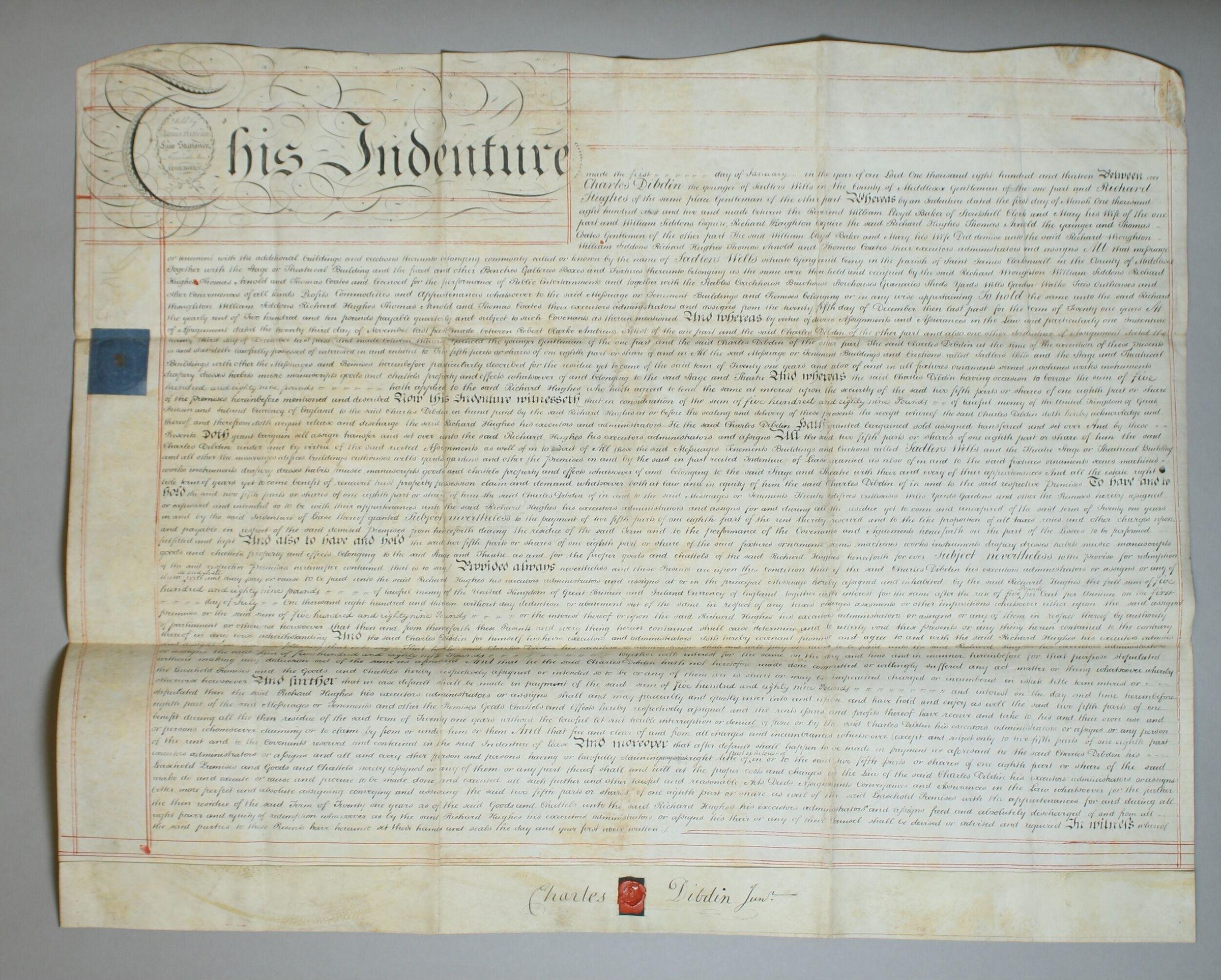
This is an indenture document, a legal agreement written in formal eighteenth-century English script across two facing pages. The left page carries an ornamental header with the words 'his Indenture' in elaborate calligraphic lettering, surrounded by decorative flourishes. The body of the document is densely packed with small, handwritten text in iron gall ink, with several passages underlined or marked for emphasis. At the foot of the right page, beneath the text, are two signatures: 'Charles' and what appears to be 'Vialdin Junr' with what may be a wax seal impression to the left. The paper is aged cream-coloured parchment, creased from folding and showing foxing and discolouration consistent with late Georgian storage and handling. This is not a depiction of dance or dancers, but a legal document—most likely an apprenticeship or service agreement from the early 19th century.
The dancing
No human figures or dancers appear in this image. The document contains only written text and formal script.
The dance depicted
This document does not depict dance. It is a legal indenture. While the catalogue record identifies the artist as 'Dancer, James'—suggesting the signer may have been a dancing master—the document itself records a contractual agreement, not a dance scene or performance.
How it was made
This is a manuscript indenture on parchment, written in iron gall ink by hand in formal eighteenth-century legal script. The document was created as a legal instrument and would have been executed in duplicate (as was standard practice for indentures), with one copy retained by each party. The formal handwriting and ornamental heading indicate a document prepared with care for a transaction of some formality and expense, likely requiring professional scribal work.
About this work
This is a legal indenture document dated 1813, bearing signatures attributed to Charles and a Vialdin (possibly a dance master or student). The document is densely written in formal Georgian legal language and appears to record an apprenticeship or service agreement. It is not a work of art depicting dance, but rather a historical record of a contractual arrangement, possibly between a dancing master and an apprentice or between a dancer and an employer. Its inclusion in a dance art gallery would be unusual and may indicate a cataloguing error or a misunderstanding of the object's nature.
How to look at it
This is not a work to look at in an aesthetic sense. It is a historical document to be read. The ornamental header and formal script indicate the solemnity of the transaction. The presence of two signatures and a seal confirm it as an executed legal agreement. The dense body text would require palaeographic expertise and historical knowledge to parse fully.
The artist
The catalogue lists 'Dancer, James' as artist. This may refer to a dancing master or professional dancer active in the early 19th century, but the document itself is a legal agreement, not an artwork. If James Dancer was indeed a notable figure in Regency-era dance pedagogy or performance, the historical record should be consulted; the indenture would be evidence of his professional activities, not a creation for artistic purposes.
The period
In the Regency period (1811–1820) and early Georgian era, apprenticeship and service indentures were the standard legal instrument for binding a young person to a master craftsman or professional for training. Dancing masters were established professionals who took apprentices and negotiated formal agreements. Such documents are historically valuable for understanding the economics and social structures of dance instruction, but they are not visual or artistic works.
Where it lives
The document is held in a collection identified only as 'Agreement' (source: 'va', possibly Virginia). No accession number, collection history, or institutional context is provided in the catalogue record.
Questions about this work
Is this a work of art?
No. This is a legal document—an indenture or service agreement. It is not a painting, engraving, drawing, or other artistic depiction. It belongs in a historical archive, not a gallery of dance imagery.
What does the document say?
The text is too small and densely written to read clearly in this image. Professional transcription by a palaeographer would be required. The formal structure and signatures indicate it is a binding legal agreement, possibly an apprenticeship indenture.
Who are Charles and Vialdin?
The catalogue record does not identify them beyond the signatures. If 'Dancer, James' refers to James Dancer, one of these signatories may be him; the other may be an apprentice, employer, or witness. Further research would be needed.
Why is this in a dance gallery?
This appears to be a cataloguing error or a misclassification. Unless the document has documented significance to dance history—as the personal agreement of a famous dancer or the first known contract of a notable figure—it should be reclassified as a historical document, not dance imagery.
More dance artwork





