49 works in this view — arrow keys or swipe to move between them.
Dance in Art
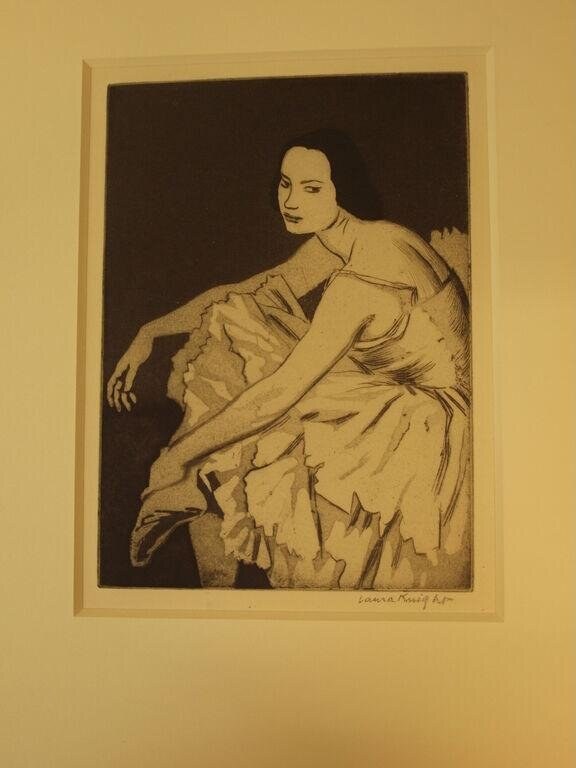
Dancer Resting
Knight, Laura
- Collection:
- Source:
- Victoria and Albert Museum
- Rights:
- Rights vary by item — check the source record before reusing this image. Source record ↗
- Recorded as:
- V&A — check rights per item
Knight was one of the few major visual artists of her generation with sustained, authentic access to the dance world—she lived in theatrical circles and drew dancers repeatedly in study and performance. This work matters because it resists the spectacle of dance and instead offers a portrait of labour, fatigue, and the dancer's interiority. It also documents, through the quality of her line and her formal choices, what early 20th-century artists understood about the aesthetics of the moving body even in stillness.
What you are looking at
A woman reclines in a languid, three-quarter pose against a dark ground, her body folded and angled as though caught mid-rest or in a moment of intimate repose. She wears a pale, loosely draped garment—a slip or chemise—that falls in generous folds around her torso and legs, the fabric rendered in soft sepia tones that catch light along its creases and edges. Her dark hair is sleekly styled, pulled back from her face in a 1920s fashion, and her gaze is directed downward and away, introspective rather than engaging the viewer. The composition emphasizes languor and a kind of theatrical exhaustion: her left arm extends across her body, her right leg drawn up slightly, the whole arrangement suggesting the studied ease of a body between movement and stillness. The tonal range is narrow—sepia-brown throughout—which flattens the image and makes the play of light and shadow on the cloth the primary visual interest. The artist has signed the work in the lower right in a flowing hand.
The dancing
A single female figure, weight distributed unevenly across the composition—one hip anchoring the pose, the other lifted slightly. Her torso twists gently, creating a sinuous S-curve through the body. The arms are soft and unextended, not held in any formal position; there is no turnout, no pulled-up spine, no athletic tension. Instead the body settles into itself, a quality of surrender or ease that reads as the opposite of balletic carriage. The head drops forward with the weight of fatigue or contemplation.
The dance depicted
This is likely a Romantic or early modern dance subject—a dancer captured in repose rather than motion, which became a favoured theme in visual art from the late 19th century onward. The deliberate lack of tension in the body, the soft drapery, and the inward gaze all suggest a moment between performances or a studied state of rest. The work does not document a specific dance form or technique so much as it captures an idea central to early 20th-century artistic interest: the dancer's body as a vehicle for mood and poetry rather than skill. The female soloist at rest was a Romantic and Modernist leitmotif.
How it was made
This is a print—most likely an etching or engraving, given the linear precision of the contours and the tonal control through hatching and fine line work. The sepia tone suggests either a hand-tinted original or printing from a prepared plate in warm ink; the monochromatic palette was typical of art-historical printmaking of the early 20th century. Etching or engraving allowed for wide distribution and placed works of this kind in the hands of dancers, teachers, and collectors rather than only wealthy patrons who could commission paintings. The technique also suited Knight's interests in capturing subtlety of line and fabric fold.
About this work
This is a study of female stillness and interiority by Laura Knight, one of the most celebrated painters of theatrical and dance subjects in early 20th-century Britain. Created in 1923, it captures a moment—perhaps real, perhaps invented—of a dancer at rest between performances or in the quietness of the studio. The work sits at the intersection of Romantic tradition (the dancer as muse, the body as instrument of feeling) and early Modernist interest in the figure as psychological subject rather than narrative vehicle. Knight was fascinated throughout her career by the dancer's life off-stage as well as on, and this print belongs to a body of work exploring the intimate, unglamorous moments that constitute professional dance.
How to look at it
Attend to the quality of line—notice how Knight has used minute shifts in pressure and spacing to suggest the weight of fabric and the softness of flesh without heroicizing either. Look at how the body settles rather than poses: this is not a study in beauty but in actuality, the reality of a body between performances. The composition is also unusual in its refusal of the picturesque: there is no background, no narrative, no supporting detail. Everything is the body and the cloth. That emptiness, and the figure's downward gaze, draws you into a private moment rather than a public performance.
The artist
Laura Knight (1877–1970) was a British painter and printmaker of major stature, celebrated for her vivid, intimate portraits of theatrical and circus life. She had regular access to performers and rehearsal spaces in London's West End and was particularly drawn to dancers and the choreographers of the Ballets Russes era. Her practice moved fluently between oil painting, etching, engraving, and lithography, and she was prolific in all media. Knight was fascinated by the female body in motion and at rest, and she worked with a realist's attention to anatomical truth combined with a colourist's sensibility. She was elected a Royal Academician in 1936, one of the first women to achieve that honour.
The period
By 1923, the figure of the dancer had become central to European avant-garde visual culture. The Ballets Russes, founded in 1909, had transformed choreography into a gallery-worthy spectacle and made dancers into artistic celebrities. Simultaneously, artists across media—visual, literary, photographic—became fascinated by the dancer's body as an expression of modernity, psychology, and the unconscious. In British painting, Knight and her contemporaries brought documentary realism to theatrical subjects at precisely the moment when abstraction and Expressionism were declaring the figure dead. The early 1920s also saw a sophisticated printmaking revival, with etching and engraving returning as serious fine-art media after decades of photographic dominance.
Where it lives
The work is held as a print in an unidentified holding collection (catalogue source: va, likely Victoria and Albert Museum). As a print, it was made for circulation and has likely passed through many hands since its creation, which is one reason specific provenance is often difficult to establish for works of this kind.
Questions about this work
Is this a real dancer, or did Knight invent her?
Knight worked directly from performers and rehearsal observation, but she also composed subjects from memory and imagination. This may be a specific dancer she knew, or a type—the archetypal dancer at rest. The work itself does not tell us. What matters is that Knight understood the dancer's body well enough to render rest convincingly.
Why is the figure not wearing a costume or performing?
This reflects a shift in early 20th-century artistic interests: dancers were no longer only interesting as spectacle, but as working people with interior lives. Knight was among the first major visual artists to document the dancer off-stage, in the unglamorous moments of study and fatigue. This humanized the dancer and asserted that art lay in observation, not in theatrical machinery.
What dance training or background would produce this posture?
The pose itself is not technically demanding and could belong to any performer accustomed to holding her body with basic awareness. The absence of balletic rigidity—the soft arms, the relaxed spine—suggests either a performer trained in a non-classical idiom, or deliberately a moment of release from technical discipline. The ease suggests modern or interpretive dance rather than classical ballet.
More dance artwork





