49 works in this view — arrow keys or swipe to move between them.
Dance in Art
V. Odudua Dancers
Phillips, Tony
- Collection:
- Source:
- Victoria and Albert Museum
- Rights:
- Rights vary by item — check the source record before reusing this image. Source record ↗
- Recorded as:
- V&A — check rights per item
The work is an historical artifact of how African and diasporic dance and performance were represented, often caricatured, in European visual culture. For historians of race, representation, and cultural encounter, it documents both the presence of African diasporic traditions in early modern consciousness and the distorting lens through which they were viewed. The engraving's formal sophistication also raises questions about the relationship between artistic medium, satirical intent, and ethnographic representation.
What you are looking at
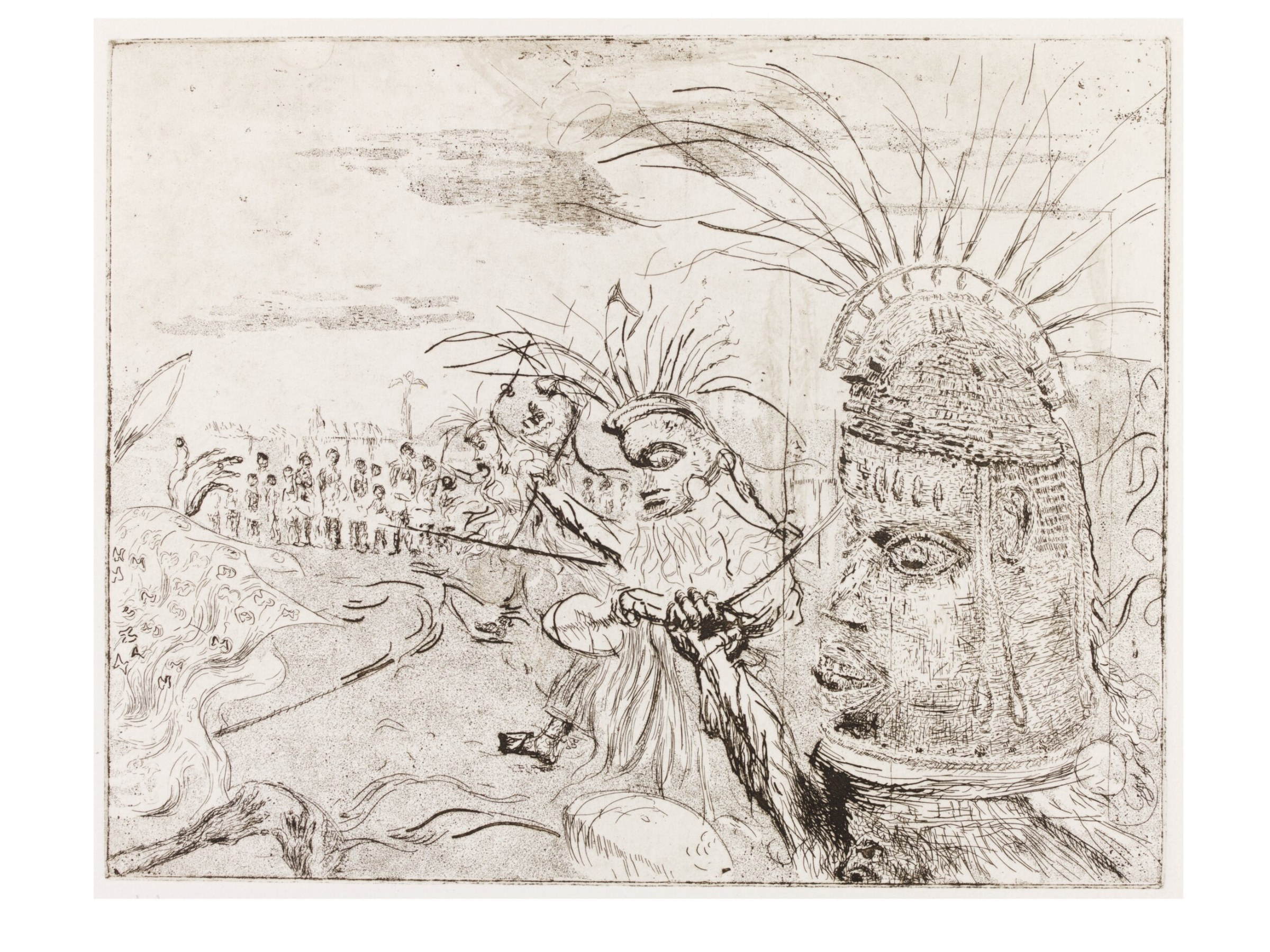
A densely populated satirical engraving depicts a chaotic assembly of grotesque figures in a landscape setting. On the left, a large mass of small human figures crowds together near a body of water with undulating waves. In the center and right, two enormous grotesque heads dominate the composition—their faces are distorted and heavily hatched, with wild hair or vegetation sprouting from their crowns. The figures appear to be in motion or agitation, their poses suggesting frenzied activity. The sky above is lightly rendered with a few clouds. The entire work is executed in fine parallel line work characteristic of engraving, with dense hatching to create volume and shadow in the larger figures. The style suggests Northern European Renaissance or early modern satirical tradition.
The dancing
The two large heads in the foreground display exaggerated facial features rendered through careful cross-hatching; their mouths are open in what may be song, speech, or laughter. The numerous small figures in the background lack clear individual articulation but appear distributed across the landscape in loose groupings rather than organized formation. Their postures suggest spontaneous movement rather than choreographed step-patterns. The composition does not reveal the precise bodily positions, arm holds, or footwork that would allow identification of a specific dance tradition.
The dance depicted
The title references Odudua, a Yoruba deity, and suggests the image may depict or allegorize African or diasporic performance traditions. However, the engraving's style, grotesque character heads, and satirical Northern European convention do not align visually with any identifiable African dance practice. The dense crowd of small figures and their apparent spontaneous motion could suggest communal celebration or ritual gathering, but the image is too abstract and too heavily mediated by European satirical convention to support confident identification of a specific dance form. The work appears to be a European artist's allegorical or fantastical interpretation rather than a direct observation of dance practice.
How it was made
This is an engraving executed on copper or steel plate, identifiable by the fine parallel hatching lines and characteristic linear modeling throughout. The technique allows precise detail in the faces of the large heads while rendering the crowd through gestural marks rather than individual portraiture. Engravings of this type were designed for print circulation—they could be reproduced in multiple impressions and distributed widely, making them vehicles for satirical commentary, religious allegory, or fantastical narrative intended for educated viewers familiar with symbolic and classical references.
About this work
This engraving presents a visually arresting but enigmatic image: two enormous grotesque heads presiding over a crowd of small figures in apparent motion, titled with reference to an Yoruba deity. The work operates in the tradition of Northern European satirical engraving, using exaggeration, crowding, and allegorical scale to create meaning. Whether it depicts, mocks, or fantasizes about African diasporic performance remains unclear from the visual evidence alone. The work sits at the intersection of European printmaking tradition and the complex iconography of colonial-era encounters with African and African-descended cultures.
The image's primary interest lies in its historical documentary value regarding how African and diasporic traditions were imagined and represented in European visual culture—less as an accurate record of dance practice than as a window into European fantasy, satire, or allegorical imagination of difference. The engraving's formal sophistication and circulation as a print made it a significant vehicle for these representations.
How to look at it
Attend first to the scale relationship: the two enormous heads and the tiny, dense crowd create a hierarchical composition that invites allegorical or satirical reading. Look at how the engraver used line—the careful parallel hatching in the faces versus the gestural marks suggesting the crowd's motion. The title promises reference to an African tradition, but the visual language is entirely European: this disjunction between title and image is itself the subject worth examining. Ask whether the work is documenting, satirizing, fantasizing, or critiquing.
The artist
Tony Phillips is a contemporary artist whose practice engages with historical prints, appropriation, and representation. Without access to fuller documentation of this specific work, it is difficult to establish the exact context of this engagement with a historical engraving. The work's date (1984) and medium (print) suggest it may be a re-working, reinterpretation, or critical commentary on an earlier satirical tradition.
The period
The engraving's visual language—grotesque heads, dense crowds, allegorical scale, fine hatching technique—belongs to the Northern European Renaissance and early modern satirical tradition (15th–17th centuries). This was the era when European contact with African peoples intensified and visual culture began to incorporate African and African-descended figures, often filtered through classical allegory and comic distortion. By the 1980s, when Phillips created this work, there was growing critical engagement with colonial representation and archive, suggesting this may be a deliberate reinvocation of an older satirical tradition for contemporary commentary.
Where it lives
The work is held as a print in a collection labeled 'va' in the source record, suggesting a Virginia-based holding. As a work by Tony Phillips dated 1984, it is a modern print—whether an original print, a reproduction of an historical engraving, or a contemporary re-interpretation is not clarified by the record provided.
Questions about this work
What is Odudua and why is the print titled with that name?
Odudua is a foundational deity in Yoruba religion and cosmology, associated with creation, the earth, and fertility. The title suggests the image intends reference to Yoruba or broader African diasporic cultural traditions. However, the image's visual language—Northern European satirical engraving—does not appear to depict Yoruba dance or religious practice directly, raising questions about whether the title is allegorical, ironic, or critically engaged with colonial representation.
Is this engraving from the Renaissance, or is it a modern work?
The visual style—fine hatching, grotesque character heads, allegorical scale—mimics Northern European Renaissance and early modern engraving traditions. However, the work is dated 1984 and attributed to Tony Phillips, a contemporary artist. It may be a modern re-creation, reinterpretation, or critical engagement with historical satirical print traditions, rather than an original historical object.
What dance is depicted in this image?
No specific dance can be confidently identified from the visual evidence. The small, densely-packed figures in apparent motion could suggest communal celebration or ritual gathering, but their poses and arrangements do not correspond to recognizable dance formations or techniques. The image appears to be an allegorical or fantastical composition rather than a documentary representation of dance practice.
More dance artwork





