49 works in this view — arrow keys or swipe to move between them.
Dance in Art
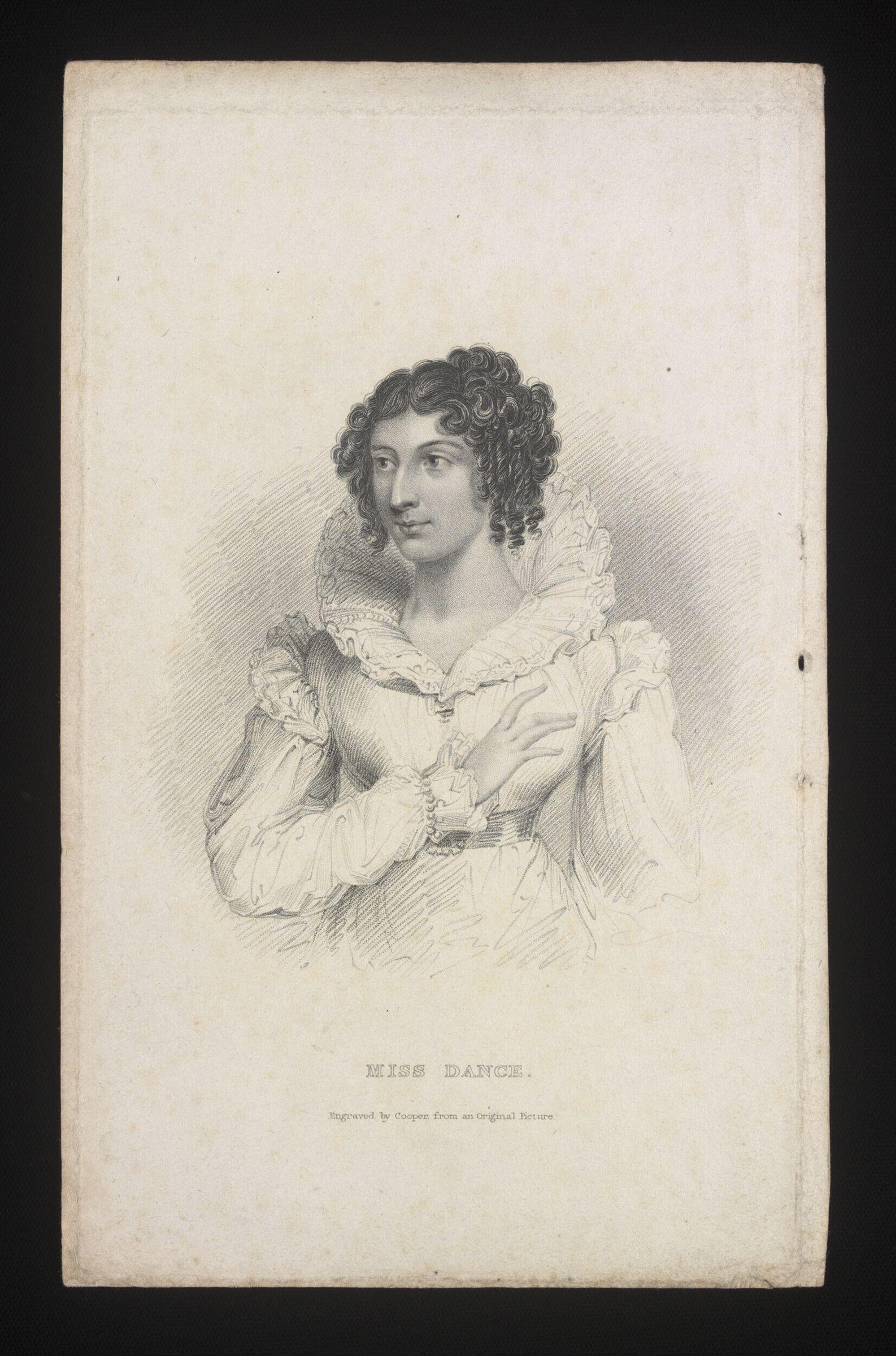
Miss Dance
Cooper
- Collection:
- Source:
- Victoria and Albert Museum
- Rights:
- Rights vary by item — check the source record before reusing this image. Source record ↗
- Recorded as:
- V&A — check rights per item
This engraving is a document of Regency-era dance celebrity: it captures how a performer named Miss Dance was presented to the public, and how the print trade capitalized on theatrical fame. The work demonstrates that by the early 19th century, individual dancers—not just companies or spectacles—could be marketed and circulated as images, a marker of the professionalization and stardom of dance.
What you are looking at
A three-quarter-length portrait of a young woman facing left, her body angled to reveal the full silhouette of an elaborate early 19th-century dress. She wears a high-waisted white muslin or cotton gown with characteristic Regency puffed sleeves that rise sharply at the shoulder and taper at the forearm. The neckline is low and wide, finished with a deep lace or cambric collar that frames the shoulders in the Vandyke style typical of the period. A narrow belt cinches the dress just below the bust. Her dark, curled hair is arranged in ringlets framing the face and piled loosely atop the head in Regency fashion. The background is plain and neutral, rendered with light cross-hatching to suggest volume and space. The figure is posed with grace and slight formality, her hands folded before her, gazing away from the viewer with a composed, refined expression characteristic of Regency portraiture.
The dancing
A single standing figure in a relaxed but dignified pose, weight distributed evenly on both legs in a neutral stance. The arms are held loosely at the sides with hands folded or lightly clasped in front of the body—a posture associated with feminine deportment of the period. The upper body is held upright and open, the shoulders relaxed. This is the stance of a woman being presented or displayed rather than a moment of movement or dance.
The dance depicted
This is not a depiction of dance in motion, but rather a portrait of a dancer presented as a society figure. The title 'Miss Dance' combined with the Regency-era costume suggests this woman was known as a performer or entertainer in the early 19th century. The portrait format—a formal standing pose for public display—suggests she was a professional of sufficient status to be engraved and circulated as a print. Without additional inscription or context, her specific dance specialization cannot be determined from the image alone.
How it was made
This is a steel or copper engraving, identifiable by the fine linear hatching, crisp contour lines, and the print medium visible in the support. The technique allowed for precise rendering of fabric texture and surface detail—the delicate lace collar, the volumetric sleeves, and the fall of the muslin are all suggested through varied line weight and density. The inscription at bottom states the work was 'Engraved by Cooper from an Original Picture,' indicating this is a reproductive print, likely circulated as a separate sheet or collected in a folio. The high finish and careful execution suggest a commercial print made for the theatrical or entertainment market.
About this work
A formal portrait engraving of 'Miss Dance,' a Regency-era performer, presented in the refined style of early 19th-century theatrical prints. The work documents not a moment of performance but the social presentation of a woman known for dancing—shown in street dress or formal wear rather than costume, suggesting her fame was sufficient to justify her portraiture independently of a specific theatrical role. The engraving is both a record of her identity and an artifact of the print culture that promoted performers to a paying public. It belongs in a dance gallery as evidence of the economics and celebrity of Regency theatre and the specific fame that attached to named dancers of the period.
How to look at it
Attend to the dress: the precision of the engraver in rendering the Regency silhouette—the high waist, the puffed sleeves, the delicate neckline finish—tells you this is a work of some commercial care and skill, made to appeal to a fashion-conscious audience. The pose itself is conventional and non-narrative: she is being shown to us, not caught in a moment of dance or performance. This is the language of theatrical celebrity portraiture: the subject is presented for viewing in a formal setting, and her identity as a performer is given by the title and context alone.
The artist
Cooper is identified as the engraver. The catalogue record does not establish whether this is an original engraving by Cooper or a reproduction from a painting or drawing by another artist. The inscription 'Engraved by Cooper from an Original Picture' suggests Cooper was the reproductive engraver, copying a portrait in another medium; the original artist is not named.
The period
In the Regency era (1811–1820) and the decades immediately before and after, the theatre was a major site of entertainment and social spectacle, and individual dancers—especially female performers—were beginning to acquire celebrity status as named individuals. The print trade capitalized on this: engraved portraits of actors and dancers were sold as separate sheets or bound into collections, allowing theatregoers to take home likenesses of their favorite performers. This was a period of transition toward the Romantic ballet and the rise of the ballerina as a central cultural figure. The costume visible here—high-waisted Empire silhouette, refined detail, minimal ornament—places the subject and the work in the Regency or early Georgian era. The formal portrait style reflects the conventions of theatrical portraiture of the period.
Where it lives
A print engraved after an original picture. The source is listed as 'va,' indicating the work is held in a Virginia collection; no accession number or institution is specified in the record.
Questions about this work
Who was Miss Dance?
The historical identity of this performer is not established in the catalogue record. 'Miss Dance' may be a stage name, a sobriquet, or a surname. The engraving is insufficient to identify her without additional research into Regency theatre records and print archives.
Why is she not dancing?
This is a portrait, not a scene from a performance. The convention of theatrical prints in the Regency era was to present the performer in formal dress or street wear as a public figure, rather than in character or mid-movement. The subject's fame as a dancer is established by the title and context, not by depicting her in the act of dancing.
What kind of dancer was she?
The image alone does not specify her dance specialization. The Regency period saw both social dancing (balls, assemblies) and theatrical dancing (pantomime, ballet, popular spectacles). Without inscription or additional documentation, her genre cannot be determined from the engraving.
When was this made?
The catalogue record does not provide a date. The costume, engraving style, and print conventions suggest the early 19th century, likely between 1800 and 1825, but the exact date cannot be established from the image alone.
More dance artwork





