49 works in this view — arrow keys or swipe to move between them.
Dance in Art
Miss Dance
Rose Emma Drummond
- Collection:
- Source:
- Victoria and Albert Museum
- Rights:
- Rights vary by item — check the source record before reusing this image. Source record ↗
- Recorded as:
- V&A — check rights per item
The work matters as evidence of how a person identified with the surname Dancer presented themselves (or was presented) during the Regency era, and as a record of fashionable dress and portraiture practice in 1821. It may have value for genealogical research or for those studying the social status and visibility of people connected to dance in this period, though it offers no evidence of the subject's actual practice, reputation, or involvement in dance.
What you are looking at
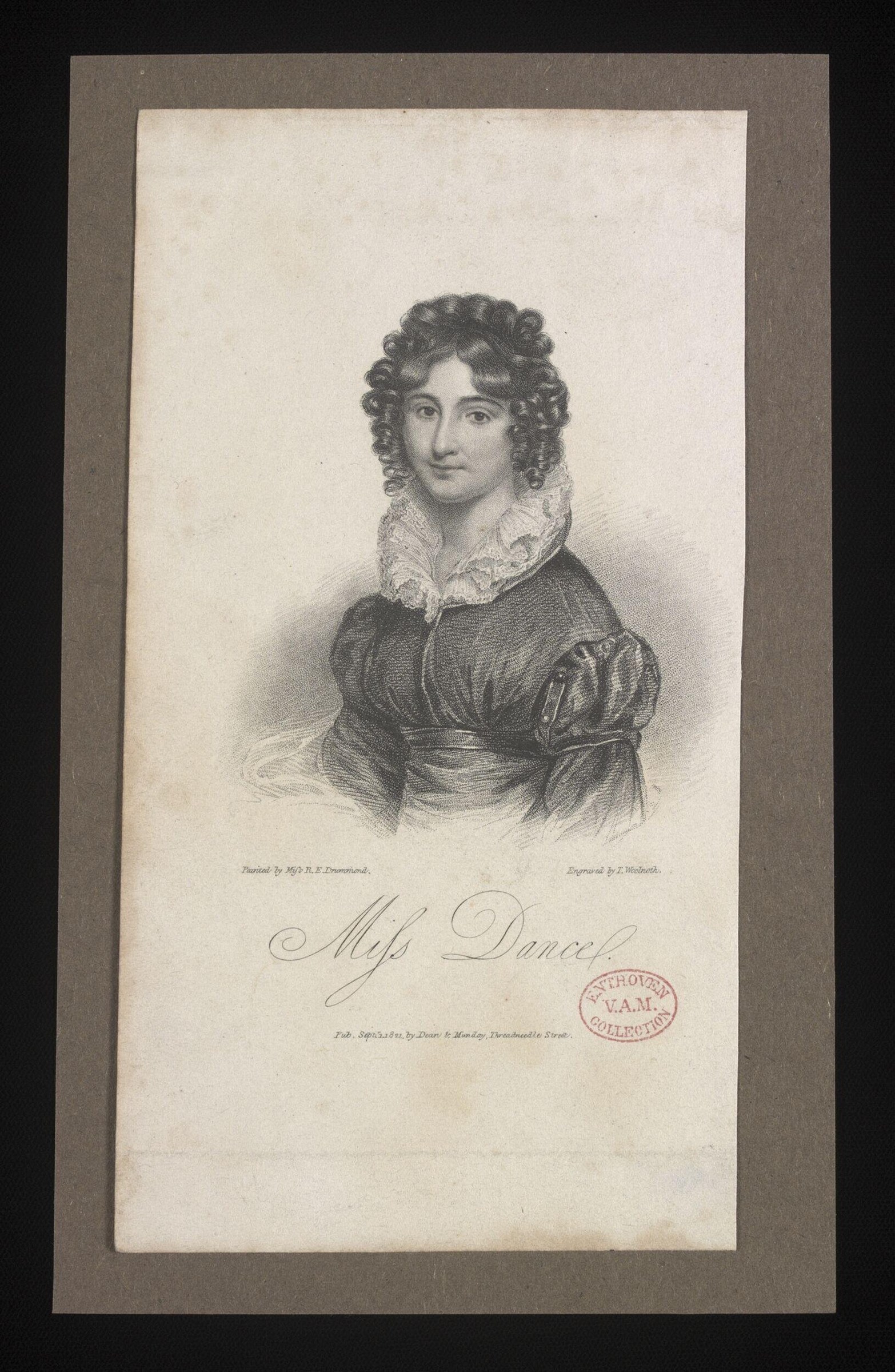
A half-length portrait of a young woman, presented in three-quarter view against a plain background. She is dressed in early 19th-century fashion: a dark dress with a fashionably full puffed sleeve visible on the right side, paired with a prominent white lace collar or fichu that rises high around her neck and shoulders in the characteristic style of the Regency period. Her dark hair is styled in the curled arrangement typical of the 1820s, parted at the center with ringlets framing her face. The engraving has been worked with fine lines to establish volume and shadow, giving her face and the textures of fabric considerable delicacy. The composition is formal and restrained—a commercial portrait print designed for circulation rather than a scene of dance itself.
The dancing
The subject is stationary and posed rather than captured mid-movement. Her shoulders are relaxed and turned slightly; her gaze is directed toward the viewer with an alert but composed expression. No dance hold, frame, or footwork is visible or implied. This is a portrait of a person, not a representation of dancing body or gesture.
The dance depicted
The work is titled *Miss Dancer* and records the appearance of someone identified by that surname. However, the print does not depict dance or dancing. It is a conventional portrait of a woman in fashionable dress, standing still. The title refers to the subject's identity, not to the content of the image. Without additional documentation, it is impossible to know whether the subject was a professional dancer, an amateur, or simply a woman whose surname happened to be Dancer. The image itself contains no evidence of dance practice, training, performance, or any choreographic knowledge.
How it was made
This is a steel engraving, a reproductive print made from a polished steel plate incised with fine lines. The publication line reads "Painted by Mrs. R. E. Drummond. Engraved by J. Bromide." The technique allowed wide distribution of the portrait at modest cost; the formal presentation and commercial printing suggest this was a popular print, possibly published as a sheet for sale or as part of a series of contemporary portraits. The fineness of the line work and the careful modeling of flesh and fabric indicate skilled engraving work of the commercial portrait tradition.
About this work
This is a commercial portrait engraving from 1821 of a woman identified as Miss Dancer. Although the work carries a surname associated with dance, the image itself is a conventional portrait print in the Regency fashion tradition, recording the appearance and dress of a young woman of the period. It is not a representation of dance, dancing, or any choreographic content. The work enters a gallery of dance in art because its subject's identity has a connection to dance history, but the viewer should understand that they are looking at a portrait, not a dance scene. The work is of interest primarily to historians of portraiture, fashion, and engraving technique of the early 19th century, and to those researching the Dancer family or other genealogical connections to named individuals.
How to look at it
Attend to the fashionable detail of the dress and hair, which dates the work precisely to the early 1820s. Notice the quality of the engraving, particularly in the rendering of the lace collar and the subtle modeling of the face. Recognize that this is a commercial print designed for distribution and sale, not a unique artwork or a scene of action. The stillness and formality are the point: the work records a person's appearance at a moment in time, in the manner of a Regency portrait.
The artist
Rose Emma Drummond was a painter active in the early 19th century; she signed the work as the artist of the original painting. Beyond that attribution, little is known of her practice or other works. The engraver, J. Bromide, was responsible for translating her portrait into the commercial print format, a division of labor standard in the period.
The period
The work was made during the Regency era (1811–1820, extended loosely to the 1820s), a period of great fashion in portraiture and social display. The Regency saw a flourishing of commercial portrait engraving, and women of means often commissioned or sat for portraits in fashionable dress as a marker of status and taste. In dance, the early 19th century was the age of Romantic ballet's emergence in France—works like *La Sylphide* (1832) would follow within a decade—but the English ballroom tradition and social dances (cotillion, quadrille, country dances) remained dominant in genteel society. This portrait reflects the material culture and self-presentation of the genteel classes; it does not tell us whether Miss Dancer was a professional performer, a society dancer, or simply a woman whose surname linked her to dance tradition.
Where it lives
The work is held as a print in a collection labeled 'va' in the catalogue record. A red oval stamp visible in the lower right of the print indicates institutional cataloguing or collection ownership, though the institution is not identified in the catalogue data provided.
Questions about this work
Is this a picture of someone dancing?
No. This is a portrait print of a woman in standing pose, dressed in fashionable Regency clothing. She is not dancing or in any dance position. The work is a conventional commercial portrait of the period.
Why is this in a gallery of dance in art if it does not show dance?
The subject's surname is Dancer, which flags a potential connection to dance history. The work is included for researchers interested in the people and social contexts surrounding dance in the early 19th century, though the image itself does not depict dancing or choreographic practice.
Who was Miss Dancer?
The catalogue record identifies her only by surname and first initial or title. No other biographical information is provided. She may have been a professional dancer, a member of a dance family, or simply a woman who commissioned a portrait during the Regency era.
What does the red stamp on the print mean?
The stamp indicates that the work is part of an institutional collection and has been catalogued. The institution itself is not identified in the available record.
More dance artwork





