49 works in this view — arrow keys or swipe to move between them.
Dance in Art
Dancing Doll
Brittain, William James
- Collection:
- Dancing doll
- Source:
- Victoria and Albert Museum
- Rights:
- Rights vary by item — check the source record before reusing this image. Source record ↗
- Recorded as:
- V&A — check rights per item
For a dance historian, this object matters as a record of what dance-adjacent material culture looked like in the 1840s—not the dance itself, but the toys and playthings that channelled children's imaginative engagement with movement and style. The elaborate hairstyle suggests this doll may have been valued for its fashionability rather than its capacity to move, implying that visual display and grooming were as important as action in the period's conception of a doll's appeal.
What you are looking at
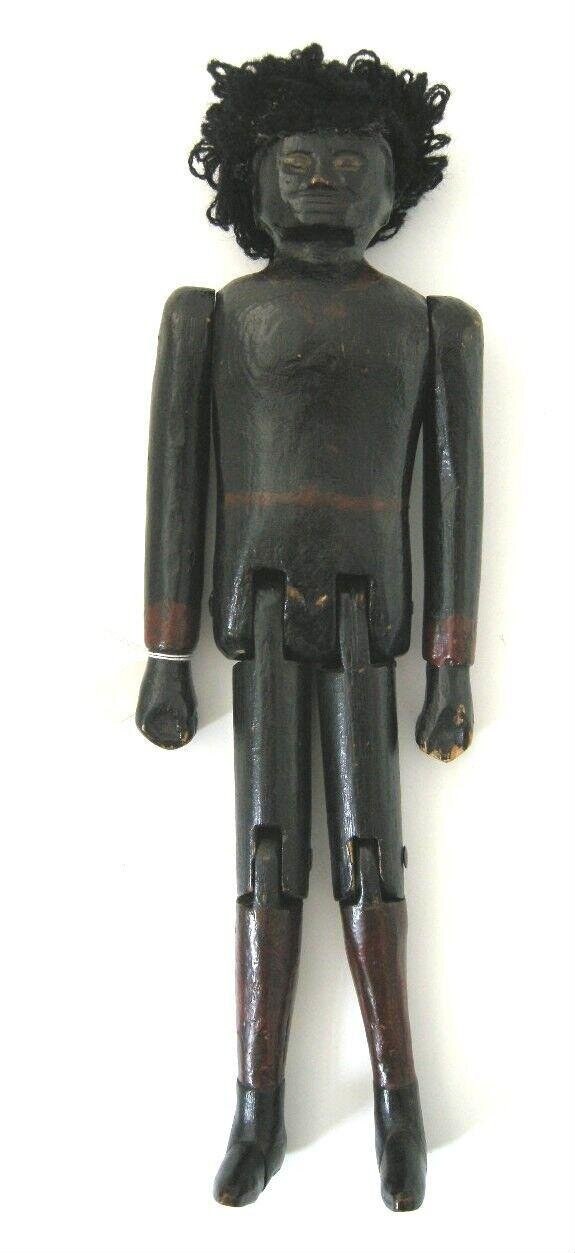
This is a wooden doll carved in the round, standing upright with arms at its sides and legs slightly apart in a neutral pose. The figure is rendered in dark wood, almost black, with visible wear and patina. The most striking feature is its hair: a voluminous crown of tightly coiled ringlets that rises well above the head, suggesting either an elaborate hairstyle or a wig typical of 18th- or early 19th-century fashion. The face is carved with simplified features—a broad nose, prominent mouth, and forward-gazing eyes. The body is essentially featureless except for a carved line marking the torso division. Bands of lighter wood (possibly inlay or paint residue in a reddish-brown tone) circle both wrists and both ankles, suggesting bracelets or binding. The proportions are childlike: the head is large relative to the body, the limbs are short and stocky, and the overall carving is blocky and geometric rather than naturalistic.
The dancing
The doll stands in a completely static, frontal pose with no suggestion of movement or dance posture. Arms hang straight at the sides with no bend at the elbows or flexion in the hands. The legs are set in a narrow stance with no weight shift, turn, or positioning that would indicate even a basic dance step. The figure presents no closed or open hold, no frame, no counterbalance. This is a standing figure at rest, not a figure in motion or in the act of dancing.
The dance depicted
This object does not depict a dance or a dancer in motion. It is a static carved figure, likely a toy or decorative object made in the early 19th century. The title 'Dancing Doll' may refer to a doll designed to be animated by the owner (made to dance by hand), or it may be a retrospective label applied long after manufacture. The rigid pose, lack of articulated joints visible in the carving, and static arm position suggest this was not a mechanical dancing figure either. Without evidence of internal mechanism or a flexible armature, this appears to be a simple wooden doll dressed or styled in the fashion of the period.
How it was made
This is a carved wooden doll, hand-sculpted from a single block or assembled from joined pieces. The carving technique is direct but somewhat crude—the anatomy is simplified and the surface shows tool marks consistent with hand carving rather than turning or lathe work. The dark finish appears to be the natural color of aged wood, though the lighter bands at wrists and ankles may indicate painted inlay or overlaid material. The patina and wear suggest considerable age and use. As an object, this would have circulated as a child's toy or household ornament rather than as fine art, and its survival indicates either sentimental preservation or later collecting of folk or ethnographic material.
About this work
This is a small wooden doll carved in the 1840s and attributed to William James Brittain. The figure is carved from dark wood in a simple, geometric style, with its most distinctive feature being an elaborate crown of coiled ringlets that dominates the composition. The title 'Dancing Doll' is potentially misleading: the figure itself is static and unprepared for movement, suggesting either that it was meant to be animated by hand-play, or that the title reflects a later assumption about its purpose. The object belongs to a tradition of folk and domestic dolls made in the English-speaking world, and it offers evidence of early 19th-century ideas about hair fashion, doll-making, and childhood play.
How to look at it
Attend first to the hair: the carver devoted disproportionate effort to this feature, suggesting it was the doll's primary attraction and marker of fashionability. Notice the simplification of the body—the limbs are barely differentiated, and the face is schematic. The bands at wrist and ankle are puzzling: look closely to determine whether they are painted, inlaid, or carved relief. Finally, consider the stance: the feet are set close together, the arms are at rest, and there is no suggestion of the kind of balance or posture a dancer would require. This is emphatically not a figure frozen in the act of dancing.
The artist
William James Brittain is recorded as the maker, but little is documented about his practice, training, or other works. The attribution suggests he may have been a woodcarver working in a folk or domestic tradition rather than as a fine artist. The simplicity and directness of the carving style, and the survival of the piece in a collection focused on dance or material culture, suggest he may have worked within a local or family tradition of toy and doll-making.
The period
The 1840s saw a flourishing of wooden toys and dolls in Britain and America, driven by growing middle-class disposable income and the sentimentalization of childhood. Dolls of this period often featured elaborate hair—whether real hair, mohair, or carved—reflecting the importance of hairstyle to fashion and social identity. Simultaneously, dance was undergoing significant changes: ballet was moving from the court and professional theater toward the music hall and toward Romantic ballet with its new pointe technique and narrative focus. Domestic dolls like this one occupied a different cultural space from theatrical dance, but they participated in the same broader attention to bodily display, fashion, and the aesthetics of movement.
Where it lives
The doll is held in a collection identified only as 'Dancing doll' with the source listed as 'va', possibly indicating Virginia. Beyond the artist attribution and date, no accession number, purchase history, or institutional provenance is recorded.
Questions about this work
Why is this called a dancing doll if it doesn't look like it's dancing?
The title may have been applied by a later owner or collector who assumed any doll could be made to dance by hand, or it may reflect a tradition of calling toys 'dancing dolls' regardless of their actual pose. The figure itself is rigid and static, with no carved indication of movement.
Is this doll mechanical or articulated?
There is no visible evidence of joints, wheels, springs, or any internal mechanism. The carving is solid and monolithic, suggesting this is a simple toy meant to be held and moved by a child's hands, not a self-animated automaton or wind-up doll.
What is the carving made from?
The material is wood, darkened by age and use. The lighter bands at the wrists and ankles are a different material—possibly paint, inlay, or a lighter wood applied over the dark base.
Who was William James Brittain?
Nothing beyond this attribution is currently known. He may have been a woodcarver working in a folk or domestic tradition, but his training, other works, and career remain undocumented.
More dance artwork





