49 works in this view — arrow keys or swipe to move between them.
Dance in Art
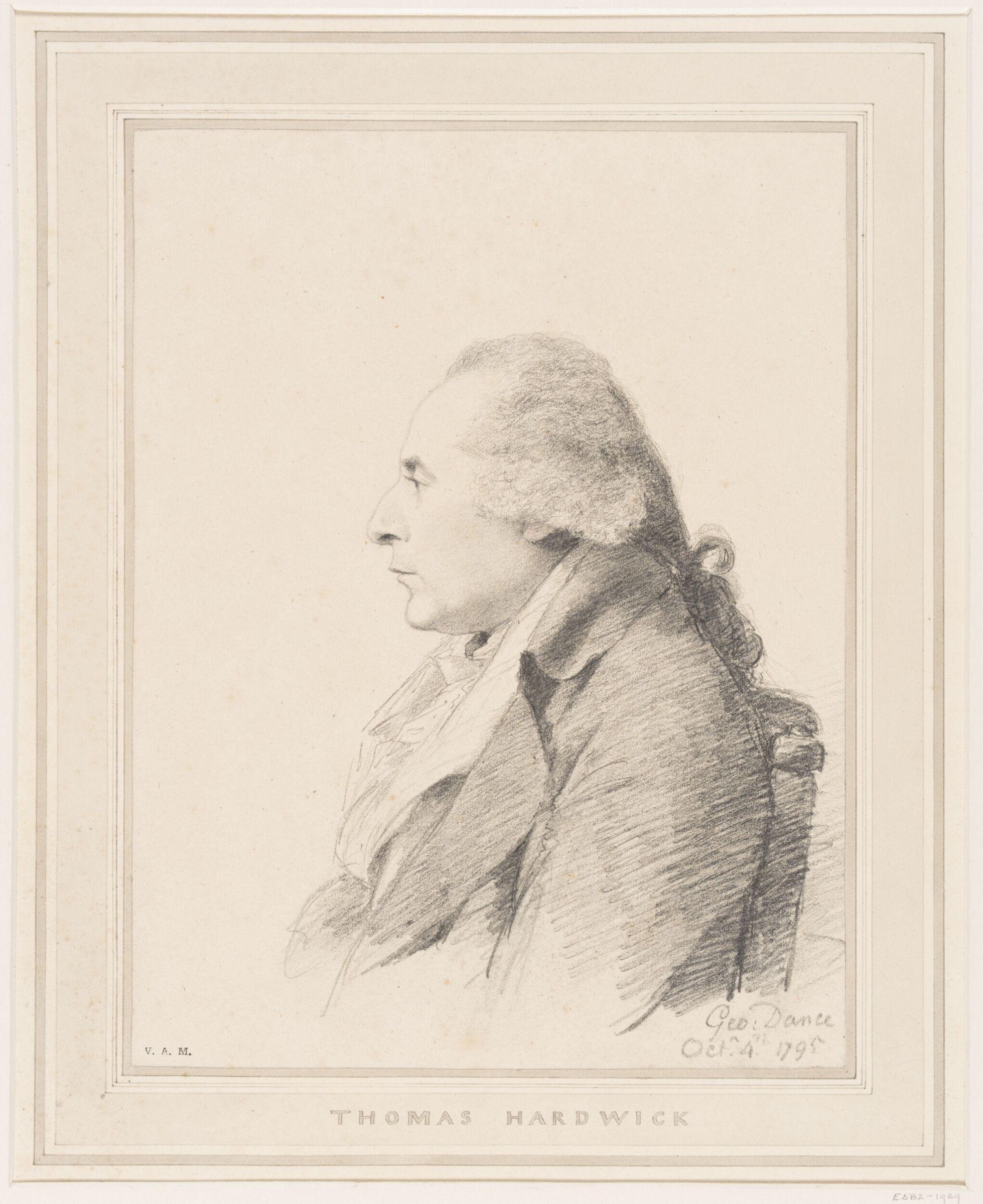
Thomas Hardwick
Dance, George
- Collection:
- Drawing
- Source:
- Victoria and Albert Museum
- Rights:
- Rights vary by item — check the source record before reusing this image. Source record ↗
- Recorded as:
- V&A — check rights per item
This work documents the artistic practice of George Dance, a significant figure in late 18th-century British art and architecture. For a dance history audience, the drawing is valuable primarily as potential evidence of who engaged with dance in London's Regency circles, though the portrait itself contains no choreographic information. The work is also an example of how the graphite portrait drawing became a standard means of recording the appearance of the urban professional class in this period.
What you are looking at
A profile portrait of a man in his middle years, rendered in graphite on cream paper. He is shown from the shoulders up, turned to the right in three-quarter view. His hair is full and somewhat tousled, receding slightly at the temples in the manner typical of the 1790s. He wears a dark coat with a high collar and a white cravat loosely knotted at the neck—the formal dress of a gentleman of the period. The drawing is executed with fine, controlled hatching that creates volume and shadow in the face and clothing, while the background remains blank. The artist has signed the work in the lower right corner and dated it 'Oct 4th 1795'. The inscription 'THOMAS HARDWICK' appears in capitals below the portrait frame.
The dancing
A single figure, shown at rest in profile. The neck is elongated and the jaw pronounced, characteristic of late 18th-century portraiture conventions. The shoulders are squared and relaxed, the posture upright but unselfconscious. There is no gesture, movement, or indication of dance. This is a still portrait of an individual in formal dress, not a representation of bodily action.
The dance depicted
This image does not depict dance. It is a portrait drawing of a man identified as Thomas Hardwick, rendered in 1795. Without additional context about Hardwick's identity or profession, we cannot determine whether he was a dancer, choreographer, teacher, or patron of dance. The portrait itself shows only a seated or standing figure at rest, with no choreographic or performative content.
How it was made
This is a graphite drawing on paper, mounted within a double-ruled rectangular border in the neoclassical style. The technique is precise and economic: the artist has used fine parallel hatching lines to model form, particularly in the hair, face, and coat, while allowing the paper ground to serve as highlight. The signature and date in the lower right indicate this is a finished presentation drawing, not a sketch. Such works were typically circulated among patrons and collectors as portable, prestigious records of appearance and status.
About this work
This is a portrait drawing by George Dance of Thomas Hardwick, dated October 4, 1795. Dance was a celebrated British architect and accomplished portraitist in graphite; his portrait drawings were sought after by London's professional and artistic circles in the late 18th century. The drawing belongs to the tradition of gentleman portraiture—formal, restrained, and executed with professional skill. Hardwick's identity in relation to dance remains unclear from the image alone; he may have been a patron, supporter, or participant in dance culture of the period, but the portrait itself is a record of appearance rather than a representation of dance itself.
How to look at it
Look at the precision of the graphite hatching, particularly in the rendering of the coat fabric and the volume of the hair. Notice the economy of line in the face itself—how much character and individuality Dance achieves with minimal marks. The pose is static and dignified, a convention of portraiture that emphasizes the sitter's social standing rather than action or movement. The date and signature in the lower right are part of the finished composition, asserting the drawing's status as a completed work of art.
The artist
George Dance the Younger (1741–1825) was a London-born architect, surveyor, and accomplished amateur draughtsman. He was the son of George Dance the Elder, also an architect, and worked extensively on public and private commissions in London. Dance was known for his penetrating portrait drawings in graphite and his ability to capture character and likeness with economical means. His drawings were highly valued by his contemporaries and circulated widely in artistic circles. He was a member of the Royal Academy and maintained a successful architectural practice throughout his life.
The period
In the 1790s, graphite portrait drawing had become the fashionable medium for capturing the likenesses of professionals, artists, and patrons in Britain. This practice emerged partly in reaction to the time and expense of painted portraiture, and partly as a conscious revival of Old Master drawing techniques. The decade saw increased interest in dance in London, including the rise of the professional male ballet dancer and growing attendance at theatrical dance performances. Late 18th-century British society was organized around networks of patronage, profession, and artistic circles, and portrait drawings like this one served as tokens of membership and respect within those networks.
Where it lives
The drawing is held in the Victoria and Albert Museum collection in London. It bears the museum's accession mark 'V.A.M.' in the lower left. As a finished graphite portrait drawing from the late 18th century, it represents the type of work that circulated among London's professional classes and was typically preserved by families or by the artists themselves.
Questions about this work
Who was Thomas Hardwick?
The identity of Thomas Hardwick is not established by the portrait itself. He may have been an architect, artist, patron, or professional man of London in the 1790s, but the drawing provides no biographical information beyond his appearance and the date. Further research in the Victoria and Albert Museum's records or in Hardwick family papers would be necessary to establish his profession and role in London society.
Why is this drawing in a dance collection?
The drawing appears in a dance-related collection or database, which suggests that Hardwick may have had some connection to dance—as a dancer, teacher, choreographer, composer, or patron. However, the portrait itself contains no visual evidence of dance involvement. It may have been included based on archival information about the sitter rather than on the content of the image.
What was George Dance's role as a portraitist?
Dance was an accomplished amateur draughtsman whose graphite portrait drawings were highly valued by his professional contemporaries in London. His portraits were not his primary profession—he was primarily an architect—but his drawing skill earned him respect in artistic circles. His works circulated among patrons and colleagues as personal mementos and records of likeness.
More dance artwork





