49 works in this view — arrow keys or swipe to move between them.
Dance in Art
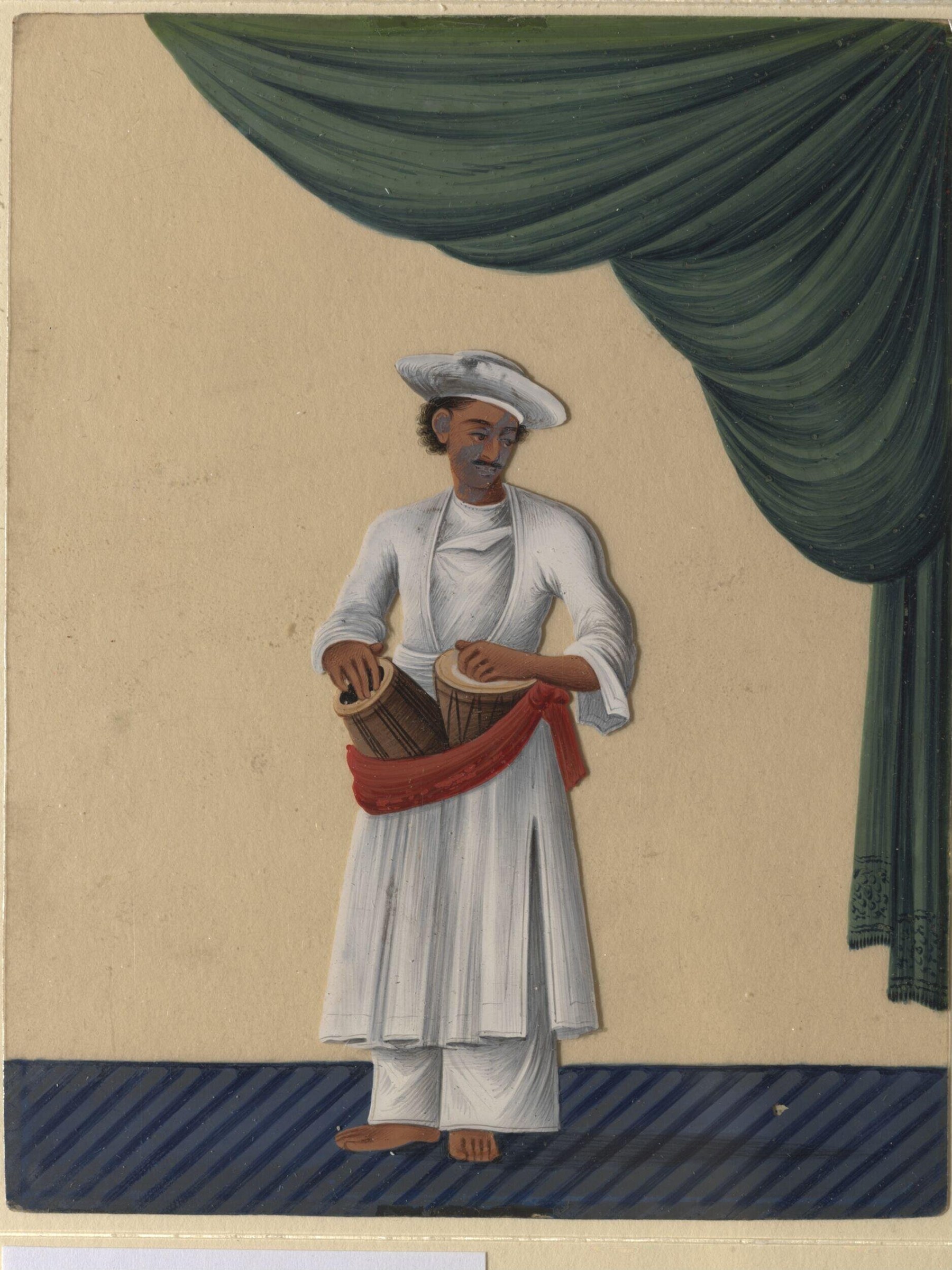
One of twelve drawings of musicians and dancing-girls.
Unknown
- Collection:
- Painting
- Source:
- Victoria and Albert Museum
- Rights:
- Rights vary by item — check the source record before reusing this image. Source record ↗
- Recorded as:
- V&A — check rights per item
For historians of Indian classical dance and music, this image is invaluable evidence of the costume, instruments, and presentation conventions of 19th-century court musicians. For anyone studying colonial-era documentation and the ways that performance traditions were catalogued and commodified for European audiences, this series of twelve figures represents a fascinating hybrid: both a commercial product for collectors and a genuine document of court dress and musicians' roles. The image reveals how integral the drummer was to the performance ecosystem, and how the visual culture of dance involved far more than the dancers themselves.
What you are looking at
A standing figure in South Asian dress occupies the center of the composition against a plain cream wall. He wears a pale gray or white long kurta over white dhoti-like lower garments, with brown feet bare or in simple footwear. A gray flat-topped cap sits on his head. A red cloth is draped loosely around his waist. In his hands he holds a small drum or percussion instrument—likely a mridangam or similar membranophone—which he plays or is about to play. A heavy dark green fabric drape hangs from the upper right, creating a theatrical frame. The floor is marked by diagonal stripes in dark blue. The figure's posture is upright and composed, neither in motion nor in a performance stance, but rather presenting himself as a musician or dancer-musician in a formal, portrait-like arrangement.
The dancing
The single figure stands in a neutral, frontal stance with the weight evenly distributed. His left arm holds the drum at the front of his body; his right arm is positioned near the instrument as if playing or aboutately to play. The shoulders are level and relaxed. The overall frame is vertical and stable rather than dynamic—this is a presentation or preparatory moment rather than an action captured mid-gesture. The posture suggests both readiness and formality, appropriate to a court musician or a performer about to begin.
The dance depicted
This is not a depiction of dance in motion, but of a musician—specifically a drummer—in the tradition of South Asian classical or court performance. The instrument appears to be a hand drum central to both instrumental music and dance accompaniment in Indian classical traditions. While the figure himself is not dancing, he is part of the ecosystem of dance: in classical Indian performances, drummers like this one would accompany dancers, their rhythmic patterns (talas) structuring the movement. The image documents the visual presentation and costume of a court or classical musician rather than the dancers themselves.
How it was made
This is a watercolor or gouache painting on paper, characteristic of the detailed commercial portraiture and occupational studies produced for European collectors in 19th-century India. The technique is precise and finished: each element—the drum, the folds of the dhoti, the texture of the cap, the fall of the drape—is rendered with careful attention to color, shadow, and material specificity. This was likely one of a series (the record notes 'one of twelve drawings of musicians and dancing-girls'), suggesting a systematic documentation of court performers and musicians, possibly compiled for a British patron or collector. The format and approach—isolating individual figures against a plain background, with theatrical props like the draped fabric—reflects the conventions of occupational albums and costume books that were popular in 19th-century India.
About this work
This is a formal portrait of a South Asian court or classical musician, rendered in watercolor as part of a larger series documenting performers. It is not a dance image in the narrow sense—the figure is not dancing—but it is an image central to the history and visual culture of South Asian dance: the drummer, the instrument, and the formal presentation style all place this squarely within the ecosystem of classical Indian performance. The work is a document of how musicians were presented, dressed, and valued in 19th-century court and commercial contexts. It belongs in a dance archive because understanding dance requires understanding the musicians who structured it, and because this image shows how European collectors and Indian court traditions collaborated to document performance traditions in the colonial era.
How to look at it
Notice the formal, almost heraldic presentation: the figure is not caught in action, but rather formally posed, as if for a portrait. The theatrical drape and the neutral background remove him from any specific location and place him instead in a kind of timeless performance space. The drum is shown clearly and prominently—it is as much the subject as the musician. Pay attention to the details of dress: the cap, the drape of the dhoti, the red cloth at the waist, the bare feet. These specific details would have been the evidence by which a 19th-century viewer identified the musician's caste, region, and status. The stillness and frontality of the pose—which might seem unnatural or stagy to a modern viewer—was the convention of occupational and costume portraiture in this period and region.
The artist
Unknown. The work is one of twelve drawings in a series documenting musicians and dancing-girls, likely produced in India in the mid-19th century for a European client or collector. The style and approach—precise watercolor rendering, occupational presentation, lack of attribution—is consistent with the commercial portraiture studios and occupational album industries that flourished in Indian cities like Calcutta, Delhi, and Lucknow during the British period. These albums were often produced by Indian artists for European patrons seeking visual documentation of Indian society, costume, and performance traditions.
The period
In 1860, Indian classical music and dance were undergoing significant transformation. The East India Company and British Raj had begun to reshape court patronage, drawing many traditional musicians away from the courts that had sustained them. At the same time, European interest in documenting 'Indian life' fueled a brisk market for illustrated albums, ethnographic series, and costume studies. These were sold to British collectors, military officers, and administrators. The series to which this work belongs—depicting musicians and dancing-girls in formal, isolated presentations—reflects both the colonial gaze (the systematic cataloguing of 'types') and the survival strategies of Indian artists and performers, who adapted to new forms of patronage. The watercolor technique and the occupational album format were relatively new in Indian art at this date, emerging from the contact between European artistic conventions and Indian artistic traditions.
Where it lives
One of a series of twelve drawings of musicians and dancing-girls in the collection; the source is given as 'va' (likely Victoria & Albert Museum or a similar British institutional collection). The series appears to have been assembled as a commercial occupational album, possibly for sale to a private collector or for institutional documentation during the colonial period. The object's history before entry into the current collection is not recorded.
Questions about this work
Is this a dance image?
Not strictly: the figure is a musician, not a dancer. But it is an essential part of dance history. In Indian classical traditions, the drummer shapes the dance through rhythm and timing. This image documents how such musicians dressed, what instruments they used, and how they presented themselves. Understanding dance requires understanding the whole performance ecosystem, including the musicians.
What instrument is he holding?
It appears to be a hand drum, most likely a mridangam or similar percussion instrument central to South Indian classical music and dance accompaniment. The drum is cylindrical, held across the body, and struck with hands—typical of Indian classical drumming traditions. Such an instrument would produce the complex rhythmic patterns (talas) that structure classical Indian dance.
Why are there twelve figures in this series?
The record does not say. Twelve was a common album size in 19th-century occupational and costume series. The artist may have documented twelve different performer types or roles—different instruments, different styles, different regional traditions. The series was likely assembled as a commercial product for sale to British collectors.
How does a screen reader user know what's in this image?
They will hear that it is a watercolor portrait of a South Asian court musician standing with a hand drum, dressed in a kurta and dhoti, with a theatrical green drape behind him. The details of his dress, the instrument, and his formal stance should be enough to convey the image's content and context.
More dance artwork





