49 works in this view — arrow keys or swipe to move between them.
Dance in Art
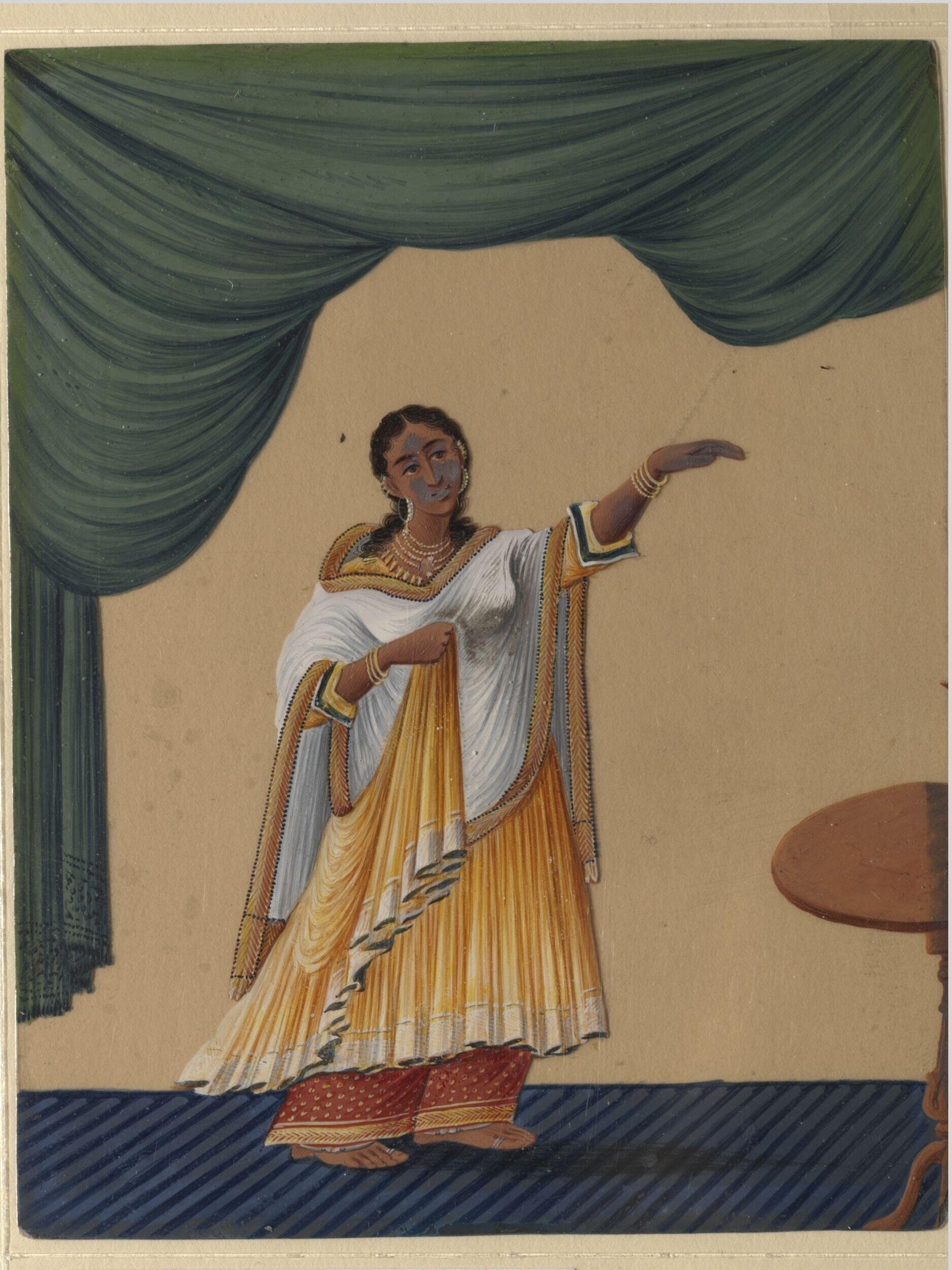
One of twelve drawings of musicians and dancing-girls.
Unknown
- Collection:
- Painting
- Source:
- Victoria and Albert Museum
- Rights:
- Rights vary by item — check the source record before reusing this image. Source record ↗
- Recorded as:
- V&A — check rights per item
This work illustrates the 19th-century fascination with classical performance and the ways artists documented—or idealized—the relationship between Greek and Roman theatrical practice and contemporary performance. It shows how 'dancing girls' were understood and visualized in the Victorian period, and how classical costume and gesture were invoked to suggest refinement, erudition, and historical authenticity.
What you are looking at
A woman in classical drapery stands alone on a blue-striped platform before a pale backdrop, framed by deep green curtains that sweep across the upper portion of the composition. She wears a white chiton or peplos with a gold-bordered himation drawn across her body; gold ornaments including a collar, bracelets, and anklets emphasize her status. Her dark hair is parted and her complexion rendered in warm brown tones. Her right arm is extended in a gesture of address or presentation, the palm open and fingers delicate; her left hand draws the drapery across her torso. Her weight is grounded and frontal, her gaze directed outward with an expression of composed authority. The composition is formally staged—the architectural frame of curtains, the isolated figure, the neutral ground—suggesting theatrical presentation rather than a scene of social dance. Red patterned fabric visible at the lower edge suggests either furnishings or additional costume elements.
The dancing
A single standing female figure in classical dress, not in closed or open hold with a partner. Her pose is formal and deliberate: the extended right arm suggests oratorical gesture or ritual presentation rather than dance movement. Weight is evenly distributed; the body is upright and frontal. There is no footwork visible, no partnered interaction, and no indication of movement through space. The gesture reads as declarative or performative rather than kinetic.
The dance depicted
This image does not depict social or partnered dance. The pose and framing suggest theatrical or ceremonial performance in a classical context—possibly a figure from Greek or Roman drama, or a neoclassical theatrical tableau. The woman's stance and gesture recall the classical orator or priestess rather than a dancer. While the work is numbered as one of twelve drawings of 'musicians and dancing-girls,' this particular figure appears to be in a moment of stillness or address, not active dance.
How it was made
The work is executed in hand-tinted pigment on paper, with careful attention to fabric texture and draping rendered in directional strokes; the gold ornaments are rendered in warm ochre and burnished tones. The green curtains show visible brushwork suggesting watercolor or similar wash technique. The style and execution suggest 19th-century theatrical or ethnographic illustration—likely created for a portfolio or publication. The tinting and draftsmanship indicate skilled artisanal production, consistent with mid-Victorian decorative or antiquarian work.
About this work
This is one of a series of twelve drawings depicting musicians and women in classical dress, dated to 1860. The work presents a formally posed female figure in Greco-Roman theatrical costume within an architecturally framed stage space. Though catalogued as one of a set of 'dancing-girls,' the actual pose shown here is one of stillness and formal presentation—a moment of classical performance or oratorical gesture rather than kinetic dance. The theatrical framing, refined execution, and antiquarian subject matter suggest this was part of a decorative or educational series produced in the mid-Victorian period, possibly for a dance history or classical studies collection.
The drawing sits within a tradition of neoclassical revival imagery popular in 19th-century Britain and Europe. The pose and costume echo both antiquarian scholarship and theatrical practice of the period—when classically inspired tableaux vivants and dramatic performances drew audiences across Europe. The careful attention to drapery and ornament, and the formal isolation of the figure, mark this as a work of documentation and aesthetic refinement rather than naturalistic observation.
How to look at it
Attend to the stillness of the figure and the formality of the stage framing—this is a moment of presentation, not movement. The extended arm and frontal stance invoke classical oratory and ritual authority rather than the fluidity of dance steps. The choice to freeze the figure in this authoritative pose, rather than in mid-movement, suggests the artist's interest in costume, status, and classical decorum. Notice the relationship between the pale, neutral background and the architectural frame of curtains—the composition emphasizes the figure's isolation and formal importance.
The period
The 1860s were a period of intense neoclassical revival in British and European art and theater. Archaeological discoveries—particularly from Pompeii and Herculaneum—fueled fascination with ancient performance. Theatrical productions drew heavily on classical themes, and visual artists produced both scholarly reconstructions and imaginative interpretations of Greek and Roman dancers and musicians. Educational portfolios and decorative series documenting classical subjects were popular among collectors and institutions. The careful, refined style of this work places it within a tradition of antiquarian illustration and theatrical documentation.
Where it lives
Catalogued as part of a series of twelve drawings of musicians and dancing-girls. The source is recorded as 'va' (likely the Victoria & Albert Museum). The work is held as a painting, though the medium appears to be hand-tinted paper.
Questions about this work
Is this figure actually dancing?
Not in the moment shown. Though catalogued as one of a series of 'dancing-girls,' this particular figure is posed in stillness—standing with an extended arm in a gesture of address or presentation. The pose suggests theatrical or ceremonial performance in a classical idiom, but not active dance movement.
What historical period does the costume represent?
The costume is neoclassical—a deliberate evocation of ancient Greek and Roman dress, composed of a white chiton or peplos with a gold-bordered himation. These were not contemporary 1860s garments, but scholarly or theatrical reconstructions of classical dress, worn in historical tableaux and dramatic performances.
Why are there curtains framing the figure?
The curtains indicate a theatrical stage setting. This suggests the figure is being presented as a performer on stage—perhaps in a tableaux vivant, a classical drama, or a concert performance. The formal architectural frame emphasizes the figure's role as a spectacle to be observed.
What is the context of this twelve-part series?
The series appears to document musicians and female performers in classical dress, likely for educational, antiquarian, or decorative purposes. Such portfolios were popular in the Victorian era among collectors interested in dance history, classical studies, and theatrical practice. The refined execution suggests production for a cultured, educated audience.
More dance artwork





