49 works in this view — arrow keys or swipe to move between them.
Dance in Art
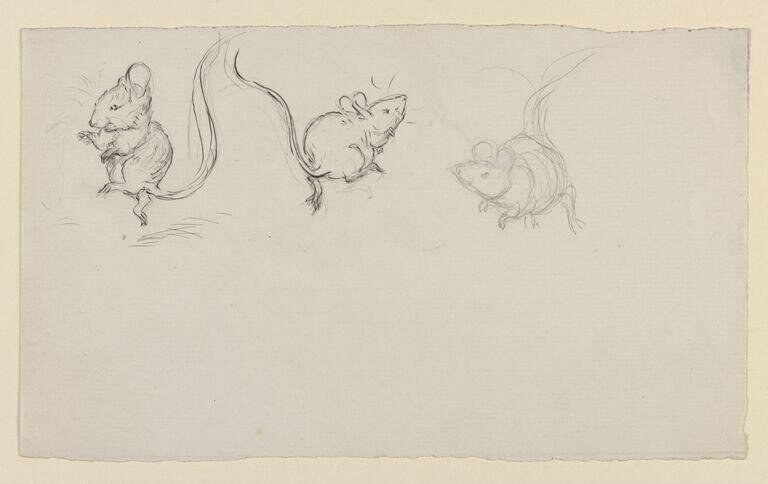
Studies of mice dancing
Beatrix Potter
- Collection:
- drawing
- Source:
- Victoria and Albert Museum
- Rights:
- Rights vary by item — check the source record before reusing this image. Source record ↗
- Recorded as:
- V&A — check rights per item
This work is significant because it opens a question about what counts as dance in art history and where the boundary lies between animal observation and anthropomorphic fantasy. Potter's decision to title these as dancing rather than simply as mice in motion suggests that the quality of celebration or synchronized social energy in movement is recognizable across species, and that artists can invoke dance as a frame for understanding animal life.
What you are looking at
Four mice are drawn in pen or pencil in various attitudes of animated movement across the page. Each mouse is rendered with delicate line work showing alert posture, lifted limbs, and energetic gestures. The mice are dispersed across the composition with no ground line or setting—they occupy a blank cream paper. The artist has captured them at different moments: one mouse at left holds its tail high and curved, body upright; one in the upper center appears to leap or spring; one at bottom center crouches lower; one at right rear stands with tail raised and front paws lifted. The line is fluid and assured, with minimal shading, suggesting movement and character through pose alone rather than through any dance partner relationship or formal choreography.
The dancing
Each mouse is drawn as a solitary figure with no physical contact between them. The poses emphasize individual alertness and vivacity: raised tails, lifted or extended limbs, upright spines. There is no partnering, closed hold, or frame of any kind. The artist has rendered the mice's natural physical capability—the springy, quick movements of small animals—as if those movements were a form of dancing or celebration. The gestural language suggests play, joy, or social interaction through mimicry of animal movement rather than through any human dance vocabulary.
The dance depicted
These are not representations of human dance or any recognizable dance form, but rather studies of mice rendered as if celebrating or dancing. The catalogue title claims dancing; the image shows the vivid, energetic movement of small animals in a state of play or animation. Potter was a skilled naturalist observer, and these studies may serve a narrative or illustrative purpose—possibly for a children's story—in which animal movement is anthropomorphized as dance. The work is closer to zoological observation rendered with expressive line than to any choreographic tradition.
How it was made
The work is executed in pen or pencil (the record does not specify) with fluid, economical line work on paper. The open, light technique allows the artist to capture the essence of movement through gestural marks rather than finished form. The minimal rendering suggests this is a working study or sketch rather than a finished artwork intended for formal exhibition. Potter's characteristic approach to animal illustration—observant, detailed in the essentials, swift in execution—is evident throughout.
About this work
This is a sheet of pen-and-ink studies by Beatrix Potter, dated 1897, depicting four mice in attitudes of animated movement. Rather than a choreographed dance scene or a scene from the history of human dance, it represents Potter's practice of observing animal behavior and rendering it with expressive line. The catalogue title "Studies of mice dancing" frames these naturalistic observations as dance, inviting viewers to see the animals' lively movement as a form of celebration or play. The work belongs in a gallery of dance in art because the artist herself has chosen to title them as dancing, asking viewers to see in animal movement the qualities of dance—joy, energy, community, individual expression.
How to look at it
Look at the variety of poses: the artist has frozen each mouse at a different instant in its movement, so that seeing them together creates an impression of motion and liveliness. Notice how much is suggested through the tail and limbs alone—Potter has not drawn fur texture or anatomical detail but rather the skeletal articulation and the direction of force and energy. The blank page allows each mouse to read as a separate study, but together they form a kind of narrative or social scene, as if the mice are in communication through their movement.
The artist
Beatrix Potter (1866–1943) was a writer, illustrator, and naturalist whose *The Tale of Peter Rabbit* and other children's books made her one of the most celebrated illustrators of her era. She was a meticulous observer of animals, fungi, and plants, and conducted serious scientific studies alongside her commercial work. Her illustrations combine naturalistic accuracy with imaginative storytelling, often placing animals in human situations and emotional states. These mouse studies, dated to 1897, fall within her period of intense work on the *Peter Rabbit* manuscript and related illustrations.
The period
In the 1890s, Potter was establishing herself as both an artist and a naturalist at a moment when children's literature was becoming a major cultural form and when scientific illustration was valued as both art and document. The anthropomorphism of animals in Victorian and Edwardian children's literature was a dominant mode—animals were not only observed but imagined as social beings with emotions, hierarchies, and celebrations. At the same time, the study of movement itself was becoming a subject of intense artistic interest: Eadweard Muybridge's photographic studies of animal locomotion had been published in the 1880s, and artists were exploring how to capture motion in still images through gesture and line.
Where it lives
The work is held in the collection noted as "va" in the source field, which likely refers to the Victoria and Albert Museum in London or another British institutional collection. It is catalogued as a drawing without further specification of medium, and bears a catalogue title rather than a known inscription on the work itself.
Questions about this work
Did Beatrix Potter really think mice could dance?
Potter was a naturalist and observer; she likely titled these studies as dancing in a playful or metaphorical sense, recognizing that the lively, coordinated movement of animals can be read as a form of celebration or social expression. The title invites viewers to see dance-like qualities in natural animal behavior rather than claiming the mice are performing choreography.
Are these studies for one of Potter's published books?
The date (1897) and style suggest these may be studies related to her work on *The Tale of Peter Rabbit* or other early stories, though no direct connection to a published illustration is documented in the record. Potter often produced multiple studies and sketches that did not appear in final publications.
What dance style is this?
This is not a representation of any recognized human dance form. It is an anthropomorphic or poetic framing of animal movement as dance—a common device in children's literature and illustration of the period.
More dance artwork





