49 works in this view — arrow keys or swipe to move between them.
Dance in Art
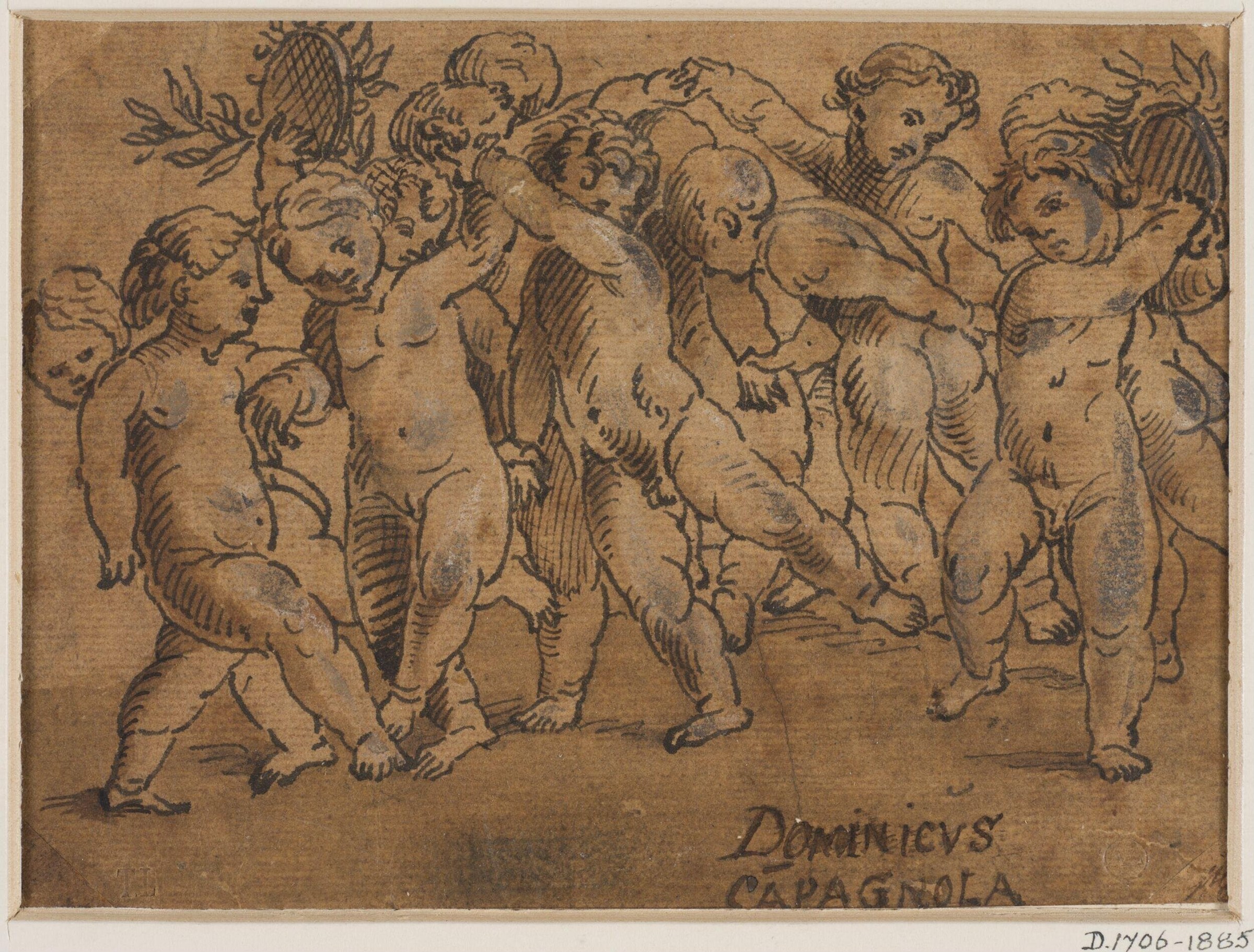
Twelve naked children dancing
Campagnola
- Collection:
- Drawing
- Source:
- Victoria and Albert Museum
- Rights:
- Rights vary by item — check the source record before reusing this image. Source record ↗
- Recorded as:
- V&A — check rights per item
The drawing demonstrates how Renaissance artists used putti compositions to explore the representation of the moving body without the constraints of courtly dance conventions. For historians of dance, it offers evidence of what artists regarded as natural, expressive movement in the period—useful context for understanding how formal dances were visualized and valued. The work shows that the interest in dynamic figure composition preceded and informed the codification of actual dance forms.
What you are looking at
A pen-and-ink drawing shows approximately twelve nude or lightly draped putti (infant-like cherubs) arranged in a loose, energetic group across the composition. The children are rendered in a classical style with careful attention to their rounded bodies, curled hair, and individualized poses. They occupy a shallow, neutral ground with minimal setting detail—no architectural elements, landscape, or props to anchor the scene. The figures cluster together in animated positions: some are leaning toward others, a few appear to be reaching or gesturing upward, and their varied stances and body angles create a sense of spontaneous, joyful movement throughout the group. The artist has used cross-hatching and linear shading to model the three-dimensional form of each body, with particular attention to the musculature and weight distribution of the children's limbs. The drawing is executed on aged, warm-toned paper, and the ink has browned slightly with time. At the bottom right, the inscription reads "Dominicus Padagnola" or similar, identifying the artist.
The dancing
The putti display a remarkable variety of poses and spatial relationships. Some stand upright with arms raised or extended; others lean at acute angles as if in conversation or play. Several figures overlap or turn to face neighbors, creating depth through figure positioning rather than perspective. The artist demonstrates confident anatomical understanding—each child's weight appears grounded, with knees slightly flexed and torsos naturally aligned. The gestures are communicative rather than formally structured: outstretched hands, tilted heads, and open stances suggest informal social interaction. There is no apparent partnering or ballroom hold; instead, the group reads as a spontaneous assembly of independent, mobile bodies.
The dance depicted
This is not a depiction of a recognizable historical dance form. Rather, it appears to be an allegorical or mythological scene of putti engaged in play or a festive assembly—a common subject in Renaissance and early modern art. While the figures are in motion and the composition is lively, they do not exhibit the formal structure, codified positions, or ensemble discipline of any established dance tradition. The artist may have intended the composition to convey music-making or celebration (putti were often shown as attendants to Venus or other deities), but the drawing shows play and movement rather than choreography. The lack of musical instruments, formal costume, or architectural framing suggests this is an imaginative study in figure composition rather than a literal document of dance practice.
How it was made
This is a pen-and-ink drawing on paper, executed in a linear, classical technique consistent with Renaissance or early modern draftsmanship. The medium—dark ink applied with a fine point—allowed the artist to achieve precise anatomical detail and controlled modeling through hatching. The apparent absence of color wash or preparatory underdrawing visible in the image suggests a finished drawing rather than a sketch. The technique and paper quality indicate this was a work of some care and intention, likely created for study or as a finished composition. Drawings of this type circulated among artists and patrons as exemplars of figure composition and anatomical knowledge.
About this work
This drawing presents a gathering of twelve putti in various poses of play and interaction, rendered in the refined pen-and-ink style characteristic of Renaissance draftsmanship. Although the figures are animated and the composition conveys a sense of movement and social energy, the work does not document a specific historical dance or dance style. Instead, it is an allegorical or imaginative study in human figure composition, probably intended as a model for artists or as a collection piece for a patron interested in classical iconography. The work belongs in a gallery of dance in art because it captures the artist's interest in rendering the human body in dynamic, varied poses—a fundamental concern of both dance and figure drawing. The lack of formal dance structure makes it marginal to the history of choreography, but it is central to understanding how artists of the period studied and represented the moving human form.
How to look at it
Attend to the variety and independence of each figure's pose: the artist has avoided repetition and symmetry, instead creating a sense of spontaneous, individual movement within a group. Notice how the overlapping of figures and the variation in scale create spatial depth despite the absence of landscape or architectural framing. The positioning of heads, the direction of glances, and the extension of arms all suggest relationships and interactions among the putti—look for which figures seem to address one another. Finally, observe the delicate balance of the bodies: even in complex, tilted poses, each child appears naturally grounded and weighted, revealing the artist's careful study of human anatomy and the mechanics of balance and movement.
The artist
Domenico Campagnola (c. 1500–1564) was a Venetian printmaker, draftsman, and painter known for his engravings, etchings, and pen-and-ink drawings. He was a prolific artist whose work ranged from mythological scenes and figure studies to religious and allegorical subjects. Campagnola's drawings are particularly valued for their refined anatomical accuracy and their influence on northern European printmaking. He worked in a period when the study and collection of figure drawings was central to artistic training and to the circulation of classical models among the learned classes.
The period
The drawing dates to the sixteenth century, a period when the study of human anatomy and classical composition was central to artistic practice. This was also the era in which court dances—particularly the pavane, galliard, and early forms of the minuet—were becoming increasingly formalized and were beginning to be documented in written dance manuals. However, the allegorical putti remained a popular subject independent of dance documentation, reflecting a broader humanist interest in classical mythology and in the representation of childhood and innocence. Artists of this period frequently created figure studies and inventive compositions that explored movement and interaction without reference to specific social dances.
Where it lives
The work is housed in the Victoria and Albert Museum (Museum no. D.1706-1885) and is catalogued as a drawing. The inscription on the sheet identifies the artist as Domenico Campagnola. The accession number suggests acquisition in the nineteenth century, likely as part of a broader collecting effort in Renaissance prints and drawings.
Questions about this work
Are these children actually dancing?
No—the composition shows putti in play and social interaction rather than the structured steps and formations of a historical dance. The variety of poses and the informal, spontaneous quality of the arrangement distinguish this from dance documentation. However, the work is relevant to dance history because it shows Renaissance artists' interest in representing the moving human body and its capacity for expressive, coordinated action.
Why are the figures nude?
The nudity is conventional for allegorical putti in Renaissance and classical art. These child-like figures were typically depicted without clothing as a sign of their divine or mythological status and their association with classical sculpture. The nudity also allowed the artist to display anatomical knowledge and to avoid the distraction of contemporary dress.
Could this be a study for a larger work or a patron's commission?
Possibly. Drawings like this sometimes served as compositional studies for paintings, frescoes, or larger prints. The finished quality of the ink work and the classical subject matter suggest it was a work of some intention, but without further archival evidence it is difficult to determine whether it was preliminary or autonomous.
How does Campagnola compare to other Renaissance figure drawers?
Campagnola was among the most accomplished draftsmen of the Venetian Renaissance. His anatomical precision and his interest in dynamic composition place him alongside figures like Michelangelo and Raphael in his attention to the human body, though his work is less monumental and more playful in subject. His drawings were highly valued and widely circulated.
More dance artwork





