49 works in this view — arrow keys or swipe to move between them.
Dance in Art
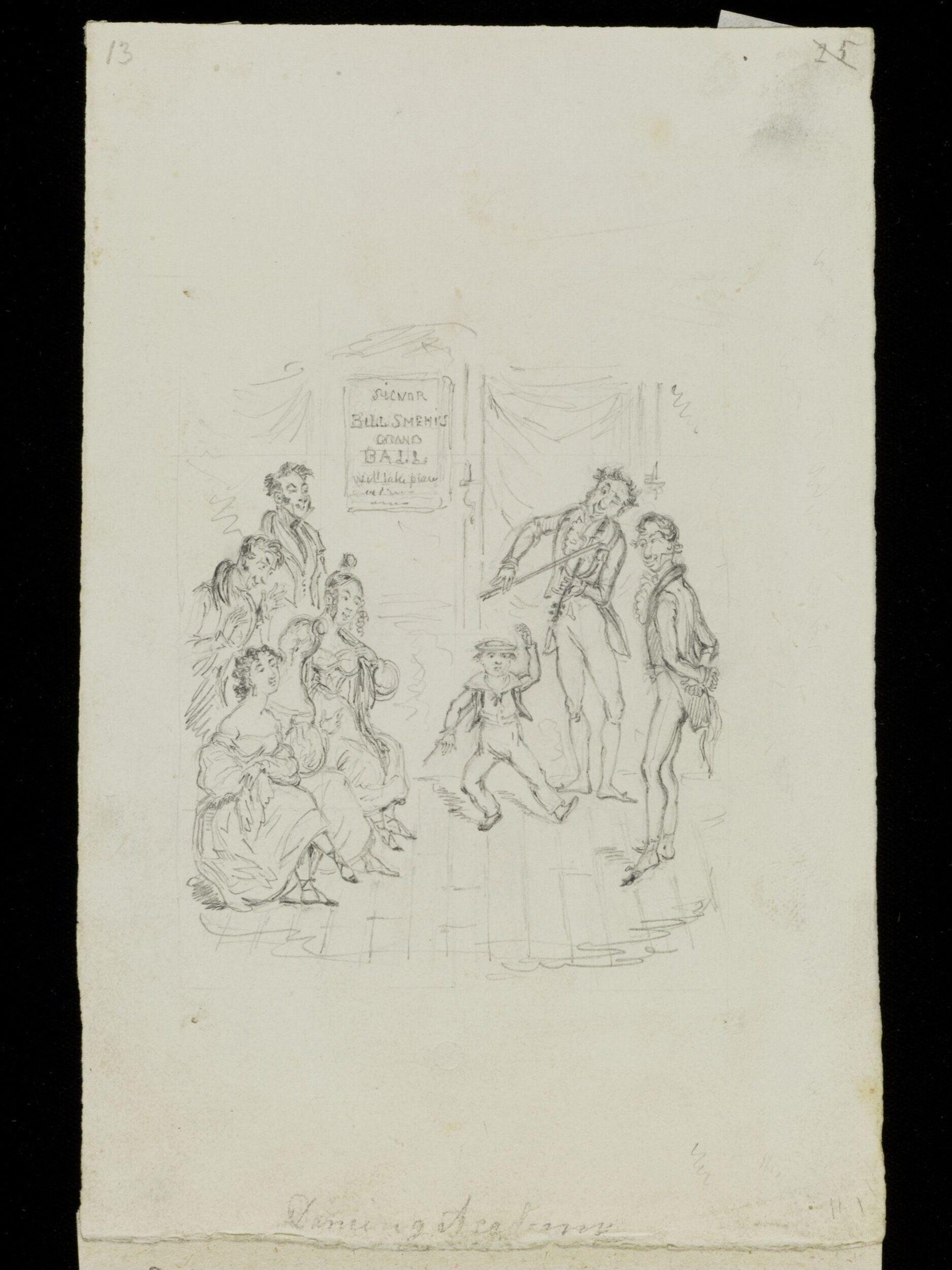
Dancing Academy
Cruikshank, George
- Collection:
- Illustration
- Source:
- Victoria and Albert Museum
- Rights:
- Rights vary by item — check the source record before reusing this image. Source record ↗
- Recorded as:
- V&A — check rights per item
This work shows how dance institutions (and dance itself) appeared in popular satire and caricature of the period, serving as shorthand for social pretension or disorder rather than as neutral subjects. It documents the cultural place of dancing academies in Regency society and the anxiety or ridicule they could attract, offering insight into how dancing masters and their pupils were perceived in early 19th-century visual culture.
What you are looking at
A crowded interior scene showing a dancing academy or ballroom in chaos. Two groups of figures face each other across a wooden floor, with a signboard above reading "BICTON'S BALL SHEWING / GRAND / GALL" (the text partially obscured). On the left, a kneeling woman in elaborate dress gestures upward in distress or supplication, surrounded by other women in high-waisted Regency gowns with bare shoulders and puffed sleeves. On the right, three or four men in tailcoats and breeches stand in aggressive or theatrical poses, one pointing downward with a sword or stick. A small child in the center stands between the two groups, apparently the focus of both parties' attention. The setting is a bare room with draped curtains or hangings above, and the floor is marked with faint gridlines suggesting a dance floor. The entire composition suggests a moment of social disorder or farce—either a violent interruption of a ball or a comedic misunderstanding.
The dancing
The bodies are rendered in exaggerated, expressive poses characteristic of theatrical caricature. The kneeling woman on the left stretches her arms upward in a gesture of alarm or pleading, her torso twisted; the men on the right adopt aggressive stances with extended limbs. No formal dance hold or posture is evident—instead, the figures occupy unstable, animated positions suggesting argument or physical confrontation rather than choreographed movement. The composition emphasizes social chaos rather than physical coordination.
The dance depicted
Despite the title 'Dancing Academy,' this image does not depict an actual dance lesson or social dancing. The scene is clearly satirical: the signboard, the disorder, and the theatrical gestures all point to the image as satire on dancing academies themselves—their pretension, their social chaos, or their failures in instruction. No identifiable dance style is in progress; the 'dance' is conceptual, referring to the institution and its absurdities rather than to any actual choreography.
How it was made
This is a pen and ink sketch on paper, drawn with fine, confident lines typical of preliminary illustration work. The medium's immediacy and economy of line—visible in the quick hatching and flowing contours—suggests this is either a finished sketch or a study for a larger work. The technique allows rapid, expressive gesture work and sharp satirical effect without the labor of engraving or color. The gridlines faintly visible on the floor may indicate the artist's preparatory measurement or compositional structure.
About this work
This is a satirical sketch by George Cruikshank depicting a 'Dancing Academy'—not a depiction of dance itself but a sharp social commentary on the institution and the pretensions or failures associated with it. The composition, with its kneeling, gesturing figures and confrontational groupings, suggests either a violent disruption of a ball or a comedy of manners unfolding in a ballroom setting. As a sketch from the 1830s, it belongs to Cruikshank's prolific output of social satire, where the trappings of dance and formal society become vehicles for criticism of class, behavior, and social convention.
The work is significant not as a document of dance practice but as evidence of how dance spaces and dance instruction featured in popular satire. The 'academy' was a recognizable social institution, and Cruikshank's mockery of it—through exaggerated poses and implied disorder—reflects anxieties or humor surrounding social instruction and propriety in Regency England.
How to look at it
Attend to the exaggerated poses and the complete absence of elegant or coordinated movement. The artist has chosen a moment of maximum disorder and emotional intensity—not a freeze-frame of actual dancing, but a theatrical representation of a social institution collapsing into farce. Notice how the signboard above anchors the setting as an 'academy,' making the chaos below a comment on the institution itself. The sketch's loose, rapid linework and lack of finish suggest this may be a preliminary study or a working sketch, which fits with Cruikshank's prolific method of capturing social scenes for later development into finished prints.
The artist
George Cruikshank (1792–1878) was one of the most prolific and celebrated caricaturists of early 19th-century Britain, known for his savage social and political satire. Working across prints, book illustrations, and standalone sketches, he targeted institutions, professions, class behavior, and public figures with sharp wit and consummate draftsmanship. His loose, confident line and exaggerated physiognomy became iconic; his work circulated widely and influenced British satirical culture. He was particularly engaged with scenes of social life—balls, academies, streets, public houses—as sites of human folly and class pretension.
The period
In Regency England (c. 1811–1820) and the decades that followed, dancing academies were established fixtures of genteel and aspirational society, teaching country dances, quadrilles, and other social forms to the middle and upper classes. They were also frequent targets of satire, mocked for their expense, their pretension, and the comic failures of their pupils. Cruikshank's sketch dates to the mid-1830s, when quadrilles and Anglicized versions of Continental dances were becoming fashionable, and when the academy itself—once a marker of true gentility—was increasingly subject to ridicule. Simultaneously, caricature itself had become a dominant form of social commentary in British print culture, with figures like Cruikshank and his rivals producing hundreds of plates annually for popular consumption.
Where it lives
This sketch is held as an illustration, catalogued under the source 'va' (likely a reference collection or archive). It is a work on paper—a preliminary or finished sketch in pen and ink—rather than a published print, suggesting it may be a study for a larger work or a circulated artist's drawing.
Questions about this work
Is this an actual depiction of dancing?
No. Despite the title, the image shows chaos and disorder, not coordinated dance. This is satire on the dancing academy as an institution—a comment on social pretension, instruction gone wrong, or the folly of ballroom society, rather than a documentary record of how people actually danced.
Why are the figures in such strange poses?
Cruikshank uses exaggerated, theatrical body language to convey emotion and comedy. The kneeling, pointing, and twisted torsos are not natural poses but caricature—a shorthand for distress, anger, or absurdity. This was a staple technique of satirical caricature.
What is the significance of the dancing academy as a subject?
Dancing academies were real institutions in Regency and early Victorian Britain, places where genteel people paid to learn fashionable dances. They were frequently mocked in satire as pretentious, expensive, or riddled with social comedy—making them perfect targets for an artist like Cruikshank.
Is this a finished work or a sketch?
This appears to be a pen and ink sketch, either preparatory or finished as a standalone drawing. The loose, fluid linework and lack of color suggest immediacy and economy, though it may have been worked up into a larger print. Many of Cruikshank's most famous works began as rapid sketches like this.
More dance artwork





