49 works in this view — arrow keys or swipe to move between them.
Dance in Art
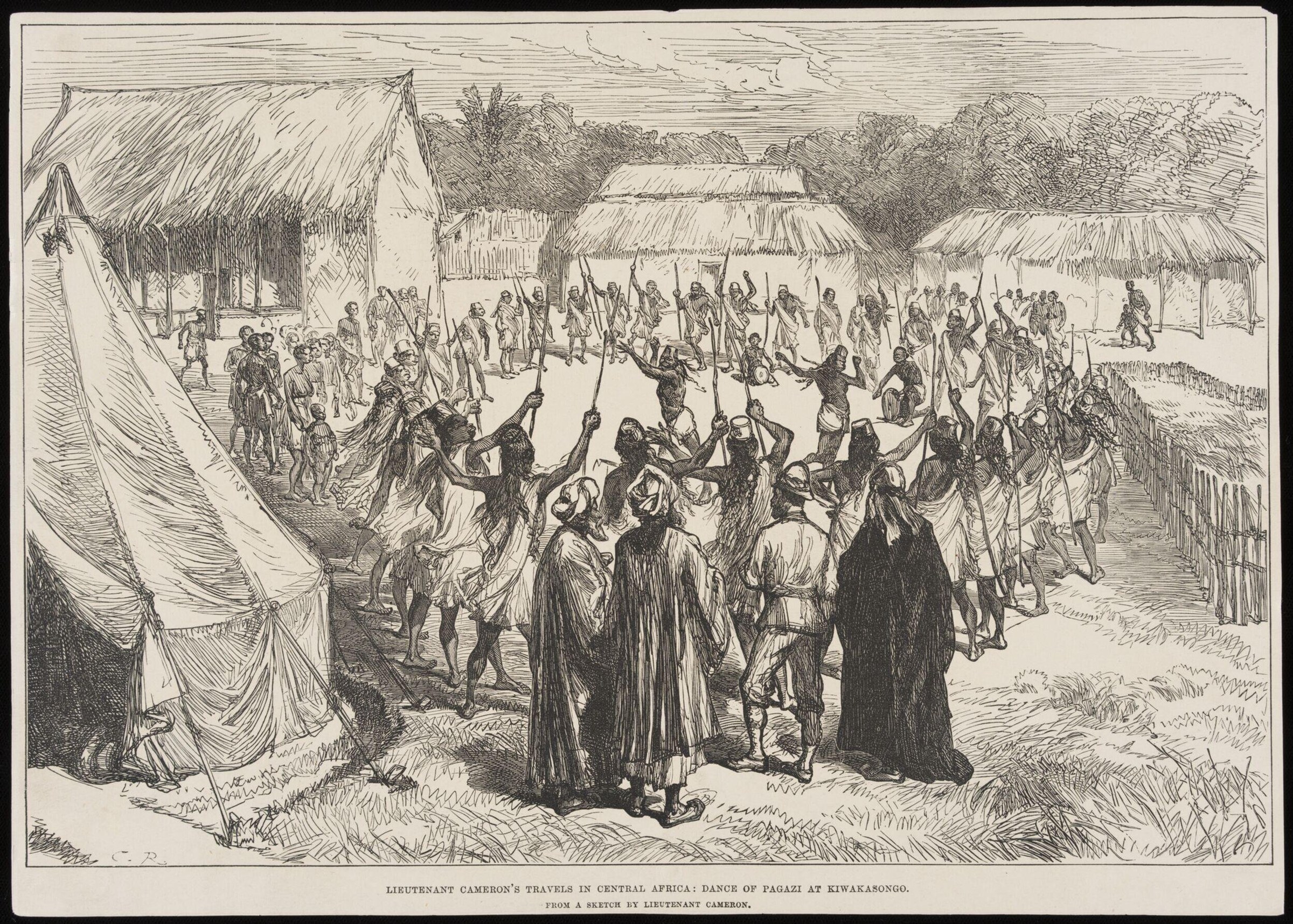
Lieutenant Cameron's Travels in Central Africa: dance of Pagazi at Kiwakasongo
Verney Lovett Cameron
- Collection:
- Source:
- Victoria and Albert Museum
- Rights:
- Rights vary by item — check the source record before reusing this image. Source record ↗
- Recorded as:
- V&A — check rights per item
This is rare 19th-century documentation of Central African dance practice during the height of European exploration, preserved because it was part of an imperial expedition narrative. For historians of African dance, global movement practices, and colonial visual culture, it offers evidence of spear-based coordinated movement, community participation, and the gendered and martial dimensions of Pagazi culture—while simultaneously demonstrating how European artists and engravers mediated and potentially distorted such practices for home audiences. The work sits at the intersection of dance history, ethnographic documentation, and colonial representation.
What you are looking at
A large gathering in what appears to be a Central African settlement, depicted in a wood engraving or similar print technique. The composition shows a central open space surrounded by thatched-roof structures typical of the region. In the foreground, a group of dancers—predominantly men—are arranged in loose formation, many raising spears or staffs vertically skyward in unison. Their bodies are depicted with minimal clothing, rendered in the ethnographic convention of the period. To the left, a large tent or European structure is visible, suggesting the presence of colonial travelers or expeditions. Numerous onlookers line the background and sides of the scene, creating the impression of a gathering or ceremony attracting community participation. The sky is rendered with fine hatching, and the foreground shows sparse vegetation typical of savanna terrain. The overall composition suggests a moment of active, collective movement rather than a formal or staged dance.
The dancing
The primary dancers occupy the center of the composition with bodies held upright, arms extended vertically or at angles, gripping what appear to be spears, staffs, or similar implements. The posture is energetic and emphatic rather than balletic—the bodies are loose and animated, with weight shifting visible in the varied stances. Multiple figures are shown in what appears to be simultaneous or synchronized raising of implements overhead, suggesting collective action rather than coupled dancing. The secondary figures around the perimeter appear to be standing, watching, or clapping. The artist has conveyed movement primarily through the vertical thrust of arms and the implied rhythm of collective gesture rather than through footwork or floor patterns.
The dance depicted
This is documented as a dance of the Pagazi (porters or carriers in East African trade networks) witnessed during Lieutenant Verney Lovett Cameron's expedition through Central Africa in the 1870s. The image depicts what appears to be a warrior dance or celebratory gathering involving the coordinated raising of spears—a form associated with many Central African cultures as both martial display and ceremonial practice. The Pagazi were crucial to the colonial-era trading expeditions, and the presence of Cameron's tent suggests this was a documented performance or gathering for European witnesses. The dance appears to emphasize collective, rhythmic arm and torso action with vertical emphasis rather than complex footwork, consistent with spear dances documented across the continent. The specific identity and significance of this particular dance form among the Pagazi cannot be fully established from the image alone.
How it was made
This is a wood engraving or possibly a steel engraving, identifiable by the fine parallel hatching lines used to create tone and shadow, the bold linear definition of forms, and the high contrast between black and white. The technique allowed for mass reproduction and circulation through periodicals and illustrated travel narratives, which was the primary distribution method for Cameron's expedition records. The precision of the line work and the density of detail suggest skilled engraving work, likely created from a sketch by Cameron or a draughtsman accompanying the expedition and then rendered by a professional engraver in Europe. This medium was standard for illustrating 19th-century exploration narratives and shaped how European audiences encountered African peoples and practices.
About this work
This engraving documents a ceremonial gathering and dance witnessed by British explorer Lieutenant Verney Lovett Cameron during his crossing of Central Africa (1873–1875), specifically noting it as a performance by the Pagazi—the porters and carriers essential to East African trade expeditions. The work is both an ethnographic record and a product of the imperial gaze: it captures genuine movement and collective practice while filtering it through European artistic conventions and the observer's frame. The image shows dancers in coordinated vertical gestures with spears, surrounded by onlookers, in a settlement setting that includes Cameron's own tent, making explicit the colonial encounter that occasioned the documentation. For a dance history page, it represents one of the few visual records of Central African movement practices from the period, albeit one mediated by expedition artists and European engravers.
How to look at it
Focus on the unified vertical thrust of the spears and the energy of the raised arms: the artist has chosen to freeze a moment of synchronized, collective action rather than individual virtuosity or couple work. Notice the distinction between the active dancers in the center and the watching figures around them—this is not a circle dance or one in which the entire community is equal participants, but rather a performance with a distinction between performers and audience. The engraving's fine hatching allows the artist to differentiate bodies and create spatial depth, making clear that this is a large, outdoor gathering. The inclusion of Cameron's tent explicitly frames this as a documented encounter between European explorer and African peoples, raising the question of how the presence of European witnesses may have shaped what was performed.
The artist
Lieutenant Verney Lovett Cameron (1844–1894) was a British Royal Navy officer and explorer who led one of the first European expeditions to cross Central Africa from east to west (1873–1875). He was not primarily an artist but traveled with sketchbooks and employed draughtsmen, producing numerous illustrations of landscape, settlement, and people encountered along the route. His expedition resulted in the book *Across Africa* (1877), which was heavily illustrated with engravings made from his sketches and those of his team. Cameron's visual documentation was typical of 19th-century exploration narratives: detailed, curious about indigenous practices, and filtered through Victorian aesthetic conventions and assumptions about race and civilization.
The period
This engraving dates to the 1870s, during the height of European exploration and the early stages of formal colonization in Central Africa. In Britain, illustrated periodicals and travel narratives were the primary means by which the public encountered African peoples and practices; such images shaped racial and cultural attitudes that legitimized imperial expansion. Simultaneously, this was a period when systematic ethnographic and anthropological documentation was beginning, though still embedded in colonial frameworks. In African dance and music practices themselves, the Pagazi and other trading communities were experiencing disruption and transformation due to the very trade networks and colonial expeditions that occasioned this image. The dance documented here took place within a context of rapid historical change and unequal power relations.
Where it lives
This engraving was published as an illustration accompanying Lieutenant Cameron's expedition narrative, likely in *Across Africa* (1877) or in contemporary periodicals such as the *Illustrated London News*, which regularly serialized exploration accounts. It is one of dozens of engravings documenting Cameron's crossing of Central Africa from 1873 to 1875. The work originated as a sketch in the field and was professionally engraved in London for mass circulation among Victorian readers.
Dance in this work
Questions about this work
Did Lieutenant Cameron actually see this dance, or is it imagined?
Cameron was present during his expeditions and sketched or commissioned sketches of what he witnessed, so the dance itself was observed. However, the engraving was created in London by professional engravers working from sketches, which means the final image reflects both the original observation and the engraver's interpretation and Victorian artistic conventions. The degree of artistic license is typical of exploration illustrations from this period.
What were the Pagazi, and why would Cameron document their dance?
Pagazi were porters and carriers essential to East African trade networks and expeditions. Cameron would have traveled with Pagazi as part of his expedition team. Documenting their practices and celebrations was part of the broader ethnographic impulse of Victorian exploration narratives—to record the customs, appearance, and behaviors of peoples encountered. Whether the dance was performed spontaneously or deliberately performed for the European audience remains unclear.
What can we actually learn about the dance from this image?
The engraving shows that the dance involved coordinated raising of spears or staffs, was performed by multiple men in an open space, attracted community onlookers, and involved vertical emphasis and collective rhythm rather than footwork. These elements are consistent with many Central African spear or warrior dances, but the specific name, meaning, and full movement vocabulary cannot be determined from a still image alone, especially one filtered through European artistic convention.
Is this a reliable ethnographic document?
It is a partial document: it captures real movement and real people, but it is also shaped by the artist's training, the engraver's interpretation, Victorian aesthetic conventions, and the colonial context of the encounter. It is valuable precisely because it is a historical artifact—evidence of how both African movement practices and colonial observation worked—but it should not be read as objective or complete documentation.
More dance artwork





