49 works in this view — arrow keys or swipe to move between them.
Dance in Art
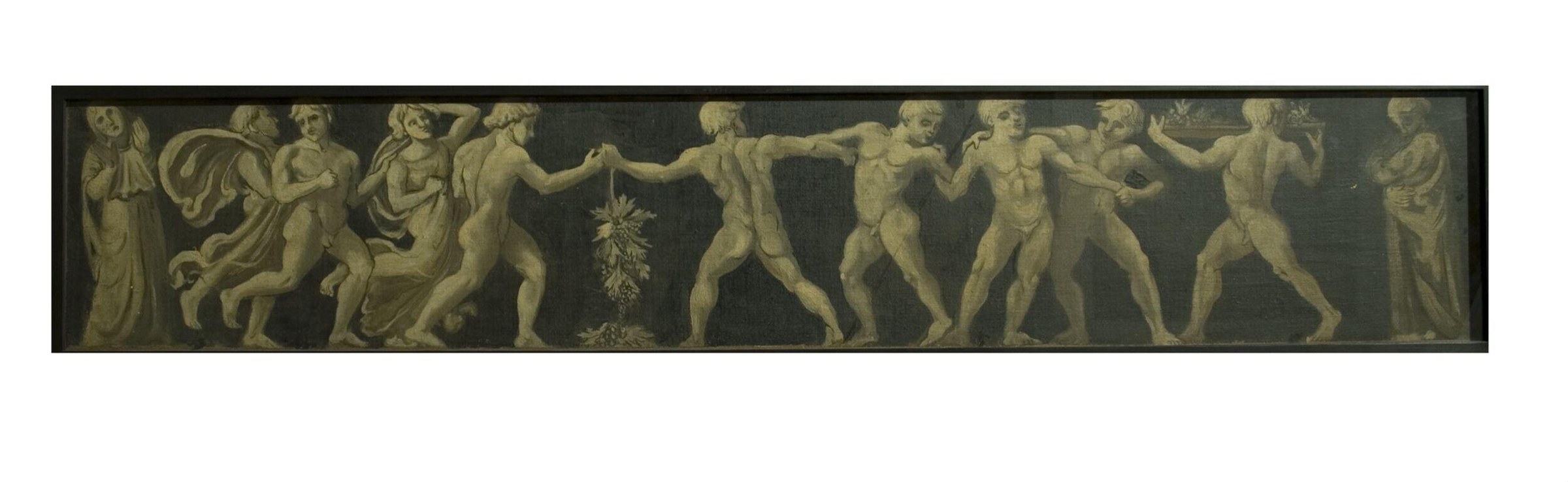
Frieze with Dancing Figures (decorative panel)
Moody, Francis Wollaston
- Collection:
- Oil painting
- Source:
- Victoria and Albert Museum
- Rights:
- Rights vary by item — check the source record before reusing this image. Source record ↗
- Recorded as:
- V&A — check rights per item
The work documents the 19th-century visual language of dance and celebration—how artists of the period understood classical movement through the conventions of antique decoration. For historians of interior design and neoclassical taste, it exemplifies the use of dancing figures as allegorical ornament in domestic spaces.
What you are looking at
A horizontal frieze depicting a procession of putti (winged cherubs) and draped female figures in classical style against a dark background. The composition reads left to right as a continuous narrative: on the far left, winged putti in flight carry or guide a billowing drapery; the central section shows a dense, animated group of nude male putti in various poses of movement and interaction, some holding hands in a chain, others gesturing broadly or leaping; between the clusters of figures hangs an ornamental swag of fruit or flowers as a visual pause; on the right side the composition echoes the left with more flying putti and draped female attendants. The entire frieze employs gilt or gold-toned figures against the dark ground, creating a luminous classical effect. The style and subject matter recall Greco-Roman decorative art and Renaissance revival ornament.
The dancing
The putti are rendered with anatomically childlike but active bodies, their poses highly varied: some are airborne with wings spread, others support themselves on one leg while the opposite leg extends in a gesture of movement, and several interlock arms in a chain or round formation. The draped female figures on the periphery stand in classical contrapposto. The overall impression is one of energetic, playful motion rather than formal choreography—these are figures in mid-flight and mid-gesture, captured in an instant of exuberant action.
The dance depicted
This is not a representation of a specific historical dance, but rather a classical allegorical composition in which the movement of putti embodies ideas of joy, festivity, and divine celebration. The animated poses and interlinking of arms suggest rounds, reels, or ring-dances of the sort associated with Bacchic and Dionysian imagery in Greco-Roman art. The work draws on the decorative tradition of Renaissance and neoclassical ornament, where dancing putti (amorini) served as emblems of harmony, love, and celebration. The frieze format and continuous narrative structure are conventions of ancient Roman decorative arts that were revived in the 19th century.
How it was made
Catalogue records indicate this is an oil painting, but the delicate gilt-on-dark technique, the frieze format, and the refined neoclassical draftsmanship suggest it may have been executed as a decorative panel or wall ornament, possibly designed for a domestic interior of high aesthetic pretension. The medium allowed for the modeling of the draped figures and the luminous separation of the gilt forms from the dark ground. Whether this is an original composition or a record of a larger decorative scheme is not established by the record.
About this work
This decorative frieze by Francis Wollaston Moody is a mid-19th-century essay in classical revival ornament, depicting a procession of dancing putti and draped attendants in gilt against a dark ground. It belongs to the neoclassical tradition of the Romantic and Victorian eras, when artists drew on Greco-Roman sources to create idealized images of movement, youth, and festivity. The work is a decorative panel rather than a narrative scene, designed to evoke the harmony and eternal youth associated with classical antiquity.
How to look at it
Observe the variety of poses among the putti: the artist has avoided simple repetition, instead creating a sense of continuous, almost uncontainable movement. Notice how the chain of hands, the flying figures, and the interlocking bodies create a narrative of festivity and interaction rather than formal alignment. The gilt technique against the dark ground gives the frieze an ethereal, almost luminous quality, emphasizing the lightness and grace of classical movement. The symmetrical flanking of the central cluster with draped figures at either end creates a sense of classical balance while the central putti remain in unruly, joyful motion.
The artist
Francis Wollaston Moody (1824–1896) was a British architect, designer, and decorative artist active in the mid-to-late Victorian era. He is known for his work in the Aesthetic Movement and his contributions to the South Kensington Museum (now the V&A). His practice encompassed architectural ornament, decorative panels, and designs for domestic interiors, often drawing on historical and classical sources. This frieze is characteristic of his approach to decorative design.
The period
The mid-19th century witnessed a strong revival of classical ornament in the decorative arts, driven by the aesthetic philosophy of the Arts and Crafts movement and the broader Romantic interest in historical sources. The neoclassical aesthetic of the Regency had given way to eclecticism, but classical imagery remained central to ideas of refinement and taste. Dancing putti and allegorical figures were stock subjects in interior decoration, appearing on friezes, panels, and fresco designs. The revival of ancient decorative techniques, including gilt-on-dark schemes, reflected antiquarian enthusiasm and a desire to recover 'authentic' historical beauty.
Where it lives
The work is recorded as an oil painting held in the Victoria and Albert Museum (source designation: va). It is catalogued as a decorative panel, a designation consistent with its frieze format and its likely intended function as domestic interior ornament.
Questions about this work
Are these figures supposed to be dancing?
The putti are in animated, playful movement rather than performing a specific dance. They represent the classical allegorical tradition in which youthful, winged attendants embody ideas of joy and celebration. Their poses—interlinking arms, leaping, flying—are drawn from the conventions of Bacchic and Dionysian imagery in ancient art, where such figures were associated with festivity and divine celebration.
Why use gilt against a dark background?
This technique imitates the appearance of classical Roman decorative arts, where gilded ornament often stood out against dark grounds in wall paintings and fresco work. Victorian and Romantic artists revived this effect as part of the neoclassical revival. The contrast gives the figures an ethereal, luminous quality and emphasizes their delicate, otherworldly character.
What is Francis Wollaston Moody known for?
Moody was a leading Victorian architect, designer, and decorative artist. He contributed to the South Kensington Museum (now the V&A) and was involved in the Aesthetic Movement. His work often drew on historical and classical sources and applied them to domestic interiors and ornamental design.
More dance artwork





