49 works in this view — arrow keys or swipe to move between them.
Dance in Art
Mice dancing
Beatrix Potter
- Collection:
- drawing
- Source:
- Victoria and Albert Museum
- Rights:
- Rights vary by item — check the source record before reusing this image. Source record ↗
- Recorded as:
- V&A — check rights per item
Mice dancing, by Beatrix Potter, is an artwork in the LODance gallery of dance in art. It's one of thousands of historic images tracing how dancing has been seen and celebrated across the centuries.
What you are looking at
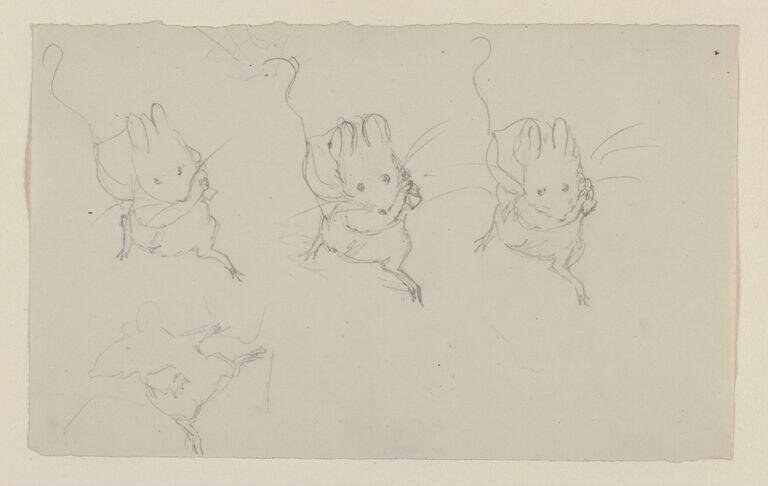
Three small anthropomorphic mice are drawn in light pencil across the upper portion of the sheet, each rendered in profile or three-quarter view facing rightward. Each mouse stands upright on hind legs with characteristic long tail curved gracefully upward. The figures wear simple garments — what appear to be short jackets or tunics — and possess the delicate proportions and expressive faces characteristic of Potter's animal illustration. The mice occupy separate positions across the width of the composition, suggesting individual poses within a choreographed sequence rather than a group formation. Below, a fourth sketch in the lower left shows a fifth mouse in a related but distinct posture. The drawing technique is spare and economical: fine pencil lines define the bodies, limbs, and facial features with minimal shading, allowing the page itself to supply the tonal ground. The sketches appear to be sequential studies, exploring variations of the same basic movement or gesture.
The dancing
Each mouse stands in an upright, anthropomorphic stance characteristic of Victorian narrative illustration. The hind legs are planted firmly while the front paws hang naturally or reach slightly outward; the postures suggest lightness and sprightliness rather than weight. The distinctive curved tails rise in elegant arcs, which in the context of dance would enhance the visual rhythm and sense of movement. The three upper figures maintain consistent proportions and pose relationships, suggesting Potter was documenting the same choreographic moment or step from different angles, or successive positions within a simple dance sequence. The sketches convey an impression of gaiety and upward energy without depicting any complex technical content.
The dance depicted
These drawings depict a children's or narrative dance of anthropomorphic animals rather than a specific historical or technical dance form. The mice appear to be engaged in a simple social or celebratory dance — a Victorian children's story illustration convention where animal characters are shown dancing to suggest festivity, joy, or a fairy-tale scene. The upright stance, the lifting of the body, and the decorative extension of the tails are all visual markers of a light, playful, non-technical choreography suitable for illustrated narrative. Potter did not intend these as documentation of human dance practice but rather as whimsical movement appropriate to her character-driven illustration work. The dance is one of convention and charm rather than technique.
How it was made
This is a graphite pencil sketch on laid paper, executed with fine, assured lines and minimal revision. The technique allowed Potter to work quickly and fluidly, capturing multiple figure studies on a single sheet — an efficient working method for illustrators preparing character poses for publication. The spare, unshaded approach is typical of preliminary illustration work and would have served as the basis for more finished drawings or for translation into print media such as wood engraving or lithography. The delicacy of the line work and the confident handling of proportion suggest this is the work of a practiced hand, drawing from habit and observation.
About this work
This sheet of pencil studies shows three (or five) anthropomorphic mice engaged in what Potter conceived as a dance — a whimsical, narrative choreography rather than a balletic or folk form. The work sits within the tradition of Victorian children's illustration in which animals are given human gestural language and posed to suggest emotion and action. Potter's approach to the dance is decorative and expressive rather than documentary: the lifted stance and rising tails create visual liveliness and convey the idea of celebration or joy. The drawing demonstrates Potter's understanding of animal anatomy and her ability to render quick, characterful figure studies — skills fundamental to her practice as an author-illustrator.
How to look at it
Observe how Potter has positioned each mouse in a standing, weight-forward posture that suggests motion rather than stasis. The curved tails are the key visual element: they rise in almost mirror-image arcs, creating a sense of uplift and rhythm across the sheet. Notice that the figures are not identical — each explores a slight variation in arm or leg position, indicating that Potter was thinking about sequence and variation, as if choreographing the moment. The sketches are studies in shorthand, conveying character and energy through minimal line: the economy of the technique is itself expressive, suggesting the quickness and lightness of the dance.
The artist
Beatrix Potter (1866–1943) was an English author, illustrator, and naturalist whose illustrated books for children, beginning with *The Tale of Peter Rabbit* (1901), became foundational texts of children's literature. She was trained as an artist and spent years observing and drawing animals with scientific precision, developing the distinctive illustration style that characterized her published works. Though best known for her naturalistic animal drawings, Potter conceived of her characters as fully realized social beings — capable of human emotion, speech, and action, including dance. This sketch demonstrates her working practice: the quick pencil studies she used to explore poses and gestures before committing them to more finished form.
The period
In the 1880s and 1890s, when Potter was developing her illustration practice, children's literature was becoming an increasingly important and prestigious literary form, and the illustrated book was the dominant medium. The Victorian anthropomorphic tradition — dressing animals in clothes and attributing them human behavior — was well established in both literature and visual art. Dance and gesture in narrative illustration served as shorthand for character and emotional state. Simultaneously, late-Victorian culture was intensely interested in movement and gesture studies, influenced by Eadweard Muybridge's photographic motion studies and by the theatrical innovations of figures like Isadora Duncan, though Potter's approach remained firmly within the illustrative rather than the documentary tradition.
Where it lives
The work is held as a drawing in a collection identified only as source VA. It is presented as a preliminary sketch or study sheet rather than a finished work intended for publication, indicating that it represents Potter's working process.
Questions about this work
Did Beatrix Potter write about dancing animals?
Not in any of her published texts that survive to prominence; however, these sketches and others like them show that she conceived of her animal characters as capable of human gesture and movement, including dance. The sketches represent the illustrator's exploratory work — visual thinking about how to render her characters in motion and action.
What kind of dance is this?
It is not a specific historical or technical dance form, but rather a narrative or illustrative dance — the kind of stylized movement that children's book illustrators used to convey joy, celebration, or festive mood. The mice appear to be engaged in a social or celebratory dance in the context of a story, not a documented or learned choreography.
Are these sketches studies for a published illustration?
Possibly, but not definitively. The sheet shows the kind of preliminary work that illustrators undertake — multiple quick studies exploring poses and gestures. Without a complete record of Potter's publication history and archive, it is difficult to say whether these particular sketches led directly to a finished illustration in one of her books.
Why are there five mice on this sheet?
The sheet appears to show variations or successive positions of the same choreographed moment or step — a common practice in figure study. Potter may have been exploring how the same pose or movement reads from different angles, or documenting a sequence of steps in a simple dance.
More dance artwork





