49 works in this view — arrow keys or swipe to move between them.
Dance in Art
Bacchanalian Dance
Cooper, Richard
- Collection:
- Source:
- Victoria and Albert Museum
- Rights:
- Rights vary by item — check the source record before reusing this image. Source record ↗
- Recorded as:
- V&A — check rights per item
Bacchanals and Dionysian subjects offer rare evidence of how 18th-century artists visualized ecstatic, non-courtly dance outside the ballroom and the theater—a counterimage to the geometric order of contemporary social dance. The print circulated widely and would have shaped how educated viewers understood classical antiquity, dance, the body, and intoxication. For historians of dance and of the body in art, it preserves a visual language of abandon and collective movement that formal dance vocabularies of the period—minuet, gavotte, rigaudon—deliberately excluded.
What you are looking at
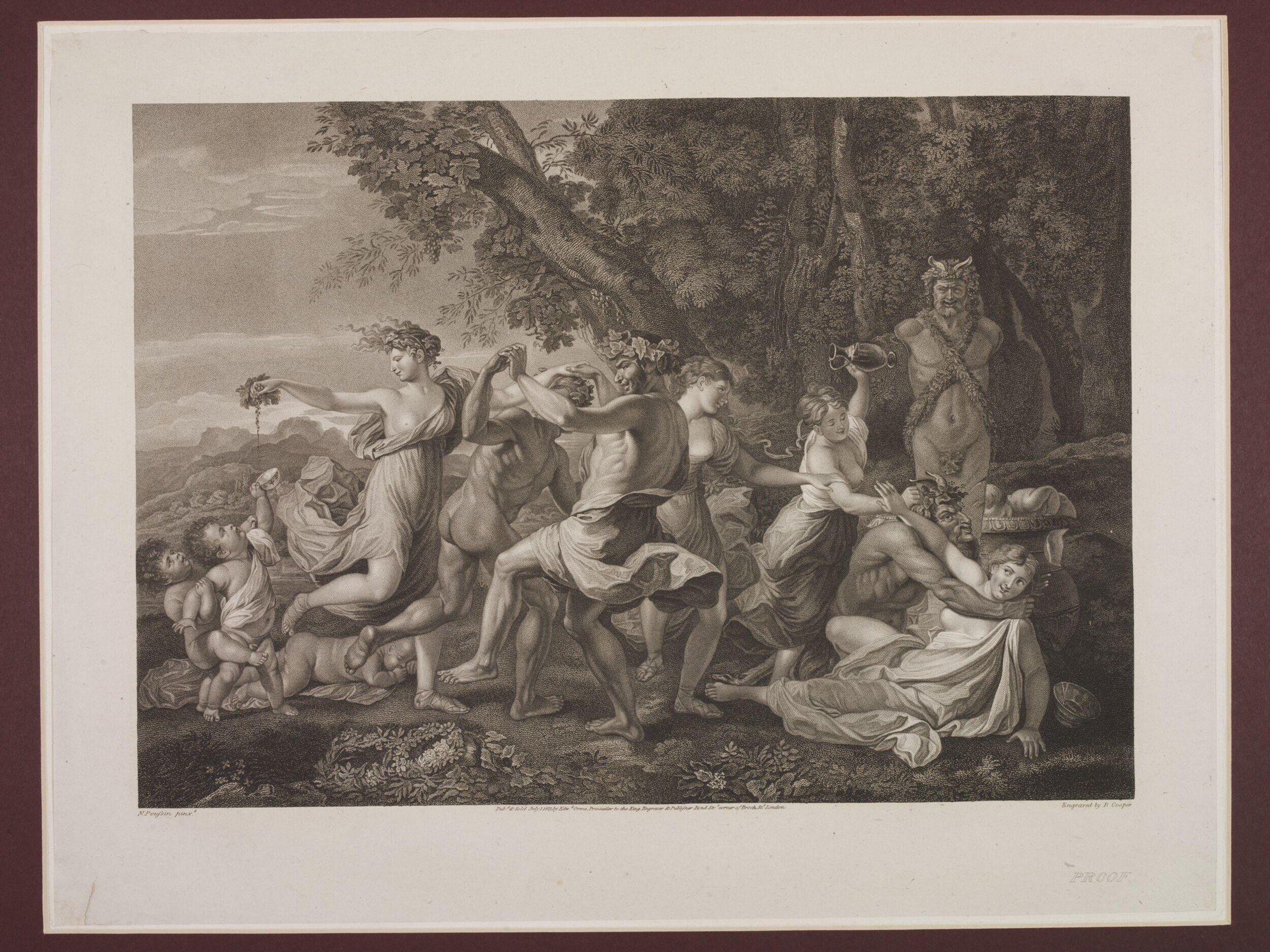
A woodland glade opens before us, densely wooded at the rear with towering trees silhouetted against a distant landscape. In the foreground and middle distance, a gathering of nude and draped female figures moves through a riotous scene of revelry. The composition is deep and layered: some figures dance or recline in the immediate foreground (right and left margins), while others cluster in animated groups toward the center and background. The lighting is soft and diffuse, suggesting late afternoon or the golden hour, which casts gentle shadows across the bodies and ground vegetation. Scattered floral garlands, wine vessels, and an overturned urn suggest abundance and intoxication. A figure crowned with ivy or vine wreath (upper right) stands elevated among the trees, presiding over the chaos. The entire scene pulses with movement—bodies twist, arms gesture expansively, some figures appear to dance while others lounge or gesture in conversation. The engraving technique has rendered every form with careful attention to musculature and drapery, creating strong contrasts between light flesh and deep shadows.
The dancing
The bodies display a vocabulary of classical antiquity: upraised arms, contrapposto stances, and flowing drapery that reveals and conceals the form. Several figures dance with arms held aloft in celebratory gestures; others are caught mid-leap or in partnered motion. The dancers' limbs are elongated and elegant, with particular attention to graceful arm extensions and the play of musculature. Weight shifts and the torsion of the torso suggest movement through space rather than static posing. Multiple figures appear to be in physical contact—dancing together, supporting one another, or gesturing in dialogue—creating a sense of collective rather than individual action. A satyr-like figure (right side, elevated) observes the scene, adding a mythological dimension to the human participants.
The dance depicted
This is a bacchanal—the riotous nocturnal revels in honor of Dionysus (Bacchus)—a subject deeply rooted in classical literature and Renaissance/Baroque artistic tradition. The dancing here is ecstatic and orgiastic rather than formal or courtly: the figures dance for pleasure and sacred intoxication, not for courtship or display. No single structured choreography is visible; instead, the image captures a moment of collective frenzy in which multiple simultaneous actions coexist. The raised arms, the abandonment of formal dress (nudity and partial drapery), and the scattered attributes of wine suggest Dionysian mystery religion and symposial revelry. The artist has chosen to freeze a peak moment of collective ecstasy, when dancers move without restraint or geometric order.
How it was made
This is an engraving, worked in fine lines with careful cross-hatching to build tone and model form. The technique allowed for wide distribution as a print, making such classical mythological imagery accessible far beyond elite patrons. Engravings of this quality and scale were prized as collector's items and as patterns for other media. The fineness of the line work and the subtle gradations of light and dark suggest a highly skilled burin, capable of rendering both the architectural solidity of the human form and the feathery delicacy of foliage and fabric. The print medium's reproducibility meant that such imagery—and the poses and compositions it contained—circulated widely and influenced visual culture across Europe.
About this work
This engraving depicts a classical bacchanal, a scene of Dionysian revels populated by nude and semi-draped female dancers in a woodland setting. Executed by Richard Cooper and dated to 1740, it belongs to a long European tradition of translating classical texts and Renaissance precedents into prints for educated collectors. The work captures a moment of ecstatic collective movement in which multiple dancers occupy the same space, some interacting with partners, others in solitary gestures of abandon. The print's refined technique and classical subject matter locate it within the taste of the Baroque and early Georgian elite—a vision of antique festivity rendered in meticulous engraved line. It is both a document of how classical dance was imagined in the 18th century and a demonstration of the engraver's skill in rendering the human form in movement.
How to look at it
Attend first to the composition's layering: the artist has created depth by placing figures at multiple distances, with the densest cluster at the center and stray figures in the foreground and background. Notice how the bodies move in different directions and at different rhythms—no uniform line or geometric formation constrains them. Look closely at the arms: they are raised, extended, gesturally varied in a way that contrasts sharply with the contained, formal arm positions of contemporary ballroom dance. The engraver has also taken care to show weight—bodies leaning, one leg bearing load while the other extends—so that despite the print's static medium, a sense of dynamic balance and momentum is preserved. Finally, observe the satyr or faun figure at upper right: its presence among the dancers insists on the scene's status as pagan ritual, not Christian propriety.
The artist
Richard Cooper (1701–1764) was a Scottish engraver and draughtsman working primarily in London, known for reproductive engravings of classical and contemporary subjects. He worked in the tradition of continental engravers and produced both original compositions and copies of paintings. His practice centered on classical mythology and history, rendering these subjects in the refined linear style of mid-18th-century printmaking. Cooper's engravings were aimed at the cultivated collector and served as a major vehicle for the dissemination of classical imagery during the Georgian period.
The period
In 1740, formal social dance in Europe was governed by strict codes of geometry and decorum. The minuet dominated fashionable ballrooms; the gavotte and rigaudon were structured courtly forms. The bacchanal as a subject, by contrast, represented an imagined realm of classical antiquity in which the body could move freely, collectively, and without restraint. Printmakers and painters of the 17th and 18th centuries drew heavily on classical texts (Ovid, Euripides) and Renaissance precedents (Titian, Mantegna) in depicting such scenes. These images offered an implicit critique of contemporary propriety—a vision of dance as ecstasy rather than etiquette. The engraving's circulation among collectors made such classical alternatives to ballroom practice visible and thinkable, even if not danced.
Where it lives
The work is held as a print in a collection marked 'va' in the source record, indicating an American institutional holding. Engravings of this type typically exist in multiple impressions and are often dispersed across museums and private collections. The print's original purpose was reproductive circulation among educated collectors and connoisseurs.
Dance in this work
Questions about this work
Is this a real dance or an imagined scene?
This is an imagined classical bacchanal—a scene from ancient ritual and literature, not a contemporary social dance of 1740. However, it reveals what the engraver and his audience thought classical dancing looked like and valued about it: freedom of the body, collective movement, and ecstatic abandon. No one in the 18th century actually danced a bacchanal; instead, such images offered an alternative vision of what dance could be.
Who were these dancers?
In classical mythology, maenads or bacchantes—female followers of Dionysus—danced in his nocturnal revels. The figures here are imagined as such participants, though rendered in the aesthetic idiom of 18th-century European art rather than with historical accuracy. Some figures may represent nymphs or other mythological attendants.
How does this compare to the dances people actually danced in 1740?
Ballroom dances of the 1740s—minuets, gavottes, rigaudons—were highly structured, geometric, and restrained. The bacchanal offered the opposite: freedom, passion, collective rather than individual or paired movement. The stark contrast tells us that the 18th-century imagination valued order and propriety in lived social dance, but remained fascinated by visions of unrestrained ecstasy.
Why did engravers keep making pictures of bacchanalian scenes?
Bacchanals allowed artists and patrons to explore the body, sexuality, intoxication, and collective emotion through the safe distance of classical antiquity. Such scenes also demonstrated the engraver's technical skill—rendering multiple moving bodies, complex drapery, and atmospheric depth required mastery. Finally, the subject aligned with broader 18th-century fascination with classical culture and the pastoral ideal.
More dance artwork





