49 works in this view — arrow keys or swipe to move between them.
Dance in Art
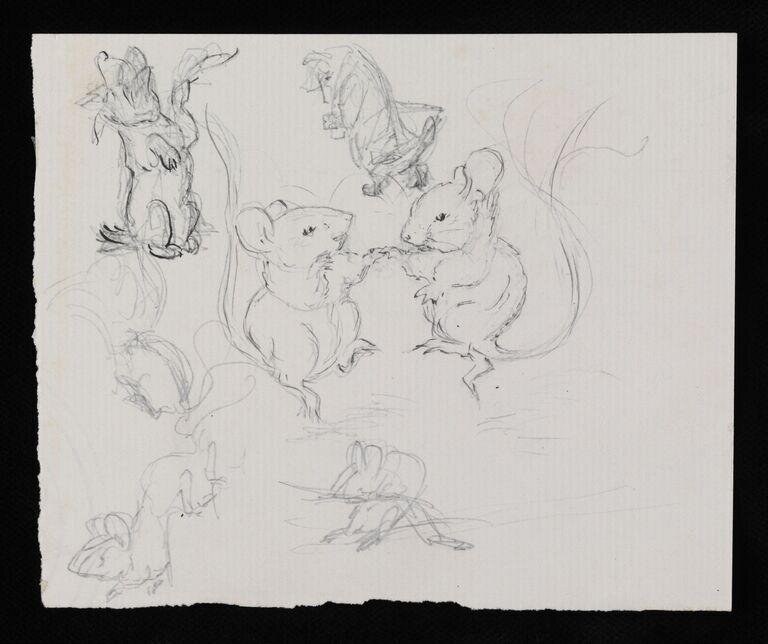
Mice dancing and two studies of dogs
Beatrix Potter
- Collection:
- drawing
- Source:
- Victoria and Albert Museum
- Rights:
- Rights vary by item — check the source record before reusing this image. Source record ↗
- Recorded as:
- V&A — check rights per item
This work documents the practice of a major children's illustrator and naturalist at a moment when the two disciplines—fine art and natural history—were still interwoven. It shows Potter as a student of movement and behavior, trained to see the drama in small creatures. For historians of dance, it is a reminder that the study of human movement has always been inseparable from the study of animal motion—and that artists have long used symmetry, facing, and mirrored gesture as a visual language for social interaction.
What you are looking at
A lively sketch page from the hand of Beatrix Potter showing multiple mice and dogs in animated poses. The composition is crowded and playful: at upper left, a mouse stands upright on hind legs with front paws raised high, mouth open. Center stage, two round-bodied mice face each other in what reads as a social encounter or dance, their postures mirroring each other. A third mouse on the right echoes the same stance. Below, two studies of dogs—one crouching or stalking with lowered head, the other in profile—interrupt the rodent revels. The paper is lightly gridded and shows the characteristic quick, assured pen line of a naturalist's study. The figures are rendered with animation and humor; Potter has caught a sense of movement and personality in every body, from the mice's perky alertness to the dogs' working tension.
The dancing
The mice are drawn in profile and three-quarter view, standing upright on hind legs with front paws lifted and held close to the body—a posture that reads as both alert and interactive. Their round proportions and small feet suggest young creatures. The two central mice are arranged symmetrically, facing each other at close distance with matching arm positions, which creates a mirror-dance effect. The dogs are rendered in the contracted, ready postures of working animals—lowered center of gravity, heads down, suggesting movement or intention rather than display.
The dance depicted
This is not a depiction of human dance, but of animal behavior observed and rendered with the eye of someone trained in natural history illustration. The mice's upright postures and mirrored facing arrangement suggest social play or courtship display—behaviors Potter would have known from keeping and studying small animals closely. The symmetry and apparent mutual regard between the two central mice create a visual echo of ballroom dancing (two figures in proximity, mirroring each other), but the dance here is genuinely rodent: a naturalist's record of animal interaction, not a human form translated to mice.
How it was made
Ink pen on gridded paper, executed with the rapid, confident line-work of a naturalist's field study or preparatory sketch. The grid suggests the page may have been used for compositional planning or transfer to another medium. Potter's technique here is typical of late-19th-century natural history illustration: economical, precise enough to convey anatomy and personality, but loose enough to capture movement and spontaneity. The page shows multiple studies of the same or related subjects, a working method common in both scientific illustration and fine art training of the period.
About this work
Beatrix Potter's sketch page presents an animal study disguised as a dance: mice and dogs in motion, rendered with the trained eye of a naturalist and the wit of an artist who saw personality and drama in the creatures she kept and observed. Potter is celebrated for her watercolored picture books, but this pen sketch reveals the working practice underneath—the constant observation, the quick notation of posture and gesture, the hunt for the telling moment. The mice, standing and facing each other in symmetrical poses, invite comparison to human social dance, but the work is fundamentally about animal behavior: Potter recording what she saw in her own menagerie. The page belongs in a gallery about dance not because it depicts human choreography, but because it captures the visual grammar of encounter and display—the mirrored postures, the mutual regard, the sense of a moment held between two creatures—that underlies all movement between bodies, animal or human.
How to look at it
Note the mirrored postures of the two central mice: both stand upright, both have raised front paws held at similar angles, both face each other at close distance. This symmetry is not accident—it is the artist's choice to emphasize the social and interactive quality of the moment. Watch how Potter has caught the energy in the dogs' lowered postures: they are not resting but tensed, ready, engaged with something outside the frame. The sketchy line and the repetition of figures (studies of the same mouse or dog from slightly different angles) reveal this as working paper, a place to think through movement and form. Potter is not performing naturalism here; she is practicing observation, trying out poses, learning how bodies arrange themselves in space.
The artist
Beatrix Potter (1866–1943) was a naturalist, illustrator, and author trained in scientific drawing and watercolor during the Victorian era. She kept a menagerie of small animals—mice, rabbits, hedgehogs, frogs—and drew them constantly from life, developing the precision and personality that would define her picture books. Her practice was rooted in natural history illustration, then a respected discipline requiring anatomical knowledge and patient observation. She submitted her scientific work to the Linnean Society and maintained correspondence with naturalists throughout her career. This sketch page is typical of her working method: rapid studies in pen, often on gridded paper, made from direct observation and used as reference for later finished works.
The period
In 1890, when this sketch was likely made, the worlds of fine art and natural history illustration were undergoing separation. Academic training still emphasized drawing from nature and from living models; the human figure was studied alongside animal anatomy. Dance itself was undergoing codification and professionalization—ballet was being formalized in Russia, and ballroom dancing was becoming a standardized social practice. Potter's sketch sits at the intersection: it uses the language of ballroom encounter (symmetry, facing, mutual regard) to describe animal behavior, suggesting that the visual grammar of social dance was so pervasive that it offered a natural template for depicting any two-bodied interaction. The grid on the paper reflects the geometric precision valued in both scientific illustration and academic drawing of the period.
Where it lives
The work is held as a drawing in the Victoria and Albert Museum collection (noted as 'va' in the source field). It is part of the rich archival material documenting Potter's practice across natural history, scientific illustration, and children's book art.
Questions about this work
Is this a scene from one of Beatrix Potter's books?
No. This is a working sketch, likely made from life observation of animals in Potter's own care. While the mice and dogs eventually appeared in her published picture books, this page shows the research and study that preceded those finished works—the artist's private, working method rather than her published art.
Why is this in a dance gallery if it shows animals, not dancers?
The mirrored postures and facing arrangement of the two central mice echo the visual grammar of ballroom dance—symmetry, proximity, mutual regard. More broadly, the page documents how artists have always used the language of social dance to describe encounter and interaction. It reminds us that dance is a language for depicting any movement between bodies.
What is the grid on the paper for?
The grid likely served as a compositional aid or a guide for transferring the sketch to another medium—a common practice in illustration and fine art of the period. It may also simply be the texture of the paper itself.
More dance artwork





