49 works in this view — arrow keys or swipe to move between them.
Dance in Art
The Dance at the Inn
Ostade, Adriaen van
- Collection:
- Source:
- Victoria and Albert Museum
- Rights:
- Rights vary by item — check the source record before reusing this image. Source record ↗
- Recorded as:
- V&A — check rights per item
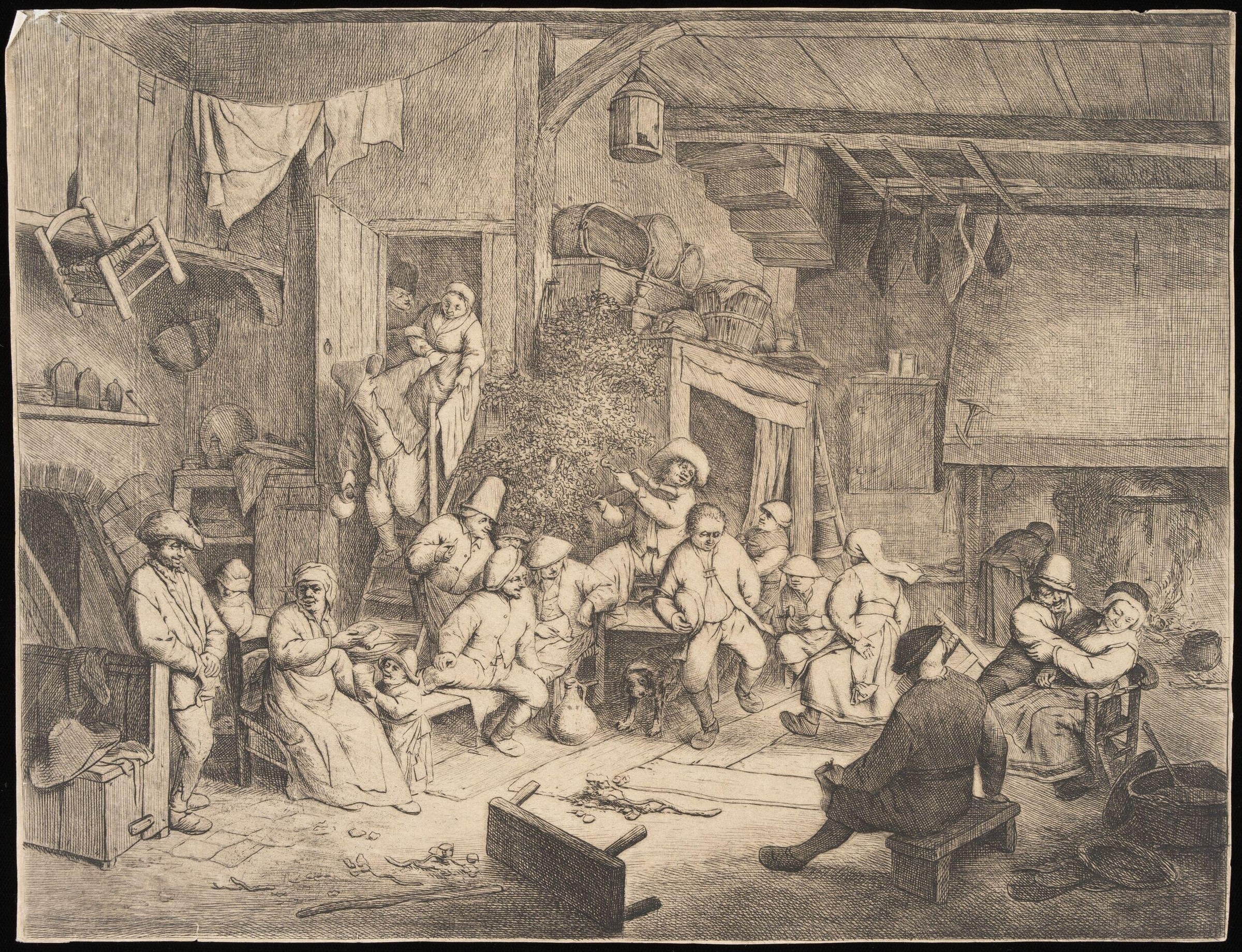
This image is evidence of how ordinary people danced in early modern northern Europe, when dance was not a staged performance but a spontaneous, integral part of village life. It shows us that the history of dance is not only the history of technique or choreographed forms, but also of social gesture, communal release, and the body in celebration.
What you are looking at
A crowded peasant interior animated with dancing figures of various ages. The setting is a modest room or inn with timber beams and a low ceiling, lit by a single lantern that casts long shadows across the stone floor. A rustic table sits in the foreground, and figures cluster in loose groups throughout the space—some dancing with energetic postures, others sitting and watching, eating, or engaged in conversation. The composition is dense and chaotic, alive with simultaneous actions: children frolic underfoot, adults gesture broadly, a figure in the doorway at the far left raises one arm, and in the middle distance a dancer kicks or jumps with exuberant abandon. The engraving is rendered in fine parallel hatching that creates deep blacks in the shadows and an almost tavern-like gloom punctuated by lighter flesh tones. Clothing is simple and practical—breeches, simple gowns, caps—suggesting rural working people rather than nobility.
The dancing
The dancers show loose, unselfconscious postures rather than formal technique. One central figure appears to jump or kick with a leg extended high; others stand with knees slightly bent and hips loose, arms lifted or gesticulating. The hold is entirely absent—this is solo or semi-solo movement within a social crowd rather than partnered dance. The figures range from toddlers to adults, and their movement quality varies from exuberant to merely swaying or stamping. The energy is expressed through the torso and legs rather than through upper-body frame or arm styling.
The dance depicted
This appears to be peasant village dancing of the Flemish Low Countries in the 16th or 17th century—the type of unstructured social dancing that took place at inns, village feasts, and celebrations among rural working people. The participants are not executing any named court dance or formal step sequence but rather moving to music in a celebratory, uninhibited manner. The setting, dress, and composition all point to folk or popular dance rather than theatrical or courtly performance. No specific dance style is identifiable from the movement vocabulary; rather, the image documents the social context and temperament of communal village celebration.
How it was made
This is an engraving (identifiable from the fine hatching technique and the characteristic line work typical of 16th–17th century printmaking). The artist has used dense parallel lines and cross-hatching to create volume and shadow, a time-intensive process that implies this was a work of some labour and intended for circulation among educated viewers who could afford prints. The medium allowed for the capture of narrative detail and social observation that would have been difficult in rapid sketch form, and the print format allowed multiple copies to reach an audience beyond the artist's immediate circle.
About this work
This engraving depicts an interior village dance or alehouse scene from the Northern Renaissance or early modern period. It is a document of popular celebration and communal joy among rural people, rendered with the observational precision and satirical wit characteristic of Adriaen van Ostade's practice. The work belongs in a dance history collection not because it depicts a recognisable dance form, but because it captures the lived context of popular dance—the social occasion, the body language of uninhibited movement, the generational mixing, and the link between dance and communal eating and drinking.
How to look at it
Attend to the range of body sizes and ages, from toddlers to elderly figures, all moving within the same celebratory space. Notice how the artist has frozen a moment of movement—feet planted, weight shifting, arms raised—that conveys momentum and energy even in still form. Observe how the artist uses shadow and light not to highlight individual dancers but to create an atmosphere of crowded, dimly lit conviviality. The composition pulls the eye across multiple simultaneous actions, inviting the viewer to read the scene as a whole rather than focusing on any single performer.
The artist
Adriaen van Ostade (1610–1684) was a Flemish painter and printmaker from Haarlem known for his genre scenes of rural and peasant life. He specialised in depicting the domestic interiors, celebrations, and everyday moments of ordinary people—farm workers, drinkers at inns, musicians, and dancers. His work combined careful observation of human behaviour with a gentle, sometimes satirical tone. He was prolific as both painter and engraver, and his prints circulated widely across northern Europe, making his images of peasant life influential visual documents of the period.
The period
In the 16th and 17th centuries, social dance among rural and urban working people was vigorous and unrestricted by courtly convention, often associated with seasonal celebrations, feast days, and informal gatherings at inns and taverns. Simultaneously, the courts of northern Europe were developing formalised dance vocabularies inherited from Italy and adapted for aristocratic display. Van Ostade's contemporaries included other Flemish painters documenting peasant life (Pieter Bruegel and his circle), but Van Ostade's prints reached a broader audience and often conveyed a more intimate, less moralising view of rural celebration. The 17th-century print market was hungry for images of 'low life' that satisfied urban curiosity about rural customs.
Where it lives
The record identifies this as a print held in a collection marked 'va' (indicating the source but not specifying the holding institution). The catalogue record is sparse, offering only the title and artist attribution without date, edition information, or technical specification, suggesting the work may not have been recently examined or catalogued in detail.
Dance in this work
Questions about this work
Is this a real event or an imaginary scene?
Van Ostade worked from observation of actual rural life in the Dutch Golden Age, but he composed scenes that were typical rather than specific—this represents the kind of celebration that regularly occurred in village inns and feast settings, not a particular documented event.
What kind of music would have accompanied this dancing?
The image does not clearly show musicians, though the dense crowd suggests music was present. Village dances of this period were typically accompanied by bagpipes, fiddles, drums, or pipes—instruments played by travelling musicians or local practitioners.
Is this a formal dance?
No. This is social or vernacular dance—movement for celebration and socialising rather than performance or technique. The participants show no training in courtly dance vocabularies and no formal partnering.
Why did Van Ostade paint peasants dancing?
Van Ostade was fascinated by the texture of ordinary life. Genre scenes of peasant activity—including dance and celebration—were popular subjects in 17th-century Flemish art, appealing to urban educated audiences curious about rural customs and attracted to the apparent authenticity and vitality of peasant celebration.
More dance artwork





