49 works in this view — arrow keys or swipe to move between them.
Dance in Art
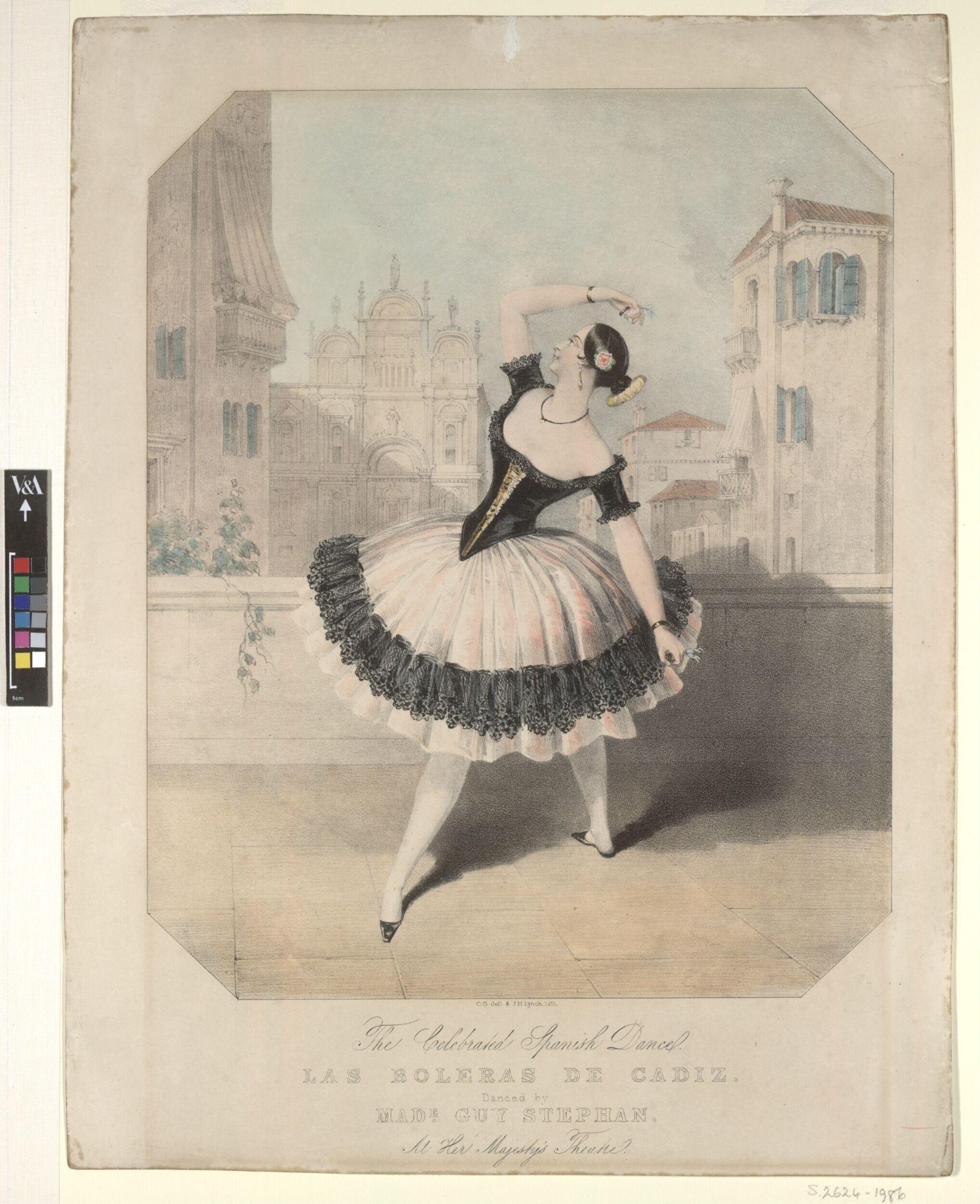
The Celebrated Spanish Dance Las Boleras de Cadiz danced by Marie Guy Stephan
Graf, C.
- Collection:
- Source:
- Victoria and Albert Museum
- Rights:
- Rights vary by item — check the source record before reusing this image. Source record ↗
- Recorded as:
- V&A — check rights per item
Boleras were among the most prestigious dances of the Romantic era, performed across European capitals and considered a test of a dancer's technical and expressive range. This print preserves the appearance of the dance and the costume as a European audience saw it—crucial evidence for how Spanish cultural material was absorbed and transformed by concert stages far from Spain. Marie Guy Stephan was a significant international performer whose name has otherwise been largely forgotten; the print is one of the main records of her career.
What you are looking at
A young woman in theatrical costume stands alone on a sunlit plaza, captured mid-performance in a pose of theatrical abandon. She wears a black velvet off-shoulder bodice with short puffed sleeves and a voluminous white tulle skirt with a deep black lace underskirt, the hem caught dramatically in motion. Her dark hair is styled close to her head with a small ornament, and she gazes upward with one arm raised, the other bent across her body. Behind her, an Italian Renaissance cathedral dominates the composition—a grand façade with a central dome and ornamental windows rendered in pale wash—while Renaissance buildings frame the plaza on either side. The setting suggests Venice or another Italian city. The print is hand-colored, with soft watercolor tones: pale blue sky, warm cream walls, subtle pink in the skirt, and deep shadows establishing the architectural recession. The composition emphasizes the solitary dancer against monumental architecture, creating a sense of theatrical spectacle within an urban landscape.
The dancing
The dancer's body is turned three-quarters to the viewer, weight shifted to one leg as the torso lifts and twists upward. Her raised arm extends toward the sky in an expressive, almost ecstatic gesture; the opposite arm curves inward toward her torso. The pose suggests a moment of suspension—neither purely on the ground nor airborne, but captured in the dynamic instant between steps. The elongated limbs, lifted arch of the visible foot, and the tilt of the head convey control and training. The costume—a short tulle skirt with heavy lace trim—allows full visibility of the legs and the mechanics of the movement.
The dance depicted
This is Las Boleras de Cádiz, a Spanish dance form from the early nineteenth century, danced here by the celebrated performer Marie Guy Stephan. The boleras were theatrical Spanish dances, usually performed solo or in pairs, that combined rapid footwork with expressive arm and torso work and were popular across European concert stages. The pose captures the characteristic blend of technical precision and emotional display that made boleras famous—the upward reach and open-chested posture suggest the proud, passionate bearing of the style. The costume, while not authentically Spanish folk dress, was the standard theatrical version worn by European concert performers of Spanish material in the 1840s. The dance was a vehicle for virtuosity and personality; a single performer could carry an entire scene.
How it was made
This is a hand-colored lithograph or engraving, printed with a pale tint stone and then individually colored with watercolor or gouache. The technique allowed for soft modeling of light and shadow—note how the architectural background recedes through gradations of wash—while preserving the precision of the drawn line in the figure and the fine detail of the lace. The hand-coloring gives the print an intimate, precious quality; each copy would have been individually tinted, making this a semi-handmade object despite mechanical reproduction. This was the standard luxury print format for theatrical portraiture in the 1840s, affordable enough for middle-class collectors but costly enough to suggest a well-known performer.
About this work
This is a theatrical portrait of the Spanish dancer Marie Guy Stephan performing one of the dances that made her famous across Europe: the boleras of Cádiz. Created around 1844, it documents not only the costume and pose of the dance but also the theatrical context of 1840s concert performance—the emphasis on the individual virtuoso, the romantic idealization of Spanish culture, and the print trade's role in making celebrity dancers known to audiences who would never see them perform. The image sits at the intersection of dance documentation, theatrical portraiture, and popular print culture. It is both a record of a specific performer and a type of work that would have circulated widely, shaping how people understood Spanish dance.
How to look at it
Attend to the moment the artist has chosen: not the height of a jump or the climax of a turn, but a moment of emotional expression and architectural balance—the dancer framed against the cathedral, her body creating a vertical line that echoes and competes with the building's dome. This is a compositional choice, not a documentary one; it tells us that the print was meant to convey the dancer's presence and significance within a scene, not merely to record steps. The raised gaze and open posture create a narrative of pride, exultation, or yearning—emotional content that was as much a part of boleras as the footwork. Notice also the rendering of the tulle and lace: the artist has taken care to show the weight and movement of the fabric, and the contrast between the delicate white tulle and the heavy black lace suggests both the visual spectacle and the technical precision required.
The artist
C. Graf was a lithographic artist active in the 1840s, part of the large European trade in theatrical portraiture and genre prints. Theatrical prints of celebrated performers were a major commercial product, and artists like Graf worked from live performances, costume sketches, or (more often) from descriptions and existing prints, adapting and refining the image for the print trade. Graf's name appears on numerous theatrical prints of the period, suggesting he was a prolific commercial artist rather than an independent creative figure—but his competence in rendering fabric, light, and the human figure in motion is evident.
The period
In the 1840s, Spanish dance was fashionable across European concert halls and ballrooms, part of a broader Romantic fascination with exotic and folk cultures. The boleras, seguidillas, and other Spanish dances were performed by both Spanish and European dancers; the style was codified into a theatrical genre with its own vocabulary of steps, arm positions, and emotional expression. At the same time, theatrical portraiture was at its height as a popular art form—colored lithographs of celebrated singers, dancers, and actors were collected like photographs or posters, serving as both souvenirs and advertisements. The theatrical portrait print was a major business, and dancers and singers of note could expect to see themselves in multiple versions circulating across Europe.
Where it lives
The work is held in a print collection (source listed as 'va'—likely the Victoria & Albert Museum), where it is catalogued as a theatrical portrait from the mid-nineteenth century. It is one of thousands of similar colored prints produced and circulated during this period, and its survival in a museum collection suggests it was considered noteworthy enough to preserve—either because of the dancer's fame or because the print itself was recognized as a fine example of the medium.
Dance in this work
Questions about this work
Was Marie Guy Stephan Spanish?
The record does not specify her nationality, but her professional name and the fact that she was celebrated for Spanish dances suggest she may have been European or possibly Spanish. The 'Guy Stephan' surname suggests French or European connections. Performers of Spanish material in the 1840s were not necessarily Spanish; there was a considerable European trade in these dances, and European dancers often became known for Spanish specialties.
What are boleras exactly?
Boleras are a Spanish theatrical dance style characterized by rapid footwork (especially zapateado, or rhythmic foot-striking), expressive arm and hand movements, and dramatic torso work. They were performed to guitar music or castanets and were traditionally social dances but became concert pieces in the nineteenth century. The boleras of Cádiz were a specific regional variant and were considered especially prestigious.
Why is she posing against a cathedral?
The architectural setting is partly a romantic convention of theatrical portraiture—creating an elegant, culturally specific backdrop. But it also places the dancer within a narrative of place and travel. European audiences were fascinated by Spanish culture, and the cathedral grounds the dance in a sense of authentic location and prestige. It is a compositional device that elevates both the performer and the dance.
How common were prints like this?
Very common. Colored lithographic prints of theatrical performers were a major popular art form in the nineteenth century, especially from the 1830s onward. They were affordable enough for middle-class collectors (cheaper than paintings or sculptures) but expensive enough to be treasured, and they circulated widely as souvenirs, advertisements, and collected series. This particular print has survived because it was preserved in an institutional collection.
More dance artwork





