49 works in this view — arrow keys or swipe to move between them.
Dance in Art
Dances with Michael No. 60
Ginsborg, Michael
- Collection:
- Drawing
- Source:
- Victoria and Albert Museum
- Rights:
- Rights vary by item — check the source record before reusing this image. Source record ↗
- Recorded as:
- V&A — check rights per item
For historians of contemporary dance and visual art, this work documents the influence of dance thinking on abstract visual practice in the early 2000s. It represents a moment when artists were increasingly interested in translating bodily knowledge—the felt sense of moving, relating, and timing—into visual languages that do not depend on figuration or representation.
What you are looking at
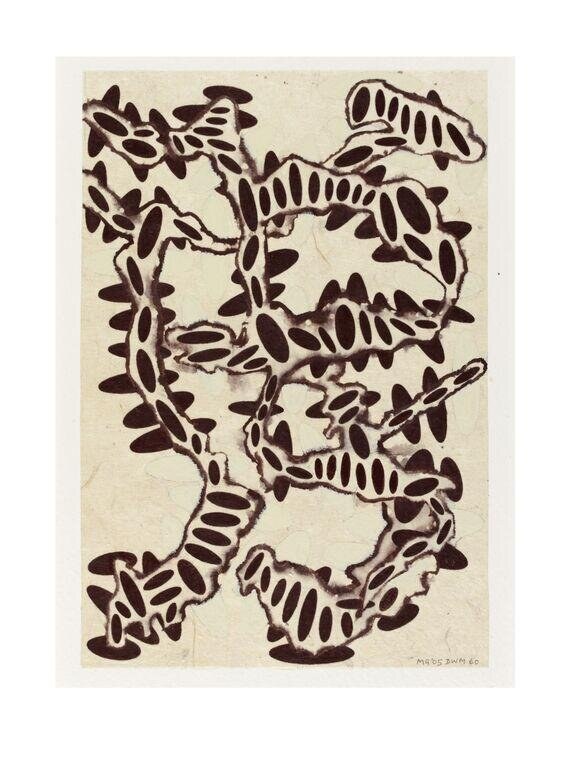
This is an abstract compositional study rendered in bold, dark brown lines on cream paper. The work fills the rectangular frame with interlocking organic forms that read as simplified, schematic representations of human figures or bodies in motion. The forms cascade vertically down the page in a roughly symmetrical arrangement, each composed of curved and angular segments—some resembling torsos, limbs, or heads—overlapping and interpenetrating in a flattened, almost mosaic-like structure. The repetition of similar leaf- or petal-like shapes creates a rhythmic visual pattern that suggests movement, multiplicity, and perhaps the superimposition of sequential gestures. There is no perspective, no ground line, no narrative setting: the work exists as pure formal investigation into the language of abstraction and bodily form.
The dancing
The individual units are difficult to isolate, but each appears to contain torso-like elements with appendages suggesting arms and legs in varied positions. The gestures are not legible as specific dance positions—there is no recognisable hold, frame, or alignment. Instead, the artist has prioritised an almost cubist or futurist decomposition of the figure, breaking bodies into component shapes and allowing them to exist in mutual relationship through overlap and juxtaposition rather than through coherent spatial logic. This is a choreography of abstraction rather than of bodies.
The dance depicted
If this work depicts dance at all, it is not representational dance. The title 'Dances with Michael No. 60' suggests a series or serial exploration, and the repeated, interlocking forms might evoke the idea of multiple dancers or multiple moments of a single body in motion—the photographic or artistic study of movement that was central to modernist experimentation in the early 2000s. However, the work is so abstracted that specific identification is impossible. It could represent an experiment in translating kinetic energy or bodily relationship into pure form, without allegiance to any particular dance genre or style.
How it was made
This is a drawing executed in ink or a similar dark medium on paper, using linear mark-making exclusively. The technique is reductive: the artist has chosen to suggest bodily form through outline and silhouette only, with no modeling, shading, or spatial depth. This approach—spare, graphic, and highly stylised—suggests work meant for exhibition or publication rather than preliminary study. The boldness and clarity of the line work, combined with the formal abstraction, places this in the lineage of early-to-mid twentieth-century modernism, though the signature and date of 2005 locate it in contemporary practice.
About this work
This is a work from a numbered series titled 'Dances with Michael' by the artist Michael Ginsborg, executed in 2005. Rather than representing dance in the conventional sense—recognisable bodies, identifiable styles, or narrative content—it abstracts the concept of dance into a purely compositional study. The work investigates how the idea of 'dancing' (multiplicity, rhythm, momentum, interrelation of bodies) can be expressed through non-representational form. It belongs in a gallery devoted to dance not because it shows us how people dance, but because it uses dance as a conceptual starting point for formal exploration.
This approach is consistent with late twentieth and early twenty-first century artistic practice, where dance has increasingly been used as a model for abstraction, kineticism, and the investigation of time and sequence within the static image. The series format suggests ongoing investigation and variation—the title 'No. 60' implies that this is one in a substantial body of work concerned with the same problem.
How to look at it
Look for the repeated unit—the basic form that the artist has built into a composition through variation and accumulation. Notice how the eye moves through the work: does it track downward? Does it find certain forms easier to read than others? Consider whether the overlapping creates a sense of spatial depth or remains resolutely flat. The work asks you to see abstraction as a kind of movement: what are the paths and rhythms available to your eye as you scan the surface?
The artist
Michael Ginsborg is a British artist and theorist working primarily in drawing, painting, and performance. His practice is grounded in sustained formal investigation and often engages with systems, geometry, and the relationship between the moving body and visual representation. The 'Dances with Michael' series suggests a collaborative or durational project exploring the intersection of choreography and visual notation, characteristic of experimental practice at the intersection of dance and contemporary art.
The period
In the early 2000s, dance was an increasingly visible reference point for visual artists interested in abstraction, temporality, and process. The influence of post-Cunningham choreography—which had severed the link between movement and narrative—made dance a model for investigating pure form and rhythm. Simultaneously, notation systems (Labanotation, Benesh notation, and experimental graphic scores) were influencing visual artists. This work sits within that context: it uses the visual language of abstraction to engage with problems that are fundamentally choreographic.
Where it lives
The work is held in a collection identified in the source record as 'va' (likely an abbreviation for an institutional holding), catalogued as a drawing. The series designation ('No. 60') and signature suggest the artist maintains a systematic record of the work.
Questions about this work
Is this actually a depiction of dance?
Not in the conventional sense. It is an abstraction derived from or inspired by ideas about dance—multiplicity, rhythm, bodily relation—translated into pure form. The title signals that dance is the conceptual starting point, even if recognisable dancers or movements do not appear.
What does 'Dances with Michael No. 60' mean?
The title suggests a series of works, probably created over time, numbered sequentially. 'Dances with Michael' might indicate a collaborative or durational project with the artist himself (Michael), or a series of investigations inspired by or developed with a dancer named Michael. The numbering emphasises that this is part of an extended inquiry.
How should I approach looking at abstract work in a dance gallery?
Rather than looking for recognisable movement or dancers, ask what aspects of dance—rhythm, accumulation, relation, timing, momentum—the visual language expresses. Abstract works in a dance collection often use the vocabulary of choreography (repetition, variation, accumulation) applied to visual form.
More dance artwork





