49 works in this view — arrow keys or swipe to move between them.
Dance in Art
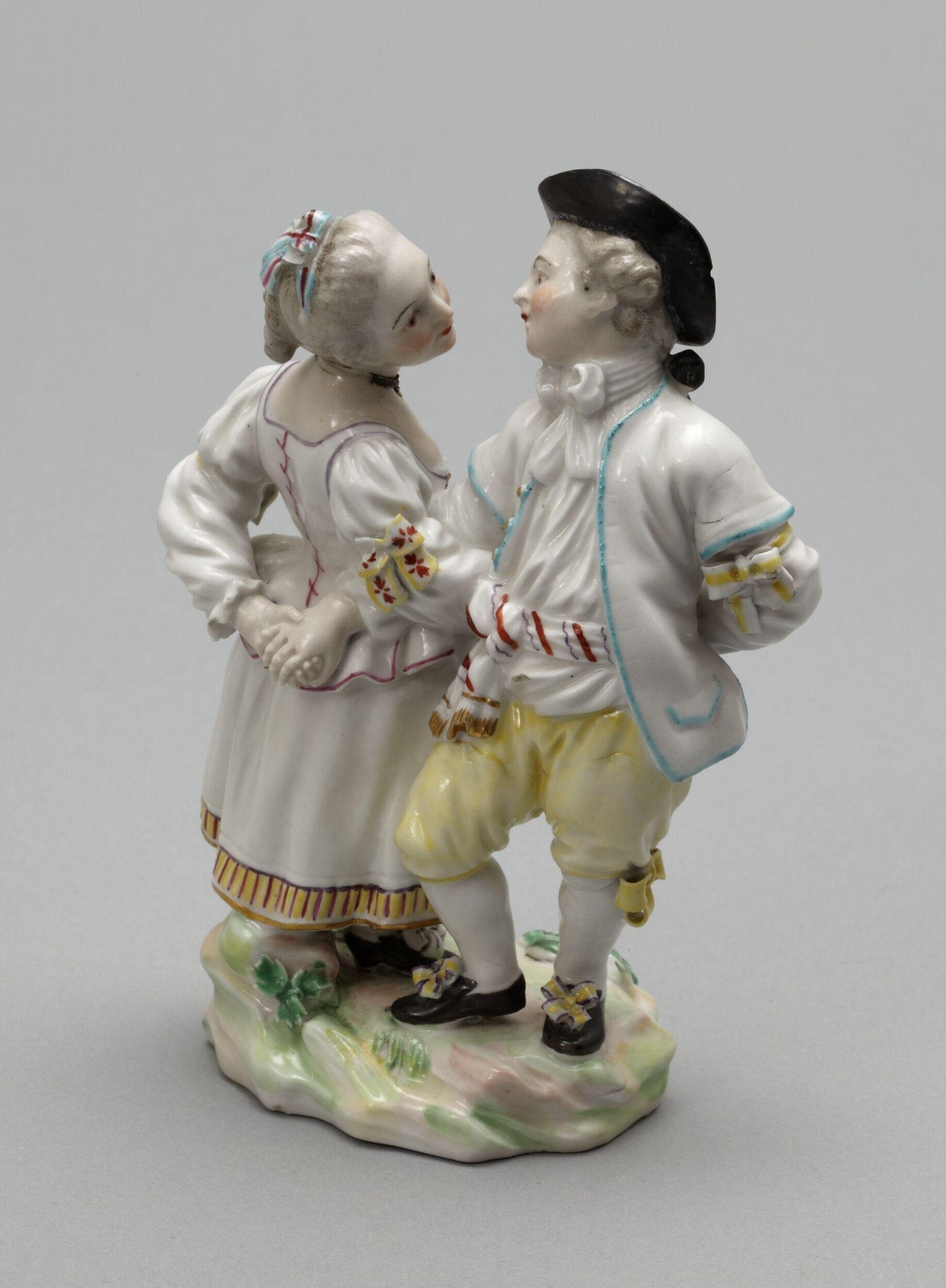
Boy and girl dancing a reel
William Duesbury & Co.
- Collection:
- Figure group
- Source:
- Victoria and Albert Museum
- Rights:
- Rights vary by item — check the source record before reusing this image. Source record ↗
- Recorded as:
- V&A — check rights per item
This is rare evidence of how the reel was understood and represented by makers of luxury goods in the late eighteenth century. The porcelain figure group shows not the technical execution of the dance but its social meaning — as a context for courtship, for the display of fashionable dress and deportment, and for the negotiation of social rank among young people. For historians of both dance and material culture, it documents the Scottish reel at the moment of its greatest fashionable reach in England.
What you are looking at
Two young dancers in eighteenth-century dress stand on a rocky ground studded with pale green foliage, posed in the moment of social dance. The figure on the left, a girl, wears a white linen shift dress with a yellow hem band and delicate coloured embroidery in red and blue; her hair is powdered and gathered up with a small bow. The boy on the right wears a white linen shirt and yellow breeches, trimmed in contrasting colours, with a black cap and his hair in a queue. Both are rendered in glazed porcelain with fine painted detail. Their bodies face each other at an angle, weight distributed evenly, in the upright posture characteristic of formal social dancing of the period. The composition captures a moment of mutual attention and courtship, the figures at the threshold of a dance step rather than caught mid-movement.
The dancing
Both dancers maintain an upright, composed frame typical of eighteenth-century ballroom etiquette. The boy's right arm is extended toward the girl; the girl's posture is open and engaged. Neither figure shows the extended limbs or turned-out positions of theatrical dance — this is social dancing between peers, where control and deportment matter more than extension. The relative scale and positioning suggest a formal approach, with space maintained between the bodies rather than a close hold.
The dance depicted
The title identifies this as a reel, a Scottish country dance popular in the eighteenth century among all social classes. The upright posture, formal dress, and the absence of energetic footwork or bending knees are consistent with the reel as a social dance of the period, performed in small sets or couples. The porcelain medium and the carefully composed moment suggest this is a portrait of fashionable leisure rather than a captured action — the dance is identified by the title and the dancers' dress, not by visible technical features. The reel was danced to bagpipes or fiddle in Scotland and had spread to fashionable circles across Britain and Europe by this date.
How it was made
This is a hard-paste porcelain figure group, likely from the Duesbury manufactory, which specialized in refined domestic ornaments for the English market. The white ground allows the painted detail — the embroidery, coloured trims, and flesh tones — to read with clarity. The glaze creates a polished, almost jewel-like surface. Such pieces were expensive and displayed on mantels or in cabinets, functioning as both aesthetic objects and demonstrations of knowledge of fashionable culture. The smooth, idealized finish is characteristic of porcelain, which could render the fine detail of eighteenth-century dress and deportment in a way that painting alone could not.
About this work
This is a porcelain figure group representing two young people in the moment before or during a reel, a popular Scottish country dance that had become part of fashionable social dancing across Britain by the 1770s. Duesbury and his Derby manufactory produced such groups for the domestic market, capturing scenes of courtship, leisure, and polite society. The piece is both a record of how the reel was danced — in formal dress, with composed bodies and maintained distance — and a document of what counted as fashionable knowledge and taste in the late eighteenth century. The reel itself was a vigorous, turning dance, but this image shows the social moment rather than the energetic execution, emphasizing the courtship and mutual attention that dancing enabled.
How to look at it
Look first at the posture and the space between the dancers' bodies. There is no close embrace, no theatrical extension — this is the formal distance and upright carriage of a polite social dance. Notice the detail in the dress: the embroidery, the colour, the careful rendering of the fabrics. This is what made such groups valuable; they displayed fashionable costume in miniature. The moment chosen is neither the beginning nor the peak of movement, but the moment of mutual attention — the social heart of the dance. The porcelain surface catches light differently at each point; walk around the group to see how the glaze modulates the effect of the painted dress.
The artist
William Duesbury founded the Derby porcelain manufactory in 1756 and established it as one of the leading English producers of fine porcelain. His factory specialized in figure groups, tablewares, and ornamental pieces, many depicting scenes of contemporary leisure, courtship, and labour. By the 1770s, when this group was made, Duesbury had a well-established market among the English gentry and merchant class. The factory's products were celebrated for their technical refinement and for their ability to capture fashionable dress and social custom in glazed porcelain.
The period
In the 1770s, the reel was at the height of its fashion among the British upper and middle classes. It had migrated from Scotland to London and the provinces, driven partly by the vogue for 'Scottishness' that followed the 1707 Union and intensified after the Jacobite rebellions. Dancing masters published treatises on the reel; it was danced at assemblies and private houses. At the same time, porcelain manufacture was becoming a major English industry, with Derby, Worcester, and Bow competing for the luxury domestic market. Figure groups like this one served as ornaments and as repositories of cultural knowledge — they told the owner and visitor what was fashionable, what was known, and what was worth owning.
Where it lives
This is a figure group from the Derby porcelain manufactory, part of the collection recorded as 'Figure group' under the source 'va' (likely the Ashmolean Museum, Oxford, or a similar British institutional collection). The exact provenance and accession details are not recorded in the available catalogue information.
Dance in this work
Questions about this work
What is a reel?
A reel is a Scottish country dance, typically performed in couples or in small groups, to lively fiddle or bagpipe music. It involves turning, weaving, and lively footwork. In the eighteenth century, reels became fashionable across Britain and were danced at assemblies and private houses, not just in Scotland. This porcelain image shows the formal, stationary moment of the dance — the preparation or the moment of social engagement — rather than the vigorous turning that gives the reel its name.
Why make dance scenes in porcelain?
Porcelain figure groups were expensive luxury goods, displayed to show taste and knowledge. A reel group told the viewer that the owner understood fashionable social dancing, could afford refined porcelain, and was aware of the current vogue for Scottish culture. Such groups also functioned as miniature records of how people dressed, moved, and entertained themselves — a kind of visual archive of polite society.
How can you tell this is a reel and not another dance?
The title tells us this is a reel. The image alone would not be enough: the upright posture and formal dress are consistent with many ballroom dances of the period. The facial expressions, the relative positions, and the quality of attention between the dancers are consistent with a social dance in which courtship is part of the transaction, which the reel certainly was. But without the title, we would need other evidence — music, setting, or documentation — to be sure.
What was Duesbury's Derby manufactory?
The Derby porcelain factory, founded by William Duesbury in 1756, became one of the leading English producers of fine porcelain in the eighteenth century. It was known for figure groups, tablewares, and ornamental pieces of high technical quality. Derby porcelain was more affordable than continental porcelain but still a luxury good, aimed at the English gentry and merchant class.
More dance artwork





