49 works in this view — arrow keys or swipe to move between them.
Dance in Art
Woman dancing in a London club
Day, Corinne
- Collection:
- Photograph
- Source:
- Victoria and Albert Museum
- Rights:
- Rights vary by item — check the source record before reusing this image. Source record ↗
- Recorded as:
- V&A — check rights per item
This work documents a moment of personal, non-codified movement that was central to 1990s nightclub culture, treating club dancing with the same aesthetic seriousness usually reserved for theatrical or classical forms. Day's approach suggests that the dancing body in a club setting is as worthy of artistic documentation as any trained dancer, challenging the hierarchy of dance forms that privileges technique and training over spontaneous, embodied expression.
What you are looking at
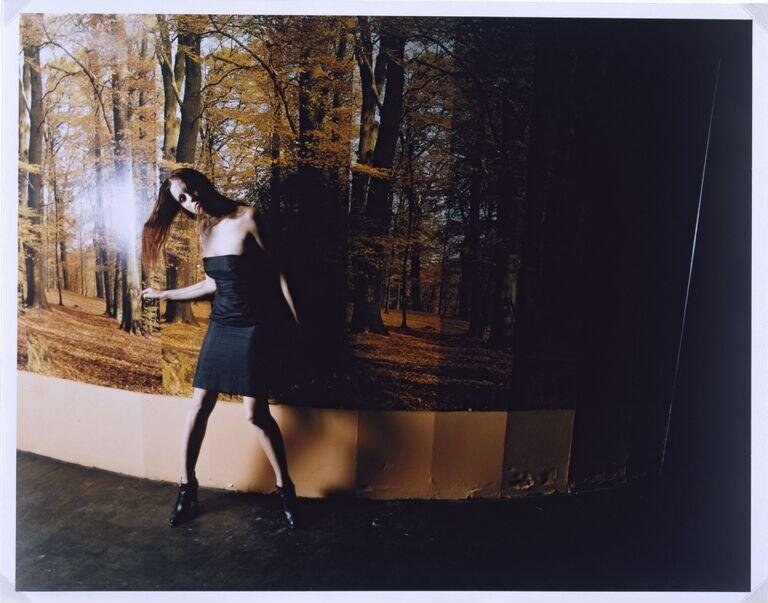
A woman in a black strapless dress dances alone in front of a large-scale photographic backdrop depicting an autumnal forest scene with golden trees and fallen leaves. The backdrop is mounted on the gallery wall and extends significantly behind her. She is captured mid-movement, her body angled dynamically, with one arm raised and her long dark hair in motion. The photograph is shot indoors in what appears to be a gallery or exhibition space, with the contrast between the warm, naturalistic forest imagery and the stark gallery setting creating a striking compositional tension. The lighting is cool and institutional, emphasizing the constructed nature of the scene.
The dancing
The dancer stands in a contrapposto-like stance with her weight shifted, one leg extended and her upper body twisting away from the camera. Her raised arm extends into the space, suggesting either a reach or a gesture of release. The movement appears spontaneous and unstructured—there is no balletic turnout, no rigid frame, no codified position. Her free arm hangs naturally. The isolation of a single figure in space, combined with the gesture's apparent ease and the casual elegance of her posture, suggests a modern, non-classical approach to movement.
The dance depicted
This is not classical or theatrical dance but rather social or club dancing, likely the kind of freestyle dancing that occurred in London nightclubs of the early 1990s. The image captures an informal, improvisational moment—the kind of dancing that was personal expression rather than trained technique. The relaxed upper body, the natural arm positions, and the absence of any recognizable codified style (no hip isolation, no specific footwork pattern visible) all point to vernacular club or social dance. The catalogue title confirms this was shot in a London club, though it is documented here as a gallery artwork rather than documentary photography of actual club culture.
How it was made
This is a colour photograph, likely a medium-format or 35mm film photograph printed and mounted on the gallery wall. The chromatic quality, the grain and tonal range, and the colour saturation are consistent with colour film stock from the early 1990s. The photograph is framed as a large-scale print, emphasizing the aesthetic deliberation of the image—this is not snapshot documentation but staged or carefully composed photography. The size and mounting suggest the work was created for exhibition in a gallery context from the outset.
About this work
This is a 1992 photograph by Corinne Day of a woman dancing alone in a London nightclub, captured in a gallery setting against a photographic backdrop of an autumnal forest. It documents a fleeting moment of social dancing—the kind of spontaneous, unstructured movement that was central to club culture in early-1990s London. The work sits at the intersection of fashion photography, contemporary art, and dance documentation, using the gallery as the site of the encounter rather than the club itself.
The photograph is significant because it treats club dancing—an ephemeral, everyday, non-theatrical form of movement—as worthy of sustained artistic attention. Day's framing and scale elevate a moment that would ordinarily be invisible or dismissed, making the body of a social dancer the subject of formal composition and gallery presentation.
How to look at it
Look at the moment Day has chosen to freeze: not a peak movement or dramatic gesture, but a turning point—the dancer mid-shift, in transition. The pose is not held or perfected; it is caught. Notice how the backdrop functions: it is simultaneously a representation of nature (the forest) and a constructed studio prop, creating a conceptual space that is neither club nor nature. The woman's body occupies the ambiguous zone between these two representations. Pay attention to her expression and posture: there is no performance here, no acknowledgment of the camera, suggesting either a moment of genuine absorption or a deliberate rejection of spectatorial awareness.
The artist
Corinne Day (1962–2010) was a British fashion and fine art photographer known for her raw, intimate aesthetic and her documentation of youth culture. She photographed Kate Moss in the early 1990s in images that helped define the 'heroin chic' aesthetic of that era. Beyond fashion, Day worked in fine art and documentary photography, often focusing on the body, intimacy, and the texture of lived experience. Her work is characterized by directness, natural lighting, and an unflinching gaze at subjects often considered marginal or overlooked.
The period
In 1992, London's club culture was at a significant moment: the acid house movement of the late 1980s had evolved into diverse club subcultures (rave, jungle, house, garage), and clubs were sites of intense social and creative energy. Simultaneously, the art world was increasingly interested in documenting and canonizing contemporary visual culture, including photography, fashion, and youth culture. Day's work emerged in this context, when the boundary between fine art and documentary, between fashion and art photography, was becoming increasingly permeable. The photograph also reflects early-1990s conceptual approaches to the body and performance in gallery settings.
Where it lives
The work is held in the collection of the Victoria and Albert Museum (VA, London), where it is catalogued as a photograph. The catalogue record provides minimal information, listing only the title, date, artist, and medium type.
Questions about this work
What kind of dance is this?
This is social or club dancing—the informal, improvisational movement people do in nightclubs. It is not a trained or codified style; instead, it is personal expression and spontaneous body movement. In the early 1990s, when this photograph was taken, club dancing in London was diverse and eclectic, drawing on influences from house, garage, jungle, and other genres, but the movement itself remained largely unstructured and individual.
Why is a photograph of club dancing in an art museum?
Day's photograph treats club dancing as a subject worthy of fine art attention. By removing the dancer from the club and presenting her image in a gallery context—against a staged photographic backdrop—Day raises questions about how we document, value, and display different forms of movement. The work suggests that club dancing and the bodies that perform it deserve the same aesthetic seriousness as any trained or theatrical form.
Is this documentary or staged photography?
It is staged, but subtly. The backdrop is clearly constructed, and the woman is being photographed in a gallery rather than an actual club. However, the gesture and posture appear spontaneous and unselfconscious, suggesting either a real moment of movement captured in a constructed setting, or a skilled performance of unselfconscious movement. The ambiguity is part of the work's power.
More dance artwork





