49 works in this view — arrow keys or swipe to move between them.
Dance in Art
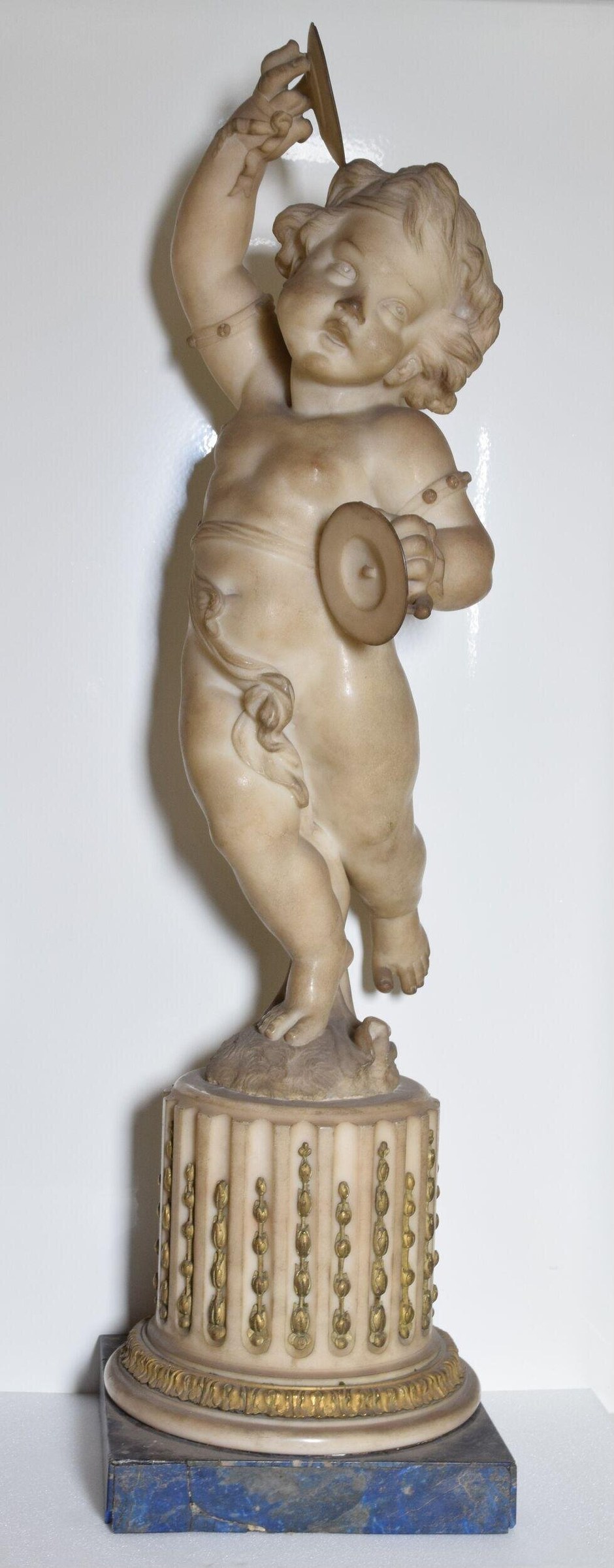
Dancing child
Unknown
- Collection:
- Statuette
- Source:
- Victoria and Albert Museum
- Rights:
- Rights vary by item — check the source record before reusing this image. Source record ↗
- Recorded as:
- V&A — check rights per item
The statuette demonstrates how allegorical and decorative conventions used the body—specifically the child's body—to express joy, victory, and celebration in movement. For historians of dance representation in visual art, it shows how the ideal of exuberant motion was expressed through sculptural form rather than through documentation of actual practice. The work exemplifies the persistence of Baroque cherub imagery into the neoclassical period, and how movement could be rendered in stone.
What you are looking at
A marble or alabaster statuette of a cherub or putto—a chubby, winged child figure—stands on a cylindrical pedestal base of pale stone with vertical fluting and gilt bronze trim at the foot. The figure is rendered in pale, luminous stone with subtle modeling. The child is depicted in motion, with one leg extended or in a dancing stance, while the upper body twists slightly. The cherub holds what appears to be a palm frond or similar leaf-like object raised aloft in one hand, tilted upward in a gesture of triumph or celebration. The figure wears drapery around the lower torso and hips. The pedestal is formally composed with regular grooved detailing typical of neoclassical ornament, suggesting this is a domestic or institutional decorative object of some refinement.
The statuette conveys a sense of joyous movement—the cherub's pose suggests a skip, bound, or leap frozen mid-gesture. The head is turned, gazing upward toward the raised palm frond, lending the pose an animated, celebratory quality. The contrast between the static architectural pedestal and the dynamic, tilted weight of the child creates visual liveliness. The work is photographed against a plain neutral ground, emphasizing the sculptural form.
The dancing
A single putto or cherub figure with visible wings, approximately child-proportioned but idealized and chubby in the manner of Baroque and later neoclassical convention. The body weight shifts noticeably—one leg extends in a stride or leap while the torso twists. The raised arm and lifted gaze suggest upward momentum or celebration. The pose is asymmetrical and energetic rather than static, with the contrapposto weight distribution suggesting motion captured mid-moment. There is no second figure or partner; this is a solitary, exuberant child.
The dance depicted
The work depicts a child in a joyful, celebratory pose that reads as dance-like or allegorical rather than literal dance training. The elevated palm frond suggests victory, triumph, or festive celebration—attributes that contextualize the movement within an allegorical or commemorative register rather than a specific codified dance style. The dynamic asymmetrical pose and upward-gazing head position evoke the joyous, unbounded movement associated with cherubs in Baroque and neoclassical allegorical tradition. This is decorative sculpture celebrating childhood exuberance and joy rather than documentation of a specific dance form.
How it was made
Carved marble or alabaster, worked three-dimensionally for viewing from all angles. The soft stone allows fine modeling of flesh, drapery, and facial features. The work appears to be carved in relief or fully freestanding, mounted on a separate architectural base. This is a luxury decorative object requiring skilled sculptural training; the finish and pedestal suggest it was made for a wealthy household or institution. The pale stone and neoclassical pedestal design indicate 18th or 19th-century manufacture.
About this work
This is a neoclassical decorative statuette depicting a cherub in a pose of joyful motion, holding a palm frond aloft. The figure is carved in pale stone and mounted on a formal fluted pedestal with gilt metal trim. Although the pose reads as dance-like and the composition celebrates movement and exuberance, the work functions as allegorical domestic or institutional decoration rather than as documentation of actual dance practice. The cherub's leap or bound represents an artistic ideal of innocent joy and triumph rather than a specific choreographic form. It sits within the long tradition of cherub imagery in Western decorative arts, where movement and celebration are expressed through the idealized bodies of children.
The work belongs in a gallery of dance in art because it represents one of the ways European artists of the 18th and 19th centuries depicted movement, joy, and celebration: through the figure of the child cherub in motion. While not a record of how people actually danced, it documents how artists imagined and represented movement, dynamism, and the body in space.
How to look at it
Attend to the asymmetry of the pose: one leg forward, the torso twisted, the head angled upward. This is not a stable, frontal stance but a moment of momentum—a leap or bound. The raised palm frond and upturned face complete the impression of celebration and upward thrust. Notice how the neoclassical pedestal, with its vertical fluting and geometric regularity, contrasts with the dynamic, asymmetrical energy of the cherub above. The sculptor has chosen to freeze a moment of exuberant motion rather than a pose of repose, emphasizing the vitality of the form.
The period
Cherub and putto imagery flourished in Baroque art and continued into the neoclassical and 19th-century periods. Such figures appeared in religious contexts, secular allegory, and increasingly as purely decorative domestic objects. The neoclassical pedestal and formal base suggest this was made in the 18th or 19th century, when such statuettes were popular luxury goods for homes and collections. The pose of the child in motion reflects Enlightenment and Romantic-era idealization of childhood as a state of natural joy and uninhibited movement, in contrast to the formality of adult courtly deportment.
Where it lives
Catalogued as a statuette in an unspecified collection, material and artist unknown. The catalogue record is minimal and offers no information on date, maker, provenance, or specific institutional holding. The source is noted as 'va' (likely indicating a visual archive or database).
Questions about this work
Is this sculpture meant to represent a specific dance or dancer?
No. The statuette is an allegorical or decorative object that uses the motif of a joyful, moving child to express themes of celebration, triumph, and innocence. While the pose is dynamic and reads as dance-like, it does not document or represent a specific historical dance form or the practice of dance training. It is art *inspired by* or *using* movement and the body, not dance documentation.
Why is a putto or cherub shown in a pose of motion rather than at rest?
Baroque and neoclassical artists frequently depicted cherubs and children in dynamic, energetic poses to express joy, celebration, and the ideal of uninhibited, innocent motion. The elevated palm frond suggests victory or festivity. The upward gaze and asymmetrical weight distribution convey exuberance rather than formal deportment, reflecting artistic and cultural ideals about childhood and celebration.
What is the pedestal made of, and why is it so formal?
The pedestal appears to be pale stone (possibly marble) with gilt bronze or brass trim. The fluted cylinder and formal base follow neoclassical architectural conventions, indicating this was a refined, expensive domestic or institutional object meant for display in a collection or home. The formal pedestal emphasizes the statuette's status as a precious decorative artwork.
When and where was this made?
The catalogue record provides no date or place of manufacture. The neoclassical pedestal design and style of the carved work suggest an 18th or 19th-century date, but without additional documentation, this cannot be confirmed. The artist and collection holding are also unidentified.
More dance artwork





