49 works in this view — arrow keys or swipe to move between them.
Dance in Art
Unknown
- Collection:
- Source:
- Victoria and Albert Museum
- Rights:
- Rights vary by item — check the source record before reusing this image. Source record ↗
- Recorded as:
- V&A — check rights per item
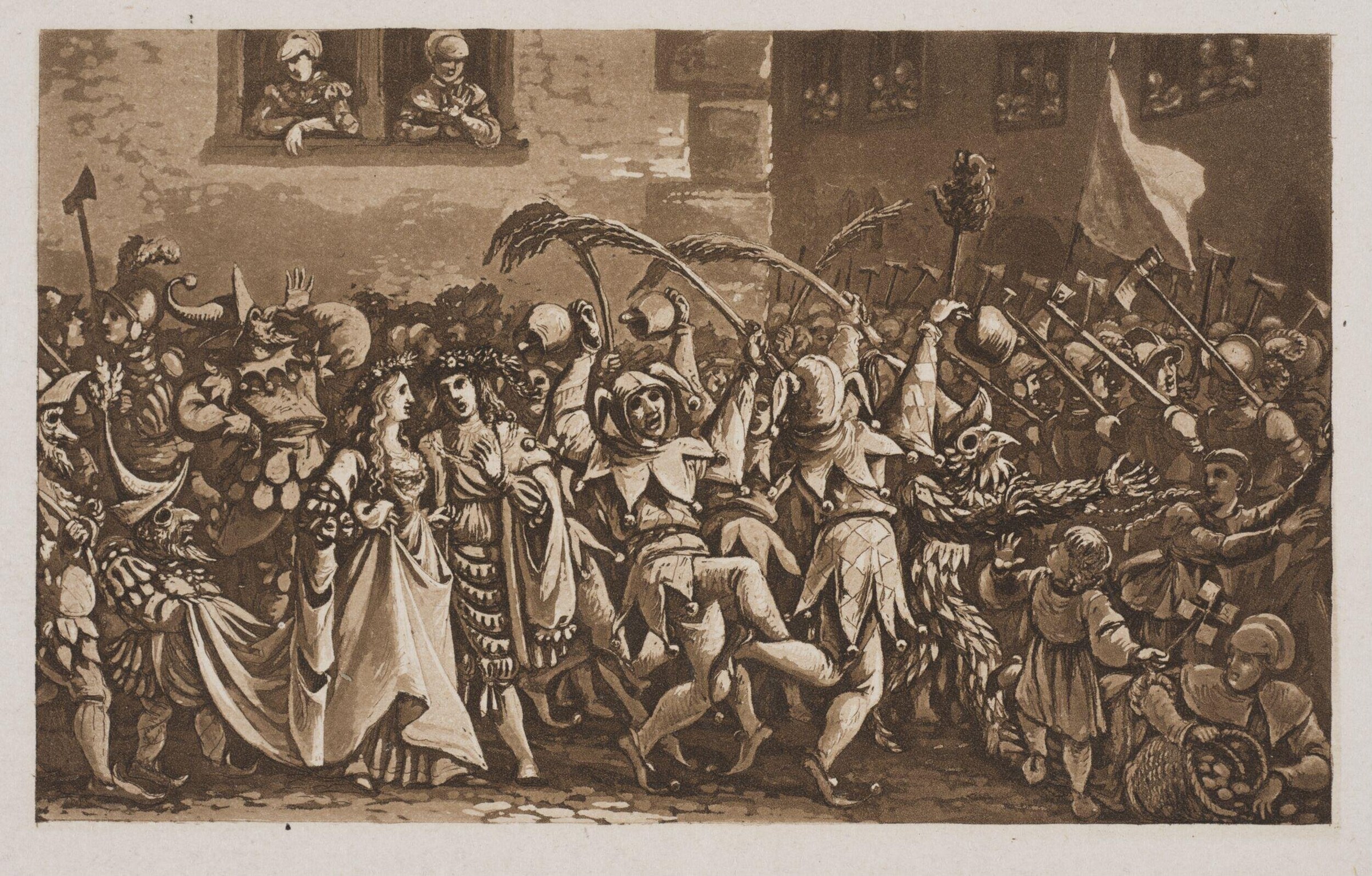
Carnival was among the most significant spaces of collective movement and performance in pre-industrial Europe, yet it is often invisible in dance history because it was not formalized as technique and left few stable records. This engraving captures carnival as a civic and theatrical event, showing how spectacle, costume, and public assembly created meaning in bodies and space.
What you are looking at
A dense, chaotic carnival or procession scene rendered in a classical engraving style, crowded with masked and costumed figures. The composition centers on a tall female figure in a flowing white gown and elaborate headdress, positioned among a throng of grotesque and fantastical characters—some wearing animal masks, others in plumed or horned costumes. The architecture of a fortified town or castle rises in the background, with windows full of spectators looking down on the festivities. In the foreground, children and smaller figures weave through the crowd. The scene is dense with overlapping bodies, pikes, flags, and decorative elements, giving an impression of theatrical chaos and social inversion typical of carnival celebration. The foreground pavement and the monumental architecture emphasize the civic and public nature of the event.
The dancing
The figures move in no coordinated pattern; instead, they occupy space with gestural abundance—arms raised, bodies at angles, some leaning or stumbling. The central tall female figure stands relatively still, her body vertical and frontal, but she is surrounded by figures in active, expressive postures. Several figures appear to be processing or parading rather than executing recognizable dance steps. The mix of upright procession and social disruption suggests the performative chaos of carnival rather than the disciplined coordination of theatrical dance.
The dance depicted
This is most likely a carnival procession, possibly Venetian or Central European, rendered as a theatrical scene rather than a depiction of ballroom or stage dance. Carnival—a period of licensed social inversion and masquerade before Lent—frequently featured processions, revelry, and folk-festival movement, but not formalized dance technique. The engraving captures the visual spectacle and social performance of the event rather than the body mechanics of any specific dance form. Carnival could include dancing, but this image emphasizes costume, hierarchy reversal (the grotesque alongside the refined), and public assembly.
How it was made
This is an engraving, executed with fine cross-hatching and careful line work to create tone and volume. The technique allows for precise detail in costume and architecture, and the circulation of such prints—mass-produced and relatively affordable—made them key documents of civic spectacle and entertainment for literate urban audiences. The date 1860 suggests this may be a reproduction or revival print of an earlier carnival image, as the engraving medium and the visual vocabulary of the composition suggest an earlier tradition.
About this work
This engraving depicts a carnival procession in what appears to be a Renaissance or early modern European town, crowded with masked figures, fantastical costumes, and civic spectacle. The work preserves a visual record of how carnival—a key ritual performance space for ordinary people—was imagined and circulated through print. Carnival was one of the most important venues for popular movement, music, and social performance in early modern Europe, yet is rarely depicted with such compositional ambition and architectural detail. The print exists at the intersection of civic ceremony, theatrical display, and folk festivity.
How to look at it
Look at the centerpiece: the tall, still female figure in white, who anchors the chaos around her. Notice how the artist has positioned spectators in the windows above, making the crowd itself a performance for internal viewers. Attend to the mixture of grotesque and refined costumes—this visual hierarchy reflects carnival's inversion of social order. The pikes and flags suggest military or civic procession as much as festival. The artist has chosen not a moment of coordinated dance, but rather the tumult and abundance of the event itself.
The period
By the 19th century (the 1860 date), carnival was already becoming nostalgic or antiquarian in many European cities. This engraving may document a historical carnival, a revival, or a theatrical reenactment of carnival traditions. The composition and style suggest it derives from or copies earlier prints, keeping alive visual memory of a form of public celebration that was increasingly regulated, restricted, or displaced by modern urban administration. Carnival had been a dominant form of licensed disorder and folk performance; by the 19th century, interest in it was often historical or romantic.
Where it lives
The work is recorded as a print, dated 1860, with no artist attribution. The source is listed as 'va', which may indicate a Virginia collection or archive. No further provenance is documented.
Dance in this work
Questions about this work
Is this a depiction of an actual carnival, or a theatrical fantasy?
The engraving shows carnival as a public civic event in a recognizable townscape, with spectators in the architecture and orderly marshaling of figures, suggesting it documents or represents an actual tradition. However, the grotesque and fantastical elements, and the density of the composition, are characteristic of how carnival was artistically imagined and circulated in prints. It is likely a representation—an artistic interpretation of carnival spectacle—rather than a direct record of a single event.
What role did dance play in carnival?
Carnival included music, dancing, and movement, but it was not formalized the way ballet or court dance was. Movement in carnival was often improvised, participatory, and social rather than performed technique. This print emphasizes the visual spectacle, costume, and social mixing of carnival more than specific dance forms, which is typical of how carnival was documented and understood.
Why does this image belong in a dance archive?
Carnival was one of the most important venues for collective movement, performance, and embodied social practice in pre-industrial and early modern Europe. Though this image does not depict formalized dance steps, it preserves visual evidence of how bodies, costumes, and space were organized in one of history's major forms of public cultural performance.
More dance artwork





