49 works in this view — arrow keys or swipe to move between them.
Dance in Art
Theatre costume
Unknown
- Collection:
- Theatre costume
- Source:
- Victoria and Albert Museum
- Rights:
- Rights vary by item — check the source record before reusing this image. Source record ↗
- Recorded as:
- V&A — check rights per item
This object matters to theatre historians and costume scholars as evidence of how historical silhouettes were reproduced in theatrical costume, and as a specimen of early 20th-century dress construction and textile printing. For dance historians, it serves as a document of what dancers wore in non-dance theatrical contexts, and how civilian dress of the period constrained or enabled movement.
What you are looking at
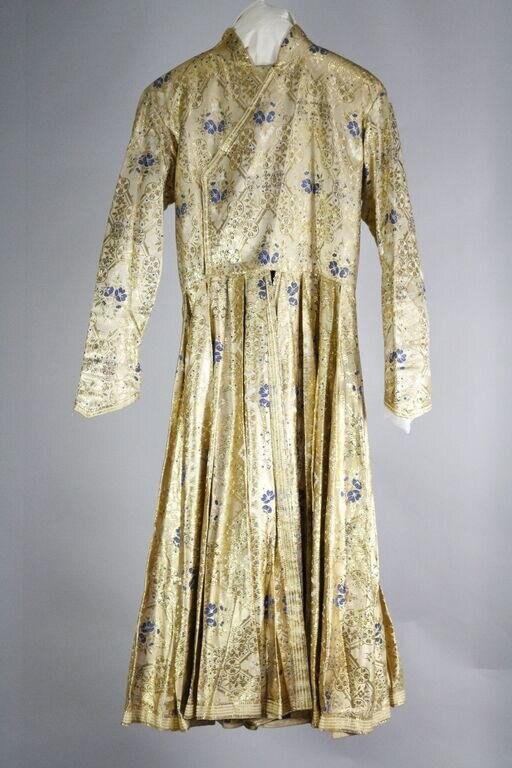
A full-length theatrical costume displayed on a dress form against a neutral background. The garment is a long-sleeved day dress or tea gown in a cream or pale gold silk fabric printed with a delicate all-over pattern of small blue floral sprigs and fern-like foliage. The dress features a high rounded neckline and extends to the ankles. The silhouette is characteristic of early 20th-century fashion, with a fitted bodice that drops into a full, gently gathered skirt with substantial volume created by unpressed pleats or knife pleats running vertically down the front and sides. The long sleeves are fitted through the forearm. The printed pattern appears consistent across the entire garment, suggesting a dress fabric rather than a constructed costume piece. The overall effect is one of refined elegance suited to indoor social occasions rather than theatrical spectacle.
The dancing
No human figure is present; the costume is displayed on a dress form or mannequin. The garment's construction reveals the silhouette and proportions of the wearer: a narrow waist with ample hip and skirt volume typical of the 1910s-1920s. The positioning of the arms—extended downward on the dress form—suggests how the wearer's arms would hang in the costume. No movement, gesture, or dance position is indicated.
The dance depicted
This does not appear to be a dance costume. The garment is a day dress or tea gown suitable for social occasions, drawing room wear, or possibly costume theatre requiring period-accurate civilian dress rather than a specialized dance costume. The fabric, construction, and silhouette are consistent with Edwardian or early 1920s fashion rather than with the cut, reinforcement, or design typical of theatrical dance wear. If this garment was worn in a dance context, it would have been in a theatrical production requiring historical costume rather than in a dance performance designed to showcase movement.
How it was made
This is a textile object—a silk dress from the early 20th century. It survives as a museum specimen and has been photographed on a dress form for documentation. The preservation as a three-dimensional garment rather than as a flat textile suggests it was significant enough for a museum collection, either as a notable example of period fashion or as a theatrical artifact. The photograph documents the garment in its current state with neutral lighting and neutral background, typical of museum conservation and collection photography.
About this work
This is a cream silk printed day dress or tea gown from the early 20th century, displayed as a three-dimensional textile object. The garment exemplifies Edwardian or 1920s silhouette with its fitted waist and voluminous skirt, finished in a delicate floral print on fine silk. It has been catalogued as a theatrical costume, though the garment itself shows no specialized features of dance wear. If it was used in theatre, it likely served as period costume in a dramatic production rather than as a garment designed for dance movement.
How to look at it
Examine the precision of the seaming, the quality of the silk, and the tightness or looseness of the pleating—these details tell you whether this was a expensive custom garment or a more practical stock piece. Note the placement of the floral print: does it align at the seams, suggesting careful pattern matching, or does it break awkwardly? Study the neckline finish and sleeve construction to understand how a performer would have moved in this garment and what restrictions it imposed. The voluminous skirt would have limited leg movement significantly—important context if this was worn in a dance scene.
The period
The dress is consistent with fashion of approximately 1910–1925. This was the era of the S-bend corset giving way to more columnar silhouettes, though this garment retains a notably fitted waist and gathered skirt more typical of the 1910s than the straighter lines of the mid-1920s. In theatre, this period saw a turn toward greater historical accuracy in costume design, influenced by figures like Edward Gordon Craig and the visual sophistication of the Ballets Russes (founded 1909). By the 1920s, theatrical costume was becoming recognized as an art form in its own right.
Where it lives
This garment is held in a theatre costume collection or fashion textile collection, catalogued as a theatre costume of unknown date and maker. The museum photography and conservation condition suggest it has been professionally cared for.
Questions about this work
Was this costume actually worn in a dance performance?
The record catalogues it as theatrical costume, but there is no evidence in the garment itself of specialized dance construction. It appears to be a civilian day dress or tea gown that may have been used in a dramatic production requiring period costume, or it may have been worn by an actor or dancer in a non-dance scene. The voluminous skirt and fitted waist would have severely restricted leg movement and jumping.
When was this dress made?
The silhouette and construction are consistent with 1910–1925, but the exact date is not recorded. The fitted waist and gathered skirt are more typical of the 1910s than the straighter lines that became fashionable by the mid-1920s, suggesting it is probably from the earlier part of this range.
What was it made from?
The garment appears to be constructed from a fine silk fabric printed with a small-scale floral pattern in blue on a cream or pale gold ground. Silk at this level of quality was expensive and suggests this was either a garment for someone of means or a special commission for theatrical use.
More dance artwork





