49 works in this view — arrow keys or swipe to move between them.
Dance in Art
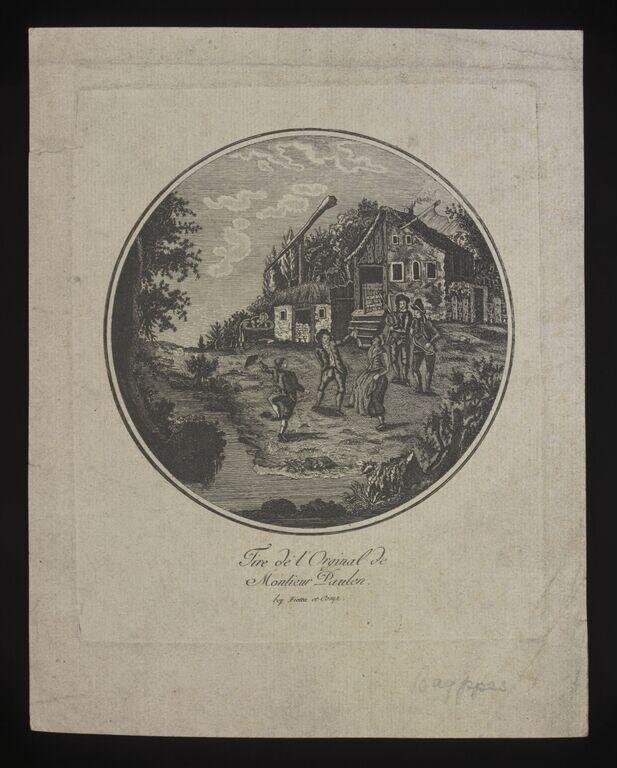
"Tire de l'Orginal de Montieur Paulen bey Fietta et Comp."
Fietta et Comp.
- Collection:
- Source:
- Victoria and Albert Museum
- Rights:
- Rights vary by item — check the source record before reusing this image. Source record ↗
- Recorded as:
- V&A — check rights per item
This image preserves the look of aristocratic social life in the era when the minuet, cotillion, and country dances dominated elite leisure and courtship. It shows that the boundaries between active dance and social gathering were fluid—that the same dress, spaces, and postures served both movement and conversation. For historians of dance notation and teaching, it is evidence of how dance was contextualized and valued as a marker of gentility.
What you are looking at
A circular engraving depicts an 18th-century pleasure garden or estate scene. In the foreground, several figures in aristocratic dress gather near a substantial stone building with a pitched roof and shuttered windows. The building occupies the right side of the composition and appears to be a country house or pavilion. To its left, a tree-lined path recedes into the middle ground, where additional figures are visible. The sky above is rendered with fine hatching to suggest clouds and atmosphere. The circular frame creates an intimate, contained view of what appears to be leisure activity among the gentry. The landscape suggests an organized garden or park setting, with vegetation framing the scene at the edges.
The dancing
At least six figures are visible, distributed across the space. Those in the foreground stand in relaxed, conversational postures—some with weight on one leg, others in profile or three-quarter view. The figures wear knee breeches, coats, and dresses consistent with 1750s–1770s fashion. No dance hold is apparent: the groupings suggest social mingling rather than formal partnered dance. The stance is upright but casual, consistent with promenade or courtship rather than active movement through a learned choreography.
The dance depicted
This is not a depiction of formal dance but rather of social leisure—the kind of aristocratic gathering where dance might occur, but in a promenade, flirtation, or recreational moment rather than a performance or organized figure. The setting and dress suggest the milieu in which minuet and cotillion were danced in the mid-to-late 18th century, but no one here is dancing. The title inscription (partly legible as a reference to an original work by Fietta et Comp.) suggests this is a reproductive engraving, likely after a painting or drawing of actual or idealized estate life.
How it was made
This is a line engraving, identifiable by the regular hatching (parallel lines of varying density) used to create tone and shadow, and the clear, fine linear work throughout. The circular composition within a rectangular field, and the inscription beneath, indicate it is a reproductive print—designed for circulation and collection. Engravings of this period required substantial skill and were expensive to produce, suggesting the original work was of some status. The technique allowed for wide distribution of the image, making it a vehicle for disseminating taste and artistic knowledge among educated collectors.
About this work
This is a mid-to-late-18th-century engraving that captures a moment of aristocratic leisure in a country estate or pleasure garden. Rather than depicting formal dance, it shows the social context in which dance occurred—the gathering, the dress, the setting—as a marker of refinement and leisure. The work belongs in a gallery about dance because it records the visual culture of the ballroom era: how bodies moved, how they dressed, what spaces held them, and what social rituals framed their leisure. The title attribution to Fietta et Comp. indicates professional production and circulation, making it a document of how the dancing classes saw themselves.
How to look at it
Attend to the posture and spacing of the figures: none are in the tight partnership or geometric formations that would mark active dance. Instead, notice the casual asymmetry—standing, turning, conversing—that marks the moments between dances or the arrival and departure at a ball. The building, the garden, and the sky are given equal visual weight to the figures, suggesting that the scene is about *place and leisure* as much as the people. The engraver's fine hatching creates depth and atmosphere, making this not a diagram of dance but a portrait of the world in which dance lived.
The artist
Fietta et Comp. is identified in the inscription as the creator of the original work. This may refer to a company of engravers or a printmaker working with collaborators; Fietta is not securely identified in standard reference sources, but the professional designation and the quality of the engraving suggest a workshop practice. The work was made for the print market and likely drawn from or inspired by paintings or prints of landscape and social scenes that were popular in Northern Europe in the 18th century.
The period
The 1750s–1770s were the peak era of rococo leisure painting and the rococo-to-neoclassical transition in printmaking. Engravings of country estates, parks, and social gatherings were highly fashionable among collectors who aspired to gentility. Dance was central to aristocratic identity during this period: the minuet dominated formal balls, and dancing masters were among the most valued teachers. At the same time, the rise of landscape and genre imagery—often tinged with idealization and sentiment—offered ways to represent leisure, nature, and social harmony.
Where it lives
The work is held in a print collection (source recorded as 'va', likely an institutional holding). It is a reproductive engraving, likely produced in multiple impressions for sale or distribution. As a print, it would have circulated among collectors, artists, and the educated public as a record of taste and artistic practice.
Questions about this work
Is anyone actually dancing in this picture?
No. The figures are standing, conversing, and moving casually through a garden or estate setting. This is a social gathering—the moment before, after, or between dances—rather than active choreography. It captures the context and costumes of aristocratic dance rather than dance itself.
Why is this in a dance gallery if no one is dancing?
Because it documents the world of 18th-century aristocratic dance: the dress, the spaces, the social rituals, and the visual culture in which minuet and cotillion were the central leisure activity. Dance historians study not only the movement but also the contexts that gave it meaning.
What does the title tell us?
The title attributes the work to Fietta et Comp. and notes it is made 'after the original' (Tiré de l'Original), confirming this is a reproductive engraving made from a painting or drawing. The inscription suggests the original work was valued enough to be commercially engraved for distribution.
How do we know when this was made?
The costume (knee breeches, cut of the coats and dresses), the rococo style of the composition, and the engraving technique all point to the mid-to-late 18th century, likely 1750s–1780s. However, the catalogue record does not provide a secure date.
More dance artwork





