49 works in this view — arrow keys or swipe to move between them.
Dance in Art
Theatre costume
Unknown artist
- Collection:
- Theatre costume
- Source:
- Victoria and Albert Museum
- Rights:
- Rights vary by item — check the source record before reusing this image. Source record ↗
- Recorded as:
- V&A — check rights per item
Dance historians and practitioners rarely get to examine the actual shoes worn by dancers of the 1920s; we usually see them only in photographs and written descriptions. These shoes provide direct evidence of heel height, sole construction, materials, and wear patterns that performers actually lived with. For anyone studying ballroom standardization, the emergence of modern dance as a profession, or how dance moved from informal to formalized movement systems, these objects are primary evidence of what the body was literally standing on.
What you are looking at
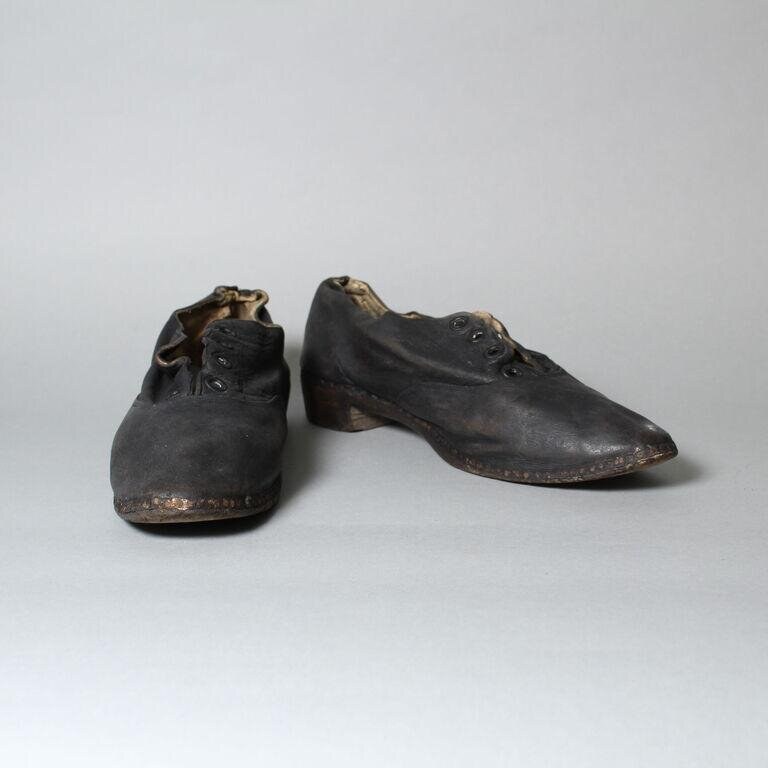
A pair of black leather shoes lies on a neutral ground. Both are heeled oxford-style shoes with pronounced block heels, rendered in soft black leather that shows wear and patina consistent with age and use. The shoes are unadorned and utilitarian in construction, with simple lacing across the vamp and rounded toe caps. They are positioned at slight angles to one another, suggesting they have been removed and placed for display. The lighting is even and shadowless, revealing the texture of worn leather, particularly visible at the heel edges where the material shows lighter bronze-colored scuffing. The shoes appear handmade or bespoke, with visible stitching and construction marks along the sole edges. This is documentary presentation rather than theatrical arrangement.
The dancing
There is no human figure present. The shoes themselves are the subject and should be read as objects of wear and use. The positioning suggests a practical removal—left shoe tilted back slightly, right shoe forward—rather than aesthetic arrangement. The block heel (approximately 1.5 inches) and narrow, pointed toe indicate shoes designed for forward motion and balance rather than flexibility. The heel wear patterns visible on both shoes suggest consistent weight-bearing in the manner of ballroom or theatrical dance, not street wear.
The dance depicted
These shoes most likely belonged to a professional or trained dancer, probably male, active in ballroom, theatrical, or early modern dance circa 1920. The construction—custom leather, substantial heel, structured vamp, careful stitching—marks these as specialty dance shoes rather than street footwear. The heel height and style suggest ballroom technique (particularly standardized Foxtrot or Waltz from the interwar period, when such shoes became standard) or theatrical performance in contemporary dance or musical comedy. The uniform wear across both heels and the patina pattern indicate extensive, regular use over months or years.
How it was made
This is a three-dimensional object: a pair of actual historical dance shoes, not a representation of shoes in another medium. They appear to be professionally conserved and photographed for archival documentation. The photograph is studio-lit and shot at a shallow angle, revealing texture and wear while avoiding harsh shadows. The neutral ground and technical lighting suggest this is object documentation for a collection rather than artistic interpretation. This approach—photographing the artifact itself—is the standard method of dance costume and equipment archives, allowing precise study of construction, materials, and patterns of use.
About this work
These are working dance shoes from approximately 1920, preserved as a theatre costume object in what appears to be a museum or archive collection. They represent the material culture of professional or serious amateur dance in the early twentieth century, a period when ballroom technique was becoming standardized and theatrical dance was expanding as a profession. The shoes tell us how dancers dressed their feet, what construction methods were available, and how the demands of regular performance shaped the objects themselves. They are not costume in the sense of decorative theatrical dress, but rather the functional footwear of practice and performance—the daily tool of the dancer's craft.
How to look at it
Examine the heel closely: the wear pattern reveals how weight was habitually distributed. Notice the stitching and construction details along the sole and vamp—these show whether shoes were factory-made or bespoke. Look at the patina and color variation: the lighter wear on heels and toe cap edges tells you where the shoe made contact, repeated thousands of times. The shoe itself is a frozen record of movement. The block heel, now standard, was a deliberate choice to provide stability and forward momentum—compare them mentally to the flexible soles of modern dance shoes or the higher heels of later ballroom wear.
The period
By 1920, ballroom dance in Britain and America was undergoing rapid professionalization and standardization. The Foxtrot, Waltz, and other Standard dances were becoming codified through competition and professional instruction. Specialist dance shoes were being manufactured to support this emerging technical culture, and heeled shoes for men became normal in ballroom and theatrical contexts, though still a marker of professional or serious amateur status. In modern dance and theatrical performance, dancers were experimenting with shoes that allowed both structure and articulation. A 1920 date places these shoes at the cusp of this professionalization.
Where it lives
These shoes are catalogued as theatre costume in a collection identified only as 'va' (likely the Victoria & Albert Museum). They are accessioned as a single pair and dated to 1920, though without individual maker's marks visible in the photograph, the maker and original wearer remain unknown.
Questions about this work
Who wore these shoes?
The wearer is not recorded. From their professional construction and wear patterns, they belonged to a trained dancer—probably male, given the style—active in ballroom, theatrical, or early modern dance around 1920. They may have belonged to a professional performer or to a serious amateur competitor in the growing ballroom competition circuit of the period.
Why do they have heels?
The block heel gave dancers height and a structural platform for posture and balance, which were central to ballroom technique. The heel also created a distinct aesthetic—these were not street shoes, but specialized performance and practice footwear that marked the wearer as a dancer or performer. In 1920, heeled shoes for men in a dance context signaled professional or serious amateur status.
How do I know they were actually used for dance?
The wear pattern is diagnostic. The heel edges show uniform bronze-colored wear consistent with repeated weight-bearing in a specific direction—forward motion with controlled weight distribution. The toe box shows less wear than the heel, which is characteristic of ballroom and theatrical dancing, where the heel strikes first. Street shoes wear differently, with more distributed pressure across the sole.
Are these the shoes of a famous dancer?
The archive record does not identify the original wearer or maker. The shoes were preserved as a theatre costume object, which suggests they had some significance—either to an institution, a collection, or a noted performer—but that connection is not recorded in the surviving catalogue information.
More dance artwork





