49 works in this view — arrow keys or swipe to move between them.
Dance in Art
Theatre costume
Unknown
- Collection:
- Theatre costume
- Source:
- Victoria and Albert Museum
- Rights:
- Rights vary by item — check the source record before reusing this image. Source record ↗
- Recorded as:
- V&A — check rights per item
This object documents the material reality of theatrical costume in a period when dance was a luxury art form performed for courts and elites. The craftsmanship and materials reveal what a dancer's body was literally weighted down with during performance—information not visible in paintings or written records alone.
What you are looking at
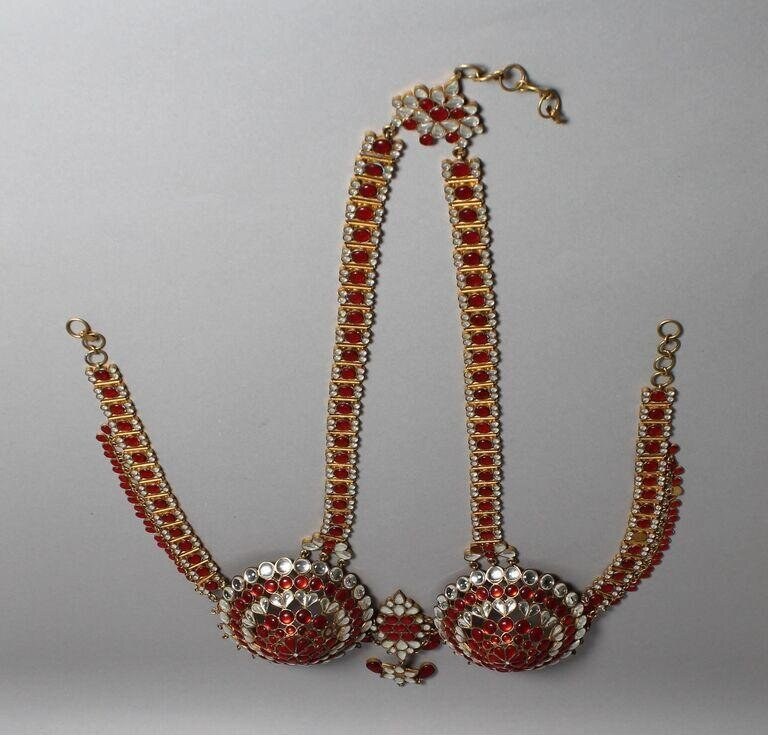
This is a theatrical ornament or jewelry piece comprising three connected elements arranged in a U-shape. The two outer sections are shorter strands, while the central section is longer and more substantial. Each strand is composed of repeated units of red gemstones (likely rubies or garnets) set in gold filigree frames, creating a beaded or segmented effect. The segments are connected by delicate gold links. At the junction points—where the outer strands meet the center section—are large circular medallions densely set with red stones in elaborate geometric patterns, surrounded by white stones (possibly diamonds or crystal) that create a radiating border. From the central medallion hangs a small pendant charm. The entire piece glimmers with the warm glow of gold and the deep red of the stones, suggesting precious materials and skilled craftsmanship. The symmetrical composition and the ornamental density suggest this was a high-status theatrical costume accessory.
The dancing
This is not a representation of human figures or dancers in motion. It is a three-dimensional object—costume jewelry or a theatrical ornament. The "composition" is abstract and geometric rather than depicting bodily movement or gesture. No analysis of dance frame, hold, or footwork applies.
The dance depicted
This object does not depict a dance or dancers. It is a costume accessory—likely a piece of jewelry worn as part of a theatrical costume, possibly a hip ornament, waist pendant, or head adornment worn by a dancer or performer. Without knowing the specific dance tradition or historical period of use, the dance context cannot be identified from the object alone.
How it was made
This appears to be jewelry or a costume ornament crafted from precious materials: gold (or gold-plated metal) filigree work combined with faceted gemstones, likely rubies or garnets for the red stones and possibly diamonds or crystals for the white accent stones. The stones are set into the metalwork in a dense, geometric pattern suggesting high-quality craftsmanship and precious materials. The technique of stone-setting in filigree metalwork allows for the intricate patterning and light-catching effects visible here. Such objects were typically made for royal courts, aristocratic performers, or wealthy theatrical companies.
About this work
This is a fragment of theatrical costume jewelry, most likely a decorative body ornament worn by a performer in a court or aristocratic entertainment. The precision metalwork and expensive materials indicate its status as a luxury item created for someone of high rank or for an important theatrical production. The symmetrical, ceremonial arrangement of stones and the weight of ornamental detail suggest this belonged to a formal or ritual dance tradition—possibly Indian classical dance, a European court dance spectacle, or Middle Eastern theatrical performance. The object itself preserves evidence of how dancers were costumed in high-status entertainments across cultures, where jewelry and metalwork were integral to the visual splendor of the performance.
How to look at it
Observe how the weight of the ornament is distributed—the dense stone-setting at the junction points creates visual anchors, while the connecting strands would drape or swing with the dancer's movement. The symmetry and geometric precision suggest this was a formal, stately dance rather than a quick or athletic one. The glimmer of the gold and red stones would have caught light with each motion of the wearer's body, making the dancer visually prominent even before considering the performer's actual movement.
The period
Without dating or cultural attribution, the period context cannot be established with confidence. The style of the filigree work and stone-setting could place it anywhere from the 16th to 19th century, and in a range of cultural contexts—European court entertainments, Indian classical dance, Middle Eastern theatrical traditions, or Ottoman court performances. The use of precious metals and gems in theatrical costume was standard practice across these traditions during the early modern and modern periods, when dance was performed primarily for aristocratic and royal audiences.
Where it lives
The object is held in a collection identified as "Theatre costume," and the source is listed as "va," likely referring to a museum or archive. The sparse catalogue record suggests this is a catalogued but poorly documented holding.
Questions about this work
What dance was this worn for?
The catalogue record does not identify the specific dance tradition or cultural context. The style and materials suggest a court or aristocratic performance tradition, but without provenance or dating, the exact dance form cannot be determined. Similar ornaments appear in Indian classical dance, European court spectacles, and Middle Eastern theatrical traditions.
Who would have worn this?
The expensive materials and skilled craftsmanship indicate this was worn by a high-status performer—likely a dancer in a royal court, a member of an aristocratic entertainment troupe, or a celebrated professional performer. Only wealthy patrons or established theatrical companies could commission such work.
How was it worn?
The U-shape and symmetry suggest it may have been worn as a hip ornament, a waist pendant, or possibly as part of a head or neck adornment. The three sections could have been positioned to frame the body and move with the dancer's movement, catching light and creating visual emphasis.
More dance artwork





