49 works in this view — arrow keys or swipe to move between them.
Dance in Art
Krishna
Devi, Bagla
- Collection:
- Painting
- Source:
- Victoria and Albert Museum
- Rights:
- Rights vary by item — check the source record before reusing this image. Source record ↗
- Recorded as:
- V&A — check rights per item
This work documents the visual and aesthetic practices of contemporary South Asian folk art and religious imagery, which often interact with but remain distinct from classical dance traditions. For dance historians, it offers context on the visual culture surrounding the sacred narratives that classical South Asian dances also draw upon.
What you are looking at
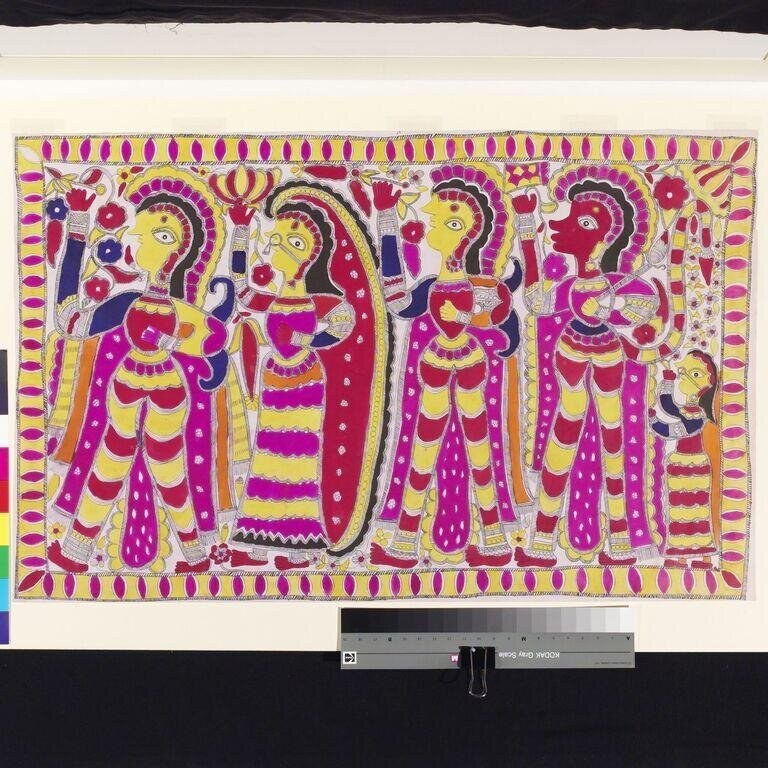
Four standing figures dominate a symmetrical composition rendered in brilliant magenta, yellow, cream, and deep blue. The figures are frontal and rigid, their bodies articulated into horizontal bands of contrasting color—magenta, yellow, and cream stripes suggesting jewelry, garments, or body paint. The leftmost figure holds what appears to be a staff or ritual object; the others stand with arms at their sides or slightly forward. Their faces are rendered in profile or three-quarter view with elongated features, marked eyes, and ornamental headdresses. The entire composition is framed by a dense border of yellow and magenta geometric patterns—alternating shapes suggesting stylized leaves or petals. The ground is unmarked; the background is cream. The style is graphic and highly patterned, with bold outlines defining every form. The figures occupy the full height of the composition and appear ceremonial or ritualistic rather than narrative.
The dancing
The four figures stand in a vertical axis, displaying no interaction or spatial depth between them. Their bodies are immobile, with weight evenly distributed and no indication of weight shift, contrapposto, or dynamic balance. Arms are either held close to the body or extended slightly; there is no reaching or gestural expressiveness. The figures appear to be wearing layered garments or ornamental body covering rendered as horizontal stripes. The postures suggest formality and stillness rather than movement—the bodies are presented frontally as icons or emblems rather than captured mid-motion.
The dance depicted
This is not a depiction of dance as an action. The figures are static, frontal, and presented as iconographic representations rather than as bodies moving through space. The title 'Krishna' and the ornamental, striped treatment of the bodies suggest iconographic or devotional imagery from South Asian religious contexts—possibly related to Krishna narratives or temple decoration traditions. The format and style align with folk or vernacular religious art practices rather than with documenting a specific dance tradition. While South Asian religious contexts include rich dance traditions (Kathak, Kathakali, Odissi), nothing in this image depicts the techniques, movement vocabulary, or performance contexts of those forms.
How it was made
The work is executed in what appears to be gouache or acrylic on paper, with bold, flat areas of color separated by strong black outlines. The technique is graphic and linear rather than modeling form through light and shade. The dense, repeating geometric border suggests either direct painting or possibly screen-printing or block-printing techniques adapted for paper. The flatness, high color saturation, and decorative patterning are consistent with Indian folk painting traditions or modern vernacular art practices drawing on those traditions.
About this work
This is a devotional or ceremonial image of Krishna and associated figures, rendered in a graphic style drawing on South Asian folk and religious art conventions. The work presents four iconic figures in static, frontal poses within a heavily patterned frame. Although South Asia has major classical and folk dance traditions, this particular work does not depict dance movement or performance—it is devotional imagery employing the visual language of religious folk art.
How to look at it
Approach this as a devotional or ceremonial image rather than a narrative scene. Notice the careful, almost heraldic presentation of each figure—their symmetry, stillness, and ornamental treatment. The repeating border is not merely decorative; it frames these figures as sacred objects of attention. The bold color and graphic simplicity make each form immediately legible and memorable, which is the work of folk devotional imagery.
The artist
Bagla Devi is recognized as a practitioner of folk painting traditions, likely working in a regional Indian vernacular style. The work reflects the continuation of folk religious art practices that have deep historical roots in Indian visual culture, where the production of devotional images has been a communal and ongoing practice rather than a fine-art commodity.
The period
The work dates to 1973, a period when Indian folk art and craft traditions were experiencing renewed documentation and interest alongside the modernization and internationalization of classical Indian dance forms. The graphic, contemporary presentation of traditional religious iconography reflects broader mid-20th-century engagement with folk and vernacular aesthetics as sources of cultural identity.
Where it lives
The work is held in a collection identified as 'va' (likely Virginia Art or a regional collection). No accession number, exhibition history, or current location data is recorded.
Questions about this work
Is this a dance painting?
No. While it depicts figures from Krishna mythology and employs bright colors and ornamental design, the figures are entirely static and frontal, presented as icons rather than as dancers in motion. There is no indication of movement, gesture, or performance.
What tradition does this drawing on?
This work employs visual conventions from South Asian folk and religious art, particularly devotional image-making practices. The flat color, bold outlines, striped ornamentation, and frontal presentation are consistent with Indian folk painting and temple decoration traditions.
Why is it in a dance archive if it is not a dance?
It provides context on the visual and religious culture surrounding South Asian dance traditions, even though it does not itself depict dance. Understanding the iconography and visual language of Krishna narratives helps contextualize the sacred narratives that classical South Asian dances also draw upon.
More dance artwork





