49 works in this view — arrow keys or swipe to move between them.
Dance in Art
Krishna
Devi, Bagla
- Collection:
- Painting
- Source:
- Victoria and Albert Museum
- Rights:
- Rights vary by item — check the source record before reusing this image. Source record ↗
- Recorded as:
- V&A — check rights per item
This work documents the visual vocabulary of Krishna devotion and South Asian sacred tradition as expressed through contemporary folk and popular art, offering insight into how classical dance iconography — costumes, headdresses, ornamental codes — is adapted and reinterpreted outside the context of actual classical performance. For historians of South Asian visual culture and dance representation, it reveals the persistence and transformation of these costume traditions in mid-twentieth-century Indian art practice.
What you are looking at
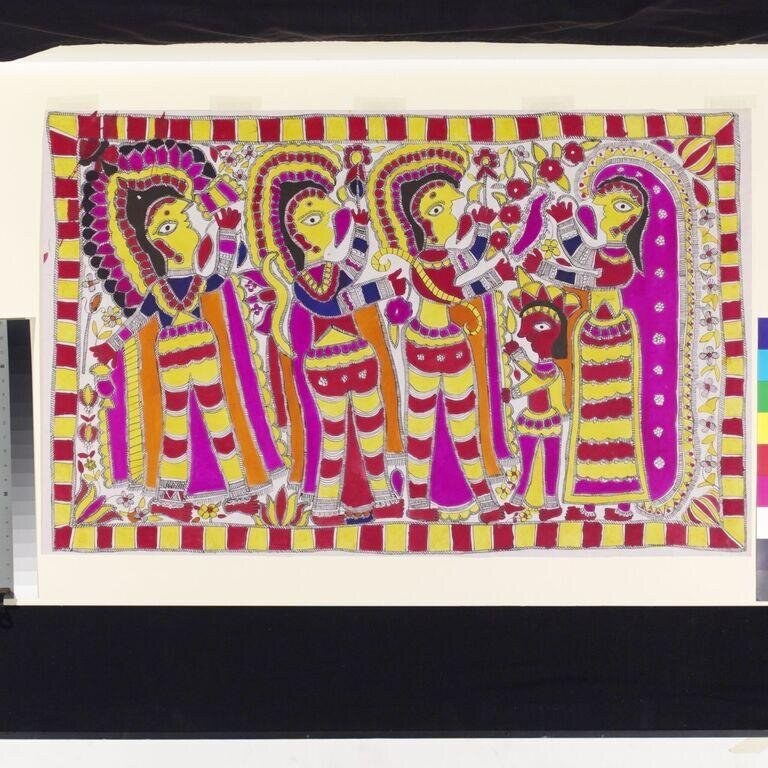
Four female figures stand in a frontal, symmetrical composition against a vivid background of alternating red and yellow squares. The women are rendered in profile or three-quarter view, wearing elaborate costumes of layered skirts in red, yellow, and purple, with heavily patterned upper garments decorated in gold, white, and dark pigments. Each figure wears a distinctive headdress with a crescent or pointed crown shape, their faces rendered with large, stylized eyes and defined features in a folk-art idiom. The painting uses bold, saturated colors and intricate surface patterning throughout. Decorative botanical and geometric motifs — flowering vines, leaves, small blossoms — fill the spaces between the figures and around the border. The overall effect is of a sacred or ceremonial grouping, with the figures appearing as a procession or gathering rather than caught mid-movement.
The dancing
The four women stand upright with minimal implied motion; their bodies are frontal or turned slightly outward, arranged in a line across the composition. Their arms hang at their sides or are positioned with hands near the body, showing no dynamic reach or extension typical of active dance movement. The posture is formal and static, suggesting a presentation or display rather than the capture of a moment in dance. Each figure is individually characterized but shares the same vertical, grounded stance.
The dance depicted
The title *Krishna* and the costume vocabulary — the layered skirts, jeweled bodices, crescent headdresses, and the ornamental treatment of the composition — suggest this work references Hindu sacred or devotional iconography, possibly the classical dance traditions of South Asia, particularly Kathakali or Bharatanatyam, which center on Krishna narratives. However, the figures do not demonstrate the characteristic mudras (hand positions), dynamic body curves, or spatial relationships of these traditions. The work reads instead as a stylized devotional or processional image, a visual gathering of female figures in ritual dress rather than a depiction of dance technique or movement. The painting may represent the visual culture of Krishna worship rather than the actual execution of a classical Indian dance form.
How it was made
This is a gouache or watercolor painting on paper, identifiable by the opaque, matte finish of the pigments, the visible brushwork defining outlines and patterns, and the bright, saturated colors typical of Indian miniature painting traditions or contemporary folk-derived practice. The technique allows for precise linear detail and flat color application, which the artist exploits fully in the geometric borders, the intricate patterning of garments, and the decorative botanical motifs. The medium and style suggest a work rooted in Indian popular or devotional art traditions rather than Western academic painting.
About this work
This is a devotional image by Bagla Devi, a painter working in Indian folk and popular art idioms in the late twentieth century. The work presents four women in elaborate Krishna-iconography costume within a densely patterned, colorfully decorated frame. Although the title references Krishna — a central figure in Hindu mythology and classical Indian dance traditions — the painting does not represent active dance performance. Instead, it is a stylized procession or gathering of female figures in ritual dress, combining elements of South Asian classical costume vocabulary with folk-art composition and the decorative density characteristic of Indian miniature painting or contemporary devotional art. The work belongs to a broader practice of sacred imagery in popular Indian visual culture, where religious narratives and iconography are expressed through figurative groupings in vivid, patterned surfaces.
How to look at it
Attend to the careful articulation of costume detail: the layered construction of the skirts, the geometric patterning of the bodices, the distinctive crescent or pointed headdresses. These elements reference classical South Asian dance dress codes, yet the artist presents them as decorative surface pattern rather than as functional costume for movement. Notice how the symmetrical, frontal composition and the ornamental framing transform the figures into a devotional tableau rather than a scene of dynamic action. The viewer should recognize that the painting is not documenting a moment of dance performance, but rather creating a sacred image through the visual language of costume and ornament.
The artist
Bagla Devi (dates unknown) worked in India in the late twentieth century, practicing in traditions of folk, devotional, and popular art. Little is documented about her biography or training, but her approach is consistent with Indian folk-painting and miniature-art practices that draw on religious and mythological narratives, using bold color, decorative surface pattern, and stylized figuration to create devotional or narrative images. Her work sits within broader twentieth-century Indian art movements that drew on indigenous visual traditions in response to colonial and postcolonial modernism.
The period
In the 1970s, when this work was created, Indian artists were increasingly examining and reviving indigenous visual traditions, including folk painting, miniature art, and devotional imagery, as a response to Western academic modernism and as a form of cultural reclamation in the postcolonial period. Classical Indian dance traditions — Bharatanatyam, Kathakali, and others — had themselves undergone significant revival and reformation during the twentieth century, moving from court and temple contexts into concert halls and national cultural institutions. Devotional imagery, particularly Krishna iconography, remained a vital subject in Indian visual and performing arts.
Where it lives
The work is held in the Virginia art collection and catalogued as a painting from 1973. No further provenance information is recorded.
Questions about this work
Is this a depiction of Kathakali or Bharatanatyam dance?
The costume vocabulary — the layered skirts, jeweled bodices, and crescent headdresses — does reference classical South Asian dance dress, particularly Kathakali. However, the figures do not demonstrate the dynamic body positions, mudras (hand gestures), or spatial relationships characteristic of these traditions. The work is better understood as a devotional image that incorporates dance costume iconography into a stylized, processional composition, rather than a direct representation of classical dance performance.
What does the Krishna title signify?
Krishna is a central deity in Hindu mythology and a dominant subject in classical Indian dance and devotional art. The title signals that this is a sacred or devotional image, and the costume and ornamental vocabulary derives from Krishna-centered religious and performance traditions. However, the title does not indicate that the painting depicts an actual classical dance performance; rather, it anchors the work within Krishna devotional iconography and visual culture.
What artistic tradition does this painting belong to?
The work draws on Indian folk painting, miniature-art traditions, and devotional imagery, using bold flat color, linear pattern, and decorative surface treatment. It sits within mid-twentieth-century Indian artistic practice that revived indigenous visual traditions in response to colonial modernism. The style is consistent with popular or folk-derived religious art rather than Western academic painting.
More dance artwork





