49 works in this view — arrow keys or swipe to move between them.
Dance in Art
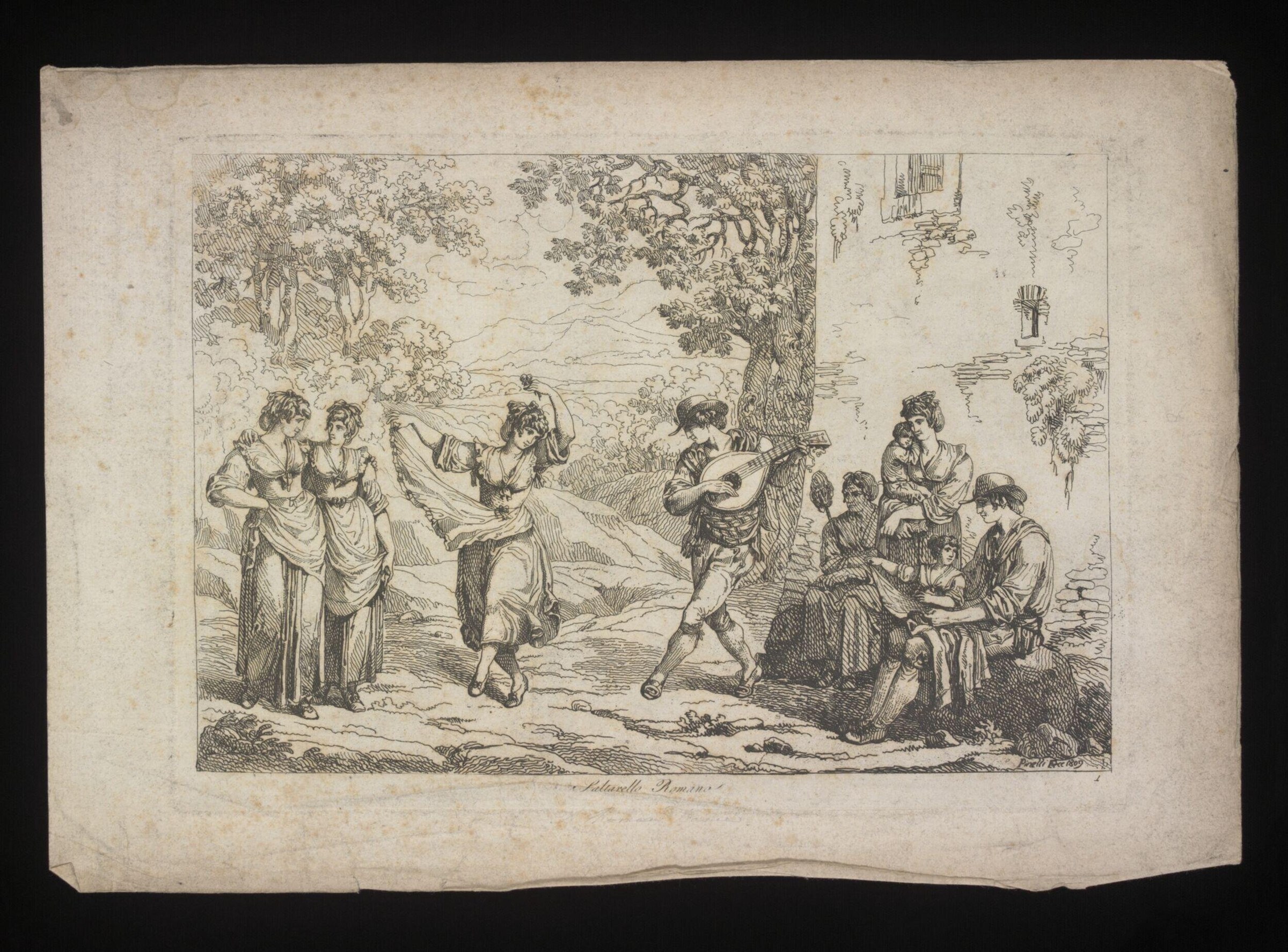
"Saltarello Romano"
Pinelli, Bartolomeo
- Collection:
- Source:
- Victoria and Albert Museum
- Rights:
- Rights vary by item — check the source record before reusing this image. Source record ↗
- Recorded as:
- V&A — check rights per item
This print documents both a specific dance form and the early 19th-century practice of representing dance history through visual media. For dance historians, it is evidence of how the saltarello was still recognized and valued as a named genre worthy of artistic representation, and of the conventions used to depict movement and musical accompaniment in the engraving tradition.
What you are looking at
A pastoral outdoor scene depicting a group of figures engaged in what appears to be a lively dance or entertainment. The setting is framed by large, leafy trees in the foreground and a distant landscape with buildings visible on the right. A figure in the center, wearing classical drapery, appears to be dancing or in vigorous motion while playing a stringed instrument—likely a lute or similar. To the left, two women in long classical dress watch or participate. To the right, a larger group of seated and standing onlookers, including women and children, observe the performance. The composition uses careful perspective to lead the eye from the active dancers in the middle distance to the audience arranged around them. The sky is rendered with light clouds, and the overall mood suggests an idealized, theatrical representation of rustic pleasure rather than a documentary scene.
The dancing
The central figure is captured mid-stride or mid-leap with one leg extended and the other bearing weight, arms positioned to hold and play the stringed instrument while maintaining the dynamic pose. The body weight is distributed in a way suggesting energetic, bouncing movement rather than the sustained poise of formal court dance. The two women on the left appear to be either about to join in or responding to the music with raised arms and animated posture. The seated and standing group on the right creates a gallery of observers, with varied poses suggesting engaged attention rather than formal arrangement.
The dance depicted
The title 'Saltarello Romano' identifies this as a saltarello, a jumping or leaping dance with Italian origins documented from the Renaissance through the 18th century. The saltarello was typically a couple or group dance marked by rhythmic hopping, springing steps, and a characteristic bounciness of carriage. The figure playing the instrument while dancing suggests the performer was simultaneously musician and dancer, a practice documented in historical sources for this folk form. The rustic setting and mixed group of spectators align with the saltarello's identity as a popular, social dance form rather than a courtly one, though by the early 19th century (the date of this print) such subjects were becoming increasingly romanticized and historicized.
How it was made
This is an engraving or etching on paper, rendered in black and white with fine hatching and cross-hatching to model form and create tonal variation. The technique allows precise, detailed linework visible in the foliage, the drapery folds, and the facial features. The print format and the style of execution suggest this was a work of circulation intended for a educated audience with an interest in historical customs or theatrical subjects. The medium's reproducibility means this image would have reached multiple viewers and likely appeared in a series or publication documenting European folk or historical dances.
About this work
This is a 19th-century engraving depicting a saltarello romano, an Italian jumping dance. The work presents the dance in an idealized, historicizing pastoral setting rather than documenting an actual performance. Bartolomeo Pinelli was a prolific printmaker and illustrator active in Rome, known for scenes of Italian daily life, historical subjects, and theatrical imagery. This print belongs to a broader 19th-century visual culture in which folk and historical dances were aestheticized and circulated as picturesque subjects for educated viewers. The image preserves visual information about how the saltarello was understood and represented at a moment when such dances were becoming objects of artistic interest and antiquarian study rather than living practice.
How to look at it
The viewer should attend to the moment of maximum lift and extension in the central figure's movement, which the artist has frozen to convey the bouncing, spring-like quality characteristic of the saltarello. Note how the figure's posture—upright torso, extended leg, and engaged upper body—contrasts with the seated, observing figures, emphasizing the energy and vigor of the dance. The instrumental accompaniment visible in the dancer's hands is important: the saltarello was a participatory social dance, often accompanied by the dancers themselves or by musicians in close physical proximity. The pastoral framing—the trees, the distant landscape, the mixed group of onlookers—is a convention of 19th-century historicizing art, meant to place the subject outside modern time.
The artist
Bartolomeo Pinelli (1781–1835) was a Roman printmaker and draughtsman celebrated for his scenes of Italian life, theatrical subjects, and historical themes. Working primarily in etching and engraving, Pinelli created images that appealed to both local Roman audiences and the broader European market for picturesque views and historical scenes. His work is characterized by lively figural composition, careful attention to costume and setting, and a tendency toward the anecdotal and theatrical. He was prolific and commercially successful, and his prints were widely collected.
The period
The early 19th century saw a surge of interest in folk culture, historical costumes, and national traditions among European artists and intellectuals, driven in part by Romantic aesthetics and emerging nationalism. Dance imagery became a vehicle for this interest, with artists representing dances as markers of regional or historical identity. The saltarello, by this date, was not a dominant form of social dance in urban centers—waltz and quadrille dominated—but was precisely the kind of 'historical' or 'rustic' subject that appealed to the aesthetic and scholarly interests of the period. Pinelli's work emerged in Rome, a city with strong ties to classical antiquity and an active tradition of historical and theatrical imagery.
Where it lives
This work is held as a print in a collection (source listed as 'va'). The print format and the artist's practice suggest it was created for circulation and likely appeared as part of a series or collection of illustrated scenes.
Dance in this work
Questions about this work
What is a saltarello?
The saltarello is a jumping or leaping dance with documented history from the Italian Renaissance through the 18th century and beyond. It is characterized by rhythmic hopping and springing steps that create a bouncing, energetic quality of movement. By the 19th century, when Pinelli made this print, the saltarello was becoming a historical subject rather than a living social dance in urban contexts, though it continued in rural areas.
Why is the figure playing an instrument while dancing?
In folk and social dance traditions, particularly in earlier centuries, dancers and musicians were often not separate roles. A skilled performer might simultaneously play an instrument and dance, maintaining the rhythm and melody while demonstrating the movements. This practice is documented in historical sources and reflects the integrated nature of music and movement in social dance culture.
Is this a historical record of an actual dance?
Not precisely. This is an artistic representation created in the early 19th century, after the saltarello had largely disappeared from fashionable urban practice. Pinelli has used the conventions of historicizing art—idealized pastoral setting, theatrical composition, classicizing drapery—to represent the dance as a picturesque historical subject. It tells us what educated 19th-century viewers believed the saltarello to be and valued about it, rather than documenting an actual performance.
More dance artwork





