49 works in this view — arrow keys or swipe to move between them.
Dance in Art
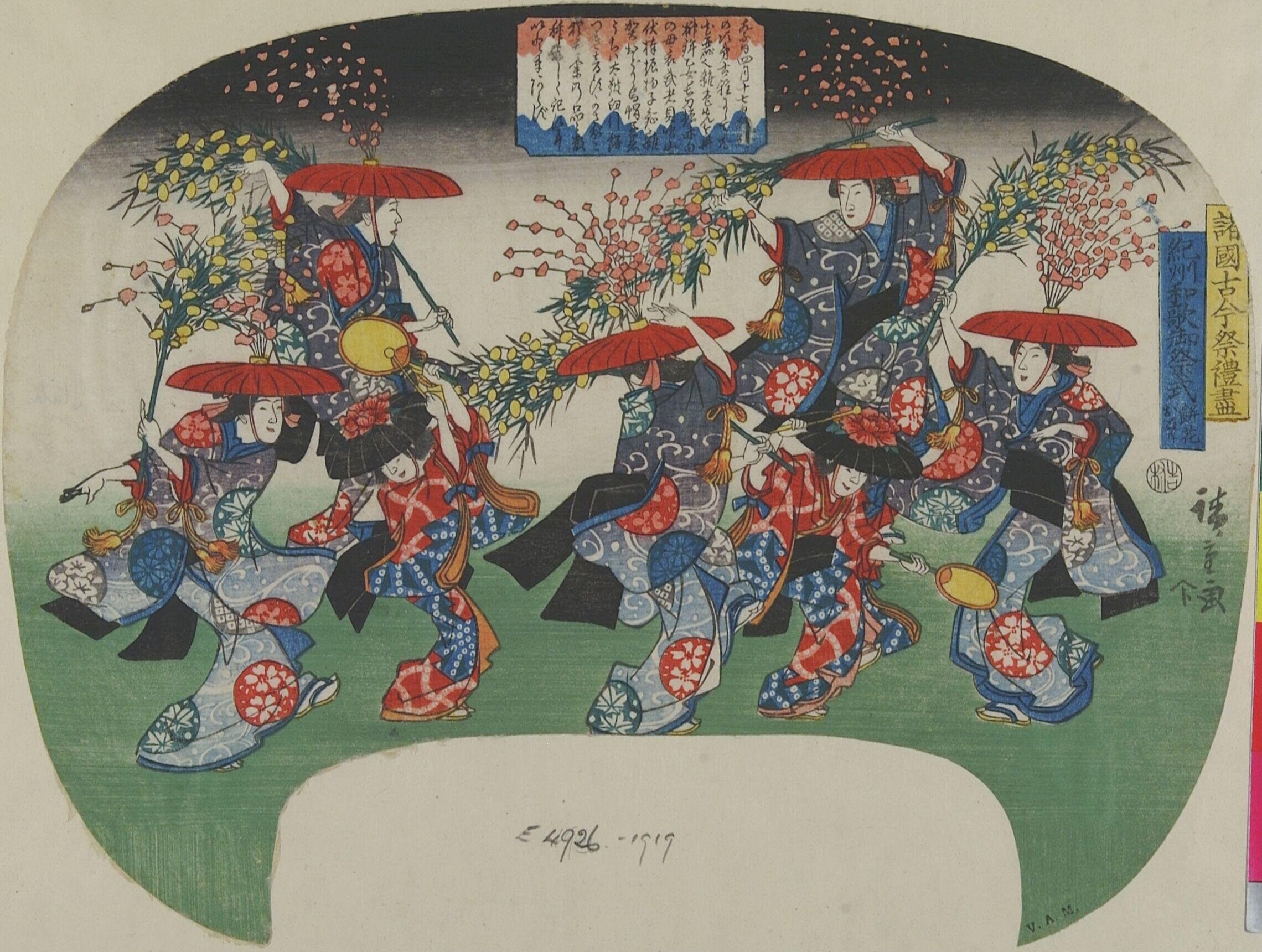
The Mochibana Dance at the Wakanoura Festival in Kii Province
Hiroshige, Utagawa
- Collection:
- Woodblock print
- Source:
- Victoria and Albert Museum
- Rights:
- Rights vary by item — check the source record before reusing this image. Source record ↗
- Recorded as:
- V&A — check rights per item
This is one of the few existing visual records of a specific named folk dance from 19th-century Japan, providing evidence of dance practices beyond the well-documented kabuki and court traditions. For dance historians, it offers rare detail about costume, grouping, outdoor performance context, and the role of women in seasonal festival celebrations. The print also documents how contemporary artists and publishers valued folk dance traditions as subjects worthy of the expensive and time-consuming medium of woodblock printing.
What you are looking at
A festive outdoor celebration unfolds across a green meadow under a darkening sky scattered with falling blossoms or snowflakes. A group of approximately eight figures, predominantly women in elaborate formal dress, moves through the landscape carrying red parasols and surrounded by flowering branches—yellow chrysanthemums and red coral-like blooms. The figures are arranged in a loose, animated formation suggesting movement and play rather than a formal processional line. In the middle distance, a wooden structure or pavilion can be seen, and the composition is framed by gracefully bending flowering branches that extend across the upper portions of the print, creating a natural canopy. A cartouche with Japanese text floats above the scene, and the artist's seal appears in the lower right. The overall effect is one of joy and seasonal celebration, with the figures seemingly engaged in a dance or play among the flowers.
The dancing
The bodies are shown in varied, dynamic postures suggesting movement and interaction rather than formation. Some figures lean into their steps with weight forward; others turn with arms extended or held at the side. The dancers wear elaborate layered kimonos in deep blues and blacks with bold red and white patterns, their legs visible in coordinated patterned leggings and raised footwear. The closest figure on the left extends an arm upward in a reaching gesture, while others move with bent knees and turned-in posture. The grouping is informal and playful—figures overlap and turn toward one another in a way that suggests group engagement and spontaneous movement rather than synchronized choreography.
The dance depicted
This depicts the Mochibana (rice-cake flower) Dance, a seasonal festival celebration from Wakanoura in Kii Province. The dance was likely a folk celebration connected to spring festivals and seasonal rituals. The informal grouping, outdoor setting, and association with flowers and seasonal abundance suggest this was participatory rather than professional dance—a community or shrine-based celebration in which dancers moved among flowering branches as part of a festive ritual. The costumes and the women-centered cast suggest this may have been performed at a Shinto shrine or seasonal festival. The specific style of movement, with its emphasis on playful interaction and informal formation among nature, marks this as a regional folk practice rather than court or theatrical dance.
How it was made
This is a woodblock print, recognizable from its bold outlines, restricted color palette (deep blues, reds, yellows, greens, and flesh tones), and the characteristic flattening of perspective. The medium allowed for mass distribution of images of contemporary life and popular celebrations. Woodblock printing in the 19th century was the primary means by which images of kabuki, festivals, and daily life reached a broad audience in Japan. The precision of the carving enabled the artist to capture fine detail in textile patterns and facial features, while the inherent qualities of the medium—flat color fields, bold contours, stylized foreshortening—shaped how the scene could be represented. This print format indicates the dance was considered noteworthy enough to document for a popular audience.
About this work
This woodblock print from 1843 documents a regional spring festival dance from Wakanoura, Kii Province, capturing a moment of joyful community celebration among flowering trees. The Mochibana Dance appears to have been a participatory seasonal ritual performed by women, combining elements of play, courtship display, and seasonal worship. The work is a rare visual record of a folk dance tradition that left few other traces, preserved through the popular medium of woodblock printing. It belongs to the body of documentation of Japanese regional festivals and folk practices during the Edo-Meiji transition period, a moment when traditional seasonal celebrations were still vital but increasingly subject to modernization and change.
How to look at it
Attend to the composition of bodies in space: notice how the figures are scattered and overlapping rather than arranged in a line, and how the forward-leaning postures and varied arm gestures create a sense of movement and spontaneity. The artist has chosen a moment of play and interaction rather than a formal display. Look at how the flowers frame and integrate with the human figures—the branches extend through and across the scene of dancers, suggesting that the dance and the seasonal abundance of flowers are parts of a single celebration. The costumes deserve close study: the patterned layers of cloth, the raised footwear, and the coordinated red parasols are all markers of formal dress and special occasion. Finally, notice how the artist has rendered the gathering moment—not a procession or performance for an external audience, but a community of women moving together in their landscape.
The artist
Utagawa Hiroshige (1797–1858) was one of the most celebrated landscape and genre painters of the late Edo period, known for his series of prints depicting sites across Japan. While famous for landscape studies like the 'Fifty-Three Stations of the Tōkaidō,' Hiroshige also documented scenes of daily life, festivals, and theatrical practice. His work is characterized by sensitive observation of light, atmosphere, and the textures of clothing and natural materials, combined with the bold compositional simplicity of the woodblock tradition. Hiroshige's prints were among the most widely distributed Japanese images in the 19th century and influenced European artists. His documentation of regional festivals and folk practices was part of a broader mid-19th-century interest in recording local traditions during a period of rapid social change.
The period
In the 1840s, Japan was in the final decades of the Edo period, before the opening to Western trade and the Meiji Restoration of 1868. Regional festivals and folk dances were active parts of community life, often connected to Shinto shrine celebrations and seasonal agricultural cycles. At the same time, woodblock printing had reached a high degree of technical sophistication and commercial organization, allowing popular images to circulate widely. The year 1843 falls in a period of particular vitality in Japanese printmaking, before photography would begin to displace woodblock documentation of contemporary life. Dance in this period existed across multiple registers: the highly codified kabuki traditions documented in prints; the regional folk practices preserved in festival celebrations; and the courtly or religious dances performed at shrines and temples. Hiroshige's choice to record the Mochibana Dance in print reflects how festival and folk traditions were becoming recognized as subjects of cultural interest even as modernization was beginning to transform them.
Where it lives
The work is recorded in a collection with the source designation 'va' and the accession number 54926-'19'. It is held as a woodblock print and appears to be part of a systematic collection of Japanese prints, though the exact institutional location is not specified in the catalogue record.
Dance in this work
Questions about this work
What is the Mochibana Dance?
Mochibana (rice-cake flower) was a seasonal festival celebration from Wakanoura in Kii Province, likely performed as part of spring festivals or shrine celebrations. Based on this print, it appears to have been a participatory dance among flowering branches, performed by women in formal dress. The specific rituals and meanings are not fully documented beyond this visual record and the archival title.
Why are the figures not in a line?
The informal scattered grouping suggests this was not a highly choreographed or staged performance, but rather a participatory community celebration. The figures interact with one another and with the flowering branches, suggesting the dance was about joyful engagement rather than formal display or synchronization.
Why are there so many flowers?
The flowers are central to the dance's identity and meaning—the Mochibana Dance was explicitly a flower-viewing and flower-interaction celebration, likely connected to spring fertility rites or seasonal shrine worship. The abundant flowering branches frame and integrate with the dancers, making the natural world part of the ritual action.
Who were the dancers?
Based on the depiction, the Mochibana Dance appears to have been performed primarily or exclusively by women. The costumes and the context suggest participants of various ages and possibly varying social status, but the print does not provide enough detail to determine whether these were professionals, shrine attendants, or members of the general community.
More dance artwork





