49 works in this view — arrow keys or swipe to move between them.
Dance in Art
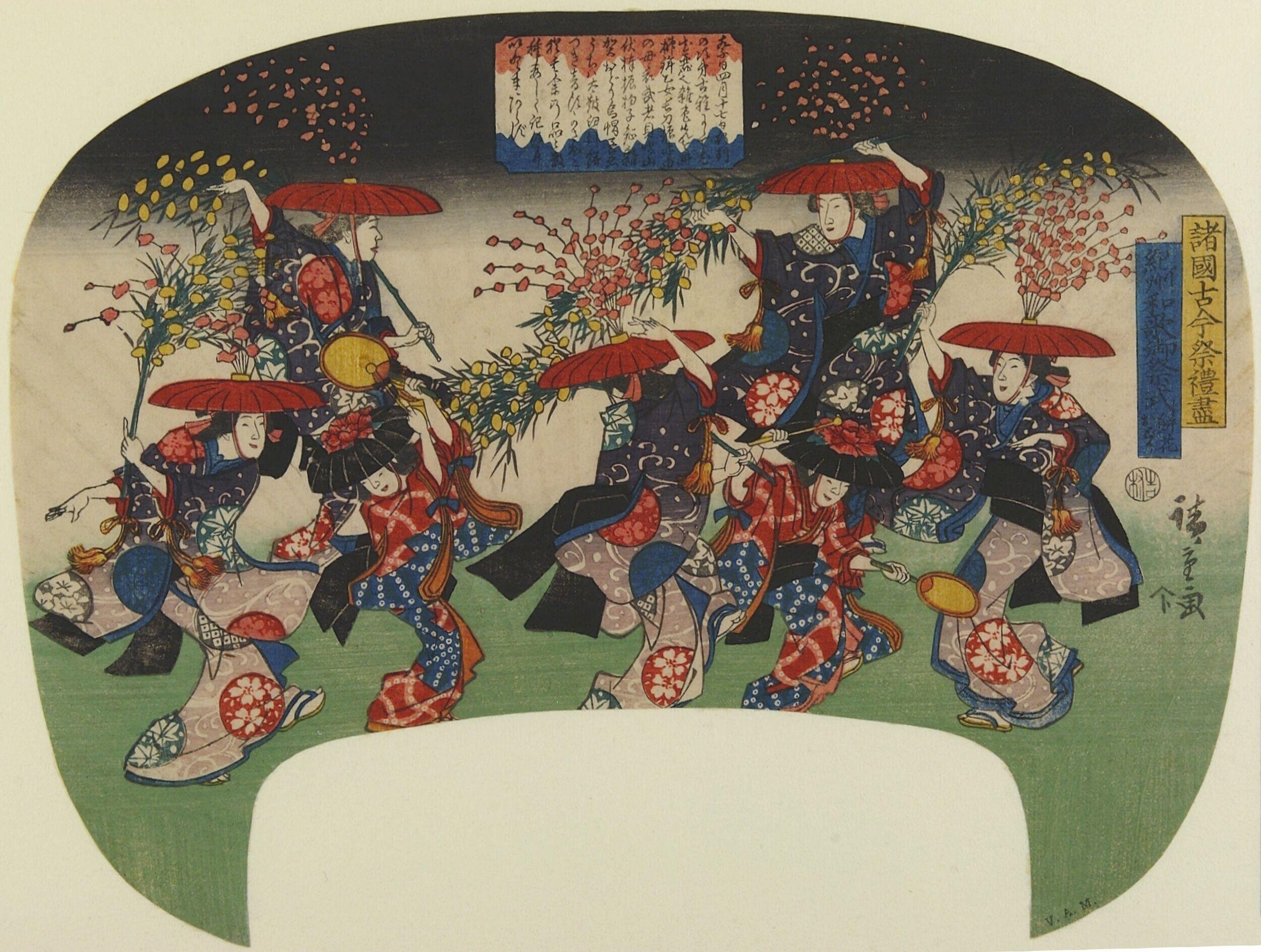
The Mochibana Dance at the Wakanoura Festival in Kii Province
Hiroshige, Utagawa
- Collection:
- Woodblock print
- Source:
- Victoria and Albert Museum
- Rights:
- Rights vary by item — check the source record before reusing this image. Source record ↗
- Recorded as:
- V&A — check rights per item
The print documents a specific regional festival practice in its material and social context—what people wore, how they moved together, what they carried, and what the occasion meant—in a way that written description alone cannot convey. For dance historians studying Japanese folk practice and seasonal ritual, this is primary source material showing the coordination, dress codes, and symbolic objects of a spring ceremony. The work demonstrates how Hiroshige used prints not merely for artistic effect but as a form of cultural documentation, preserving ephemeral social practices before they disappeared.
What you are looking at
A Japanese woodblock print depicting a festival celebration with multiple figures arranged across a green ground beneath a dark sky. Eight to ten figures in elaborate dress move across the composition, all holding red umbrellas despite clear weather, suggesting this is a processional or ritual moment rather than protection from rain. The figures wear richly patterned kimonos in blues and reds with white geometric designs, their lower legs and feet visible in patterned stockings. They carry flowering branches—chrysanthemums and other seasonal blooms in reds and yellows—creating a dense vertical rhythm throughout the composition. Above them, flowering trees with pendulous branches frame the scene, their blossoms echoing the umbrellas and carried flowers. A cartouche at top center contains calligraphic text in red and black ink on a cream ground. The composition is bounded by a rounded rectangular format typical of woodblock prints, with a blue cartouche on the right edge bearing the artist's mark.
The dancing
The figures move with synchronized, deliberate pacing across the ground plane, their bodies upright and formal rather than abandoned or ecstatic. Arms are raised to hold the umbrellas at roughly shoulder height, the other arms extended to balance the large flowering branches. The poses suggest processional movement—stately, ritualized, and coordinated—rather than individual expression. All figures maintain similar spacing and alignment, moving in the same direction across the field, which creates a strong sense of ceremonial order. The weight appears distributed evenly on both feet, with minimal dynamic shift of the body's center; the stance is stable and sustained rather than momentary.
The dance depicted
This appears to document a Mochibana (flowering branch) dance or ceremony, a seasonal celebration associated with spring festivals in Kii Province (now Wakayama Prefecture). The synchronized, processional arrangement with carried flowers and umbrellas suggests a folk or ritual practice rather than trained theatrical dance, though the formal pacing and deliberate spacing indicate this was a structured, repeatable event with established conventions. The combination of flowering branches, red umbrellas, and processional formation points to a spring fertility or seasonal renewal ceremony, likely performed communally by townspeople or shrine attendants. The print appears to document actual festival practice rather than create theatrical fantasy.
How it was made
This is a woodblock print (likely a full color woodblock or nishiki-e) from the 1840s, a technique that required separate carved blocks for each color layer. The precision of registration visible in the geometric patterns on the kimonos, the clean outlines in black ink, and the characteristic color palette (deep blues, brick reds, pale yellows, flesh tones) are consistent with commercial woodblock production of the period. The rounded format suggests this may be part of a series. The technique allowed rapid production of images for broad distribution, making this accessible documentation of a regional festival to audiences well beyond Kii Province.
About this work
This woodblock print by Hiroshige records a spring festival procession—the Mochibana dance or ceremony at Wakanoura in Kii Province—showing a group of formally dressed figures moving in synchronized formation while carrying flowering branches and holding red umbrellas. The work combines meticulous observation of dress and ritual formation with the compositional sophistication typical of Hiroshige's documentary prints of regional festivals. It belongs in a gallery of dance in art because it preserves evidence of a communal, seasonal practice that was probably already fading from living tradition even as it was being printed; it captures the structure, dress, and ceremonial order of a folk celebration in which movement and formation were essential.
How to look at it
Attend to the formal spacing and synchronized posture of the figures: each maintains nearly identical arm height, body orientation, and forward spacing, which tells you this is a choreographed or at least strongly conventionalized practice, not spontaneous celebration. Notice how the artist has frozen the moment mid-procession, with all figures at roughly the same point in their movement—this is a deliberate choice that emphasizes the uniformity of the practice rather than capturing individual variation. Look at the way the flowering branches and umbrellas create vertical echoes throughout the composition, linking the human figures to the natural forms above them: this visual strategy suggests the ceremony is a bridge between human society and seasonal renewal. The cartouche at top center likely contains a title or poetic inscription that would have anchored the print's meaning for contemporary viewers.
The artist
Utagawa Hiroshige (1797–1858) was one of the most prolific and commercially successful woodblock print artists of the late Edo and early Meiji periods. He is best known for his landscape prints—particularly the series *Fifty-three Stations of the Tōkaidō* and *One Hundred Famous Views of Edo*—but he also produced numerous prints documenting festivals, seasonal customs, and regional practices throughout Japan. His work combined topographical accuracy with artistic composition, making his prints valuable both as popular entertainment and as historical records. He worked closely with publishers and carvers to produce images in large editions, giving him significant reach into urban and provincial markets.
The period
The 1840s were a period of relative peace and economic development in Japan, during which interest in regional culture and seasonal traditions was strong among educated urban audiences. Woodblock prints of festivals and customs were commercially successful because they allowed city dwellers to experience the diversity of Japanese regional life. At the same time, industrialization and urban growth were beginning to erode traditional festival practices, making these prints increasingly valuable as records. In the broader context of Japanese art, Hiroshige's generation saw woodblock printing reach its technical and commercial apex, just before the opening of Japan in 1854 began to transform artistic practice.
Where it lives
The work is held as a woodblock print in a collection with the source designation 'va'. The print bears Hiroshige's seal on the right edge and a cartouche with calligraphic text typical of commercial woodblock series.
Dance in this work
Questions about this work
What is a Mochibana dance?
Mochibana (mochi flower or celebration branch) refers to a spring festival ceremony in which participants carry flowering branches in procession. The branches symbolized renewal and fertility; the red umbrellas in this print may reference either practical use in variable spring weather or symbolic protection and blessing. The practice was particularly associated with shrine festivals in the Kii region and was already being documented by Hiroshige's time as regional tradition.
How do we know this is a real festival and not an artistic invention?
Hiroshige titled the work to reference a specific place and practice (Wakanoura Festival in Kii Province), and his prints of festivals were marketed to audiences as documentary records rather than fantasy. The consistency of dress, the formal choreography, and the specific seasonal flowers all align with historical records of the actual Mochibana ceremony. However, like all prints, this is a composed and selected image—it shows what the artist chose to emphasize, not an unmediated record.
Who performed these dances—professionals or townspeople?
Based on the dress and formation, this appears to be a communal or shrine-based practice performed by local people—attendants, devotees, or community members—rather than by professional entertainers. The formal but non-theatrical movement style, the seasonal/ritual context, and the regional festival designation all suggest this was participatory folk practice embedded in local religious or seasonal observance.
More dance artwork





