49 works in this view — arrow keys or swipe to move between them.
Dance in Art
Theatre costume
Givens, Craig
- Collection:
- Theatre costume
- Source:
- Victoria and Albert Museum
- Rights:
- Rights vary by item — check the source record before reusing this image. Source record ↗
- Recorded as:
- V&A — check rights per item
This object shows the sophisticated engineering and craftsmanship embedded in theatrical costume design. It is a record of how dance theatre (and allied performance media) transforms the body through apparatus, and how ornament, weight, and geometry constrain and define the dancer's presence onstage.
What you are looking at
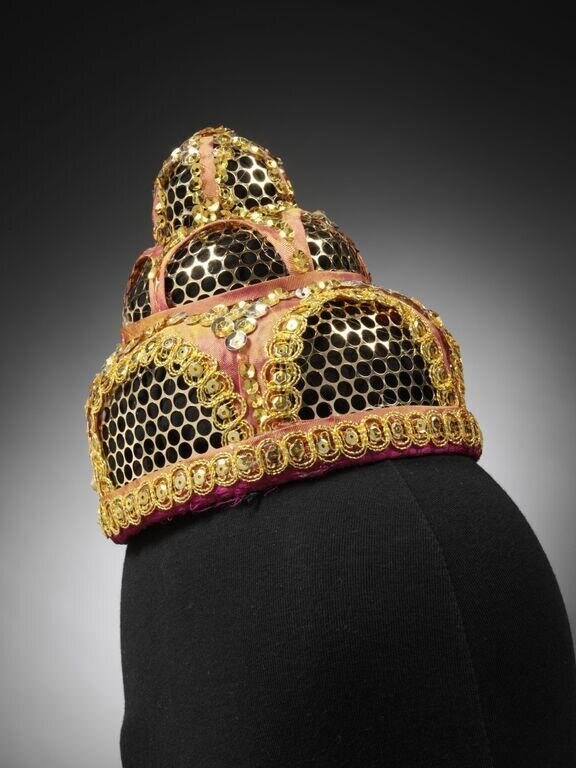
A theatrical headdress towers in layers against a neutral gray background, worn on a mannequin dressed in black. The costume piece is constructed from mesh or perforated metalwork in gold, arranged in three stacked dome shapes of decreasing size. The largest dome forms a broad base ornament about the shoulders; two smaller domes rise above it. Ornamental gold banding, likely embossed with repeated motifs, trims each layer where it meets the next. Deep red or crimson silk fabric—possibly velvet—forms the bands between the metal sections and lines the visible interior edges. Small glass or rhinestone gems are sewn at intervals across the ornamental bands, catching light. The overall effect is architectural, palatial, and vertically emphatic, designed to add considerable height and presence to the wearer's silhouette.
The dancing
No dancer is visible; the costume is displayed on a dress form. The headdress dominates the composition, sitting well clear of the mannequin's head and shoulders. Its geometric, stacked structure creates a static, frontal presentation rather than any active bodily gesture.
The dance depicted
The headdress is unlikely to be primary dancewear; its weight, bulk, and fixed architectural form are incompatible with the fluid, mobile movement required in most theatrical dance traditions. It may have been worn by a court dancer, ceremonial performer, or actor-dancer in a highly stylized, processional, or static theatrical role—possibly in historical drama, royalty representation, or fantasy spectacle. The Indian/South Asian-inspired ornamental vocabulary (the dome shapes, gem-setting, metal filigree) suggests possible use in a production drawing on or themed around subcontinental or orientalist aesthetics, though the costume's theatrical formality and the date (1986) point more to commercial theatrical production than traditional South Asian dance forms.
How it was made
This is a three-dimensional costume object, not a flat image. The headdress appears to be constructed from hand-perforated or laser-cut sheet metal (likely brass, copper, or gold-plated steel), assembled into dome shapes, joined by fabric strips, and embellished with hand-sewn gems. It represents skilled millinery and metalwork craft. The photograph is a studio documentation shot, likely taken to record the costume for archival or production purposes, using careful frontal lighting to show the object's volumetric form and surface detail clearly.
About this work
This is a theatrical costume headdress from 1986, attributed to designer Craig Givens. It is a spectacular sculptural object: three stacked domes of pierced metalwork, trimmed in gemstone-set gold banding and deep red silk. The work is a showcase of craft—precise metalwork, fabric joining, and jeweling—designed to transform the wearer's silhouette into something grand and ceremonial. It sits at the intersection of costume design, millinery, and ornamental metalwork, and belongs in a dance gallery as a document of how theatre costuming realizes character, status, and narrative through the body and its adornment. The headdress is too heavy and rigid for continuous dancing, but would serve a role in processional, courtly, or tableau-vivant performance—the kind of theatrical moment where the dancer stands or moves very deliberately, and the costume itself is a visual anchor of the scene.
How to look at it
Attend to the sheer visual weight and height of the headdress: it is designed to dominate the stage picture and make the wearer's head and shoulders into a monumental presence. Notice the precision of the metalwork—the uniform perforations, the clean geometry of the dome shapes, the careful placement of gems and trim. The choice to show it as a tower, stacked and frontal, tells you that its theatrical purpose was to create a silhouette readable from a distance; it works by shape and shine, not by intricate detail visible up close. The red silk underlay, visible at the seams, adds warmth and richness against the hard metal.
The artist
Craig Givens is credited as a theatre costume designer working in 1986. Beyond the attribution on this piece, little contextual information is available in the record. The sophistication of execution and the confident handling of ornamental and metalwork detail suggest professional training and established practice in theatrical costume construction.
The period
In 1986, theatre costume design in North America was in a period of high technical sophistication and historical eclecticism. Designers routinely drew on world costume traditions—European court dress, South Asian textiles and ornament, historical fantasy—for contemporary productions. The pierced-metal and gem-set ornamental aesthetic visible here was in dialogue with both historical precedent (eighteenth-century court dress, ornamental headwear) and contemporary maximalism in fashion and design. This was also an era before digital fabrication; such a headdress would have required hand-metalworking and labour-intensive assembly.
Where it lives
The piece is held as a theatre costume in the collection. The attribution to Craig Givens and the date of 1986 come from the original catalogue record; no further provenance information is recorded.
Questions about this work
Was this actually worn while dancing?
Probably not in continuous movement. The headdress is too heavy and architecturally rigid to permit the fluid, varied motion of most dance. It was more likely worn in a static, ceremonial, or processional role—the kind of theatrical moment where the dancer-performer stands, moves slowly, or turns as a unified figure. It transforms the body into an icon rather than freeing it for dance.
What culture or tradition does this design draw on?
The stacked domes, gem-setting, perforated metalwork, and deep red silk suggest influence from South Asian and Middle Eastern ornamental traditions, though the 1986 date and theatrical context indicate this is a costume designer's interpretation and synthesis, not reproduction of a historical form. It exemplifies the eclectic, cross-cultural borrowing common in Western theatre costume in that era.
How was this made?
The metal domes appear to be hand-perforated sheet metal (brass or copper, possibly gold-plated), assembled and joined with fabric bands. The ornamental trim is hand-sewn, as are the gems. This required skilled metalworking and millinery labour—no digital fabrication or laser-cutting technology was used in 1986.
More dance artwork





