49 works in this view — arrow keys or swipe to move between them.
Dance in Art
Hardanger fiddle
Helland, K. E.
- Collection:
- Hardanger fiddle
- Source:
- Victoria and Albert Museum
- Rights:
- Rights vary by item — check the source record before reusing this image. Source record ↗
- Recorded as:
- V&A — check rights per item
For a dancer or historian of folk traditions, this fiddle is a primary document of how 19th-century Scandinavian dances sounded and felt in performance. The Hardanger fiddle's characteristic bright, resonant tone—produced by the sympathetic strings—is inseparable from the physical experience of dancing the Halling, springar, and other Norwegian folk dances. Understanding the instrument is essential to understanding the dance.
What you are looking at
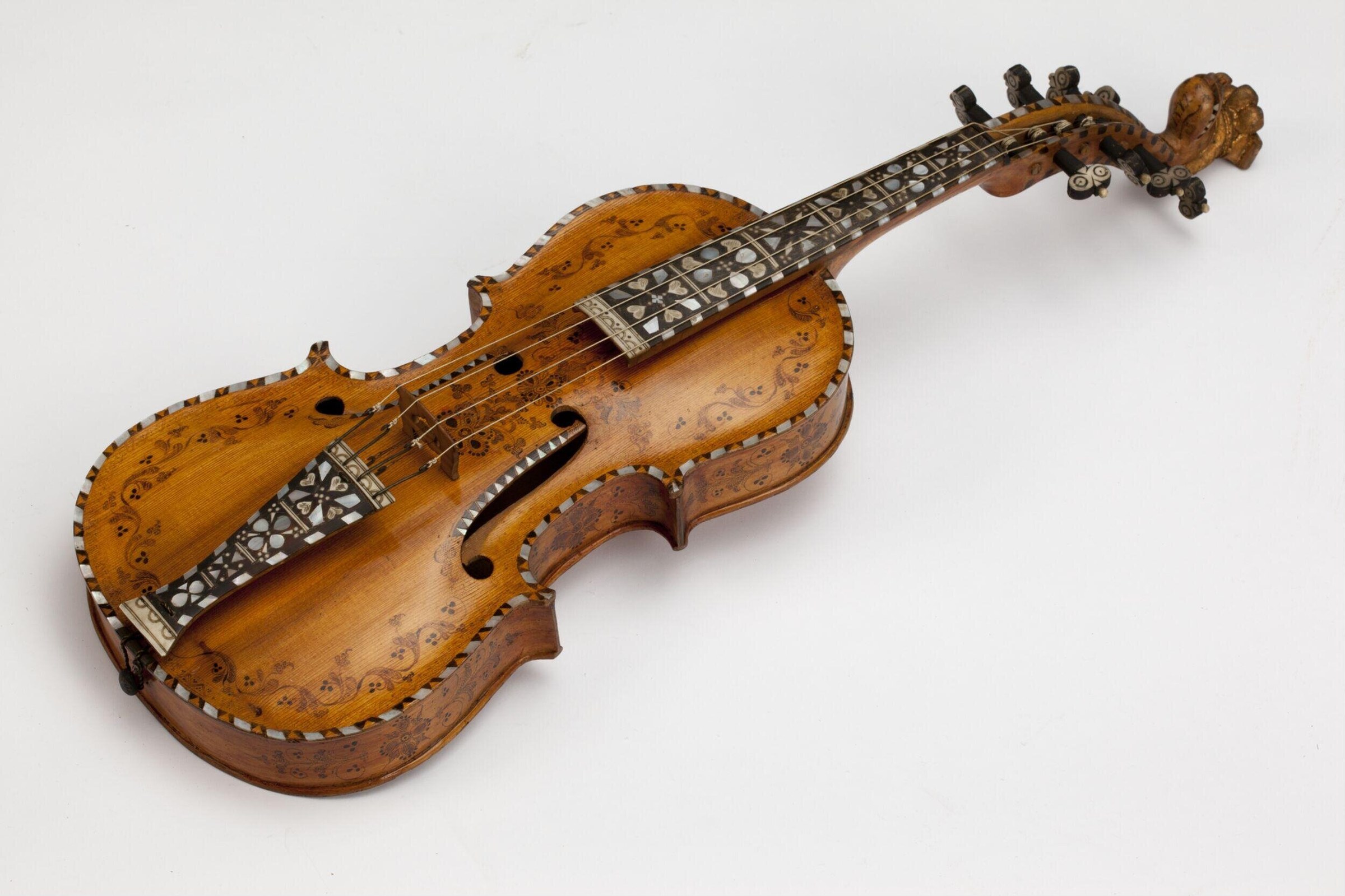
This is a Hardanger fiddle, a stringed instrument ornately decorated with inlaid wood and bone. The instrument is photographed against a neutral background, displayed at a three-quarter angle that shows its full profile. The body is made of light wood with dark burls or knots visible across the surface, and features a distinctive curved shape with pronounced bouts. The neck extends at a gentle upward angle and terminates in a carved, sculptural head with four tuning pegs protruding from the sides. A fingerboard inlaid with mother-of-pearl or bone runs down the neck in geometric patterns. Below the fingerboard, sympathetic strings (the characteristic feature of Hardanger fiddles) are visible running parallel to the main playing strings. The bridge and fine tuners are simple and functional. The entire instrument is treated as a precious object, with decorative inlay work covering much of the visible wood surface.
The dancing
This is not a depiction of dance or dancers. It is a musical instrument photographed as an artifact. There are no human figures, bodies, or gesture to analyze.
The dance depicted
The Hardanger fiddle is the primary folk instrument of Norwegian Halling and other Scandinavian folk dances, particularly those of the Hardanger region. While the instrument itself is not a dance, it is inseparable from the dance practices it accompanies. The fiddle's bright, ringing tone—produced by the sympathetic strings that vibrate in response to the main strings—provides the characteristic sound of Norwegian folk dance music. The instrument would have been played for couple dances, solo male displays of virtuosity like the Halling (a leaping folk dance), and group celebrations. This particular example, made in 1872, represents the height of the 19th-century Hardanger fiddle-making tradition.
How it was made
This is a carved and inlaid wooden instrument, not a two-dimensional artwork. It is a functional musical artifact treated as a fine craft object. The maker, K. E. Helland, was a Norwegian master craftsman whose fiddles are valued both as musical instruments and as examples of decorative woodworking. The inlay work—visible bone or mother-of-pearl set into the darker wood—required precision hand-carving and assembly. The sympathetic strings are strung alongside the main playing strings, a technical feature that distinguishes Hardanger fiddles from standard violins. Such instruments were made for professional musicians and wealthy patrons, indicating their status as prestige objects beyond mere functionality.
About this work
The Hardanger fiddle is the signature instrument of Norwegian and Scandinavian folk dance traditions, particularly the vigorous male solo dances and couple dances of the 19th century. This example, dated 1872 and made by the master craftsman K. E. Helland, represents the peak of Hardanger fiddle construction during a period when folk music and dance were being actively preserved and celebrated as markers of national identity. The instrument's ornamental inlay work and the care taken in its construction reflect both the technical demands of folk music performance and the cultural value placed on these traditions. It belongs in a gallery of dance in art because the Hardanger fiddle is as essential to understanding Scandinavian folk dance as any depiction of dancers themselves—the sound it produces shaped the rhythm, tempo, and character of the dances it accompanied.
How to look at it
Observe the sympathetic strings running beneath the main strings—these are the signature feature of the Hardanger fiddle and the source of its distinctive bright, ringing tone that cuts through the sound of other instruments in a folk ensemble. Notice the care taken in the decorative inlay work on the body and neck; this ornamentation indicates both the maker's skill and the status of the instrument as a valued possession, not merely a tool. The carved head and scrollwork are characteristic of Norwegian folk aesthetics. To understand the instrument's role in dance, imagine the brightness and clarity this fiddle would project in a room full of dancing—its tone would drive the pace and energy of the movement.
The artist
K. E. Helland was a 19th-century Norwegian master fiddle-maker whose instruments are highly regarded for their acoustic properties and decorative craftsmanship. Hardanger fiddle-making was a specialized craft, concentrated in the Hardanger region of southwestern Norway, and makers like Helland were respected artisans whose instruments were sought after by professional folk musicians. The practice of creating ornately decorated fiddles reflects the intersection of practical musicianship and folk art traditions in 19th-century Scandinavia.
The period
The 1870s were a period of intense cultural nationalism across Scandinavia, with folk music and dance being actively collected, documented, and celebrated as expressions of national identity distinct from Continental or cosmopolitan fashions. This coincided with a broader Romantic-era interest in folk traditions as repositories of authentic national character. Hardanger fiddle-making reached a peak of technical and artistic refinement in the mid-to-late 19th century, as these instruments became standardized and prized for both their musical qualities and their role in preserving and performing folk dances that might otherwise be displaced by ballroom dancing and urban popular culture.
Where it lives
The record indicates this is held within a collection identified as 'Hardanger fiddle,' with the source noted as 'va' (likely Virginia or a similar designation). The medium is not recorded in the catalogue, but visual inspection confirms it is a wooden stringed instrument with bone or mother-of-pearl inlay.
Dance in this work
Questions about this work
What makes a Hardanger fiddle different from a regular violin?
The Hardanger fiddle has sympathetic strings—additional strings that run beneath the four main playing strings and vibrate in sympathy with them, producing a bright, shimmering tone unique to Norwegian and Scandinavian folk music. This acoustic signature is essential to the character of folk dances like the Halling. The instrument is also typically more heavily ornamented than a classical violin, reflecting its role as a cultural object as well as a musical instrument.
Who played the Hardanger fiddle and for what occasions?
Professional folk musicians and gifted amateurs played Hardanger fiddles at dances, celebrations, and social gatherings throughout rural Scandinavia. The instrument was particularly important for male solo display dances like the Halling and for couple dances like springar and halling. By the 19th century, fiddle-playing had become a respected profession, and master makers like K. E. Helland supplied instruments to sought-after musicians.
Why is this a dance object?
The Hardanger fiddle is inseparable from Scandinavian folk dance practice. Dance historians and performers study instruments like this to understand the sonic and rhythmic environment in which dances developed and were performed. The fiddle's technical capabilities—its brightness, its ability to sustain long notes, its responsiveness to rapid fingerwork—directly shaped the choreography and music of the dances it accompanied.
What does the inlay work tell us?
The decorative inlay of bone or mother-of-pearl indicates that this fiddle was made for a skilled, probably professional musician or a wealthy patron—not for a casual player. The time-intensive craftsmanship reflects the high status of the instrument and its owner within folk culture, and the care taken in its construction signals that this was a valued heirloom and cultural treasure.
More dance artwork





