49 works in this view — arrow keys or swipe to move between them.
Dance in Art
Illustration
Allinson, Adrian Paul ROI, RBA
- Collection:
- Illustration
- Source:
- Victoria and Albert Museum
- Rights:
- Rights vary by item — check the source record before reusing this image. Source record ↗
- Recorded as:
- V&A — check rights per item
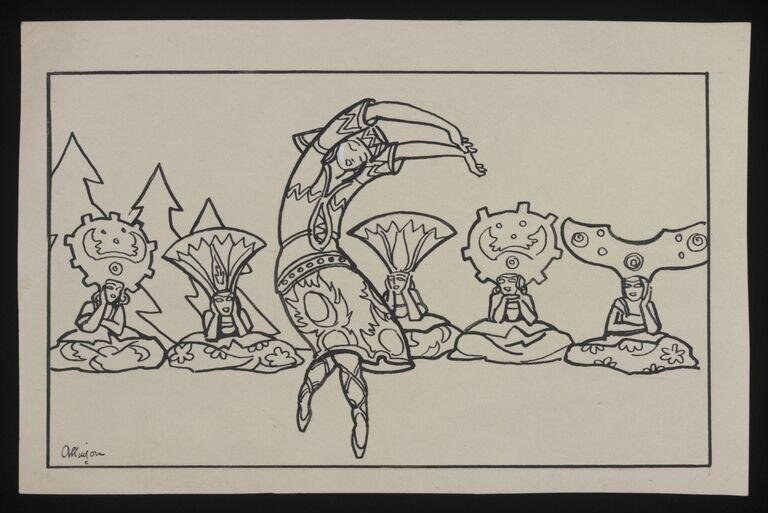
The illustration captures an early modernist approach to ornamental design and fantasy costume, reflecting the period's fascination with non-Western and experimental theatrical forms. For dance historians, it documents the visual vocabulary of pre-Ballets Russes theatrical fantasy.
What you are looking at
A line of five fantastical figures stands against a sparse landscape marked by a few stylized trees. The composition is strictly frontal and linear, arranged as if for display rather than in dramatic action. Each figure is rendered in pen with equal attention, suggesting a taxonomy or parade rather than a narrative moment. The leftmost figure wears a sun-like headdress with radiating points; the second sports a fan or shell-shaped ornament on the head; the central, tallest figure dominates with an enormous curved plume or feathered headdress and appears most elaborately dressed; the fourth figure mirrors some elements of the second; the rightmost is the most abstracted, almost geometrical. All stand upright with their weight evenly distributed. The ground is indicated by stippled patches beneath each figure's feet. The style is linear and decorative, with no shadow or volume modelling.
The dancing
The figures are nearly motionless, planted vertically with arms at their sides or held in neutral positions. There is no visible dance frame, no weight shift, no indication of momentum or step. The postures are static and heraldic rather than dynamic. The central figure's elaborate costume dominates visually but does not suggest mid-movement; instead, the exaggerated headdress reads as ornamental display. None of the bodies show the flexibility, turnout, or coordinated partnering that characterizes dance movement.
The dance depicted
This is not a representation of dance in motion. The figures appear to be costume designs, carnival or festival characters, or allegorical personages arranged for inspection. They may reference ceremonial or processional contexts—the ornamental headdresses suggest festive or ritualistic dress—but nothing in the image shows these figures dancing, moving, or engaged in choreographed action. The work is a design study or illustration of fantasy characters rather than a dance scene.
How it was made
A pen-and-ink line drawing, likely a preparatory illustration or finished work for print publication. The technique is economical and linear, relying entirely on outline and minimal cross-hatching for texture. No colour or tone modelling is used. This method suggests circulation through reproductive means—a magazine, book, or design journal. The style is consistent with early 20th-century commercial illustration, economical in means but precise in execution.
About this work
This is an illustration of five stylized fantasy or carnival figures in elaborate costume, rendered as a frontal parade or display. It is a work of imaginative design rather than a document of dance, though the ornamental headdresses and festive character suggest a theatrical or ceremonial context. The work belongs in a dance art gallery only provisionally—it depicts dress and spectacle that may be associated with performance, but not dance itself in any active sense.
How to look at it
Attend to the headdresses: they are the visual centre of each figure and suggest research into or invention of exotic ornamentation. Notice the strict frontality of the composition and the absence of any turning or spatial relationship between the figures—they are isolated within a shared plane. The work is about display and costume design, not about the bodies beneath.
The artist
Adrian Paul Allinson (1896–1959) was a British painter, printmaker, and designer associated with the Royal Academy and British modernism. He worked extensively in illustration and decorative design, contributing to magazines and theatrical productions. His work often combined precise draughtsmanship with imaginative subject matter, bridging commercial design and fine art.
The period
This drawing dates to 1918, a moment when European theatre and design were awake to non-Western aesthetics and when costume and ornament were being reconsidered through an experimental lens. The First World War had just ended; the Ballets Russes had by then profoundly shifted expectations of what theatrical spectacle could be. Allinson's work sits in this ferment of imaginative re-staging, though it appears more indebted to fantasy and decorative design than to any specific choreographic practice.
Where it lives
The work is held as part of a broader collection of illustration. It is catalogued minimally and may have been part of a larger project—a series of character designs, costume studies, or illustrations for a publication now lost to the record.
Questions about this work
Is this dance?
Not in the active sense. The figures are static costume displays, likely for a theatrical, carnival, or ceremonial context. There is no movement, no partnering, no steps—only ornamental dress arranged for inspection.
What are the headdresses?
They appear to be imaginative fantasy designs—sun-shaped, shell-shaped, plume-crowned. They may reference exotic or non-Western costume, carnival tradition, or pure theatrical invention. The artist does not identify them explicitly.
Who is the artist?
Adrian Paul Allinson, a British illustrator, painter, and designer active in the early 20th century. He worked in theatrical design and commercial illustration and was associated with the Royal Academy.
Why is this in a dance collection?
It documents theatrical costume and spectacle, which are related to performance contexts. However, it is primarily a work of costume and character design rather than a representation of dance itself.
More dance artwork





