49 works in this view — arrow keys or swipe to move between them.
Dance in Art
Scroll painting
Unknown
- Collection:
- Scroll painting
- Source:
- Victoria and Albert Museum
- Rights:
- Rights vary by item — check the source record before reusing this image. Source record ↗
- Recorded as:
- V&A — check rights per item
This work matters primarily as a historical document of artistic representation of non-European peoples and practices in the early 20th century. It does not, however, belong in a dance-focused gallery, as there is no movement vocabulary, choreographic structure, or bodily technique on display—only still narrative.
What you are looking at
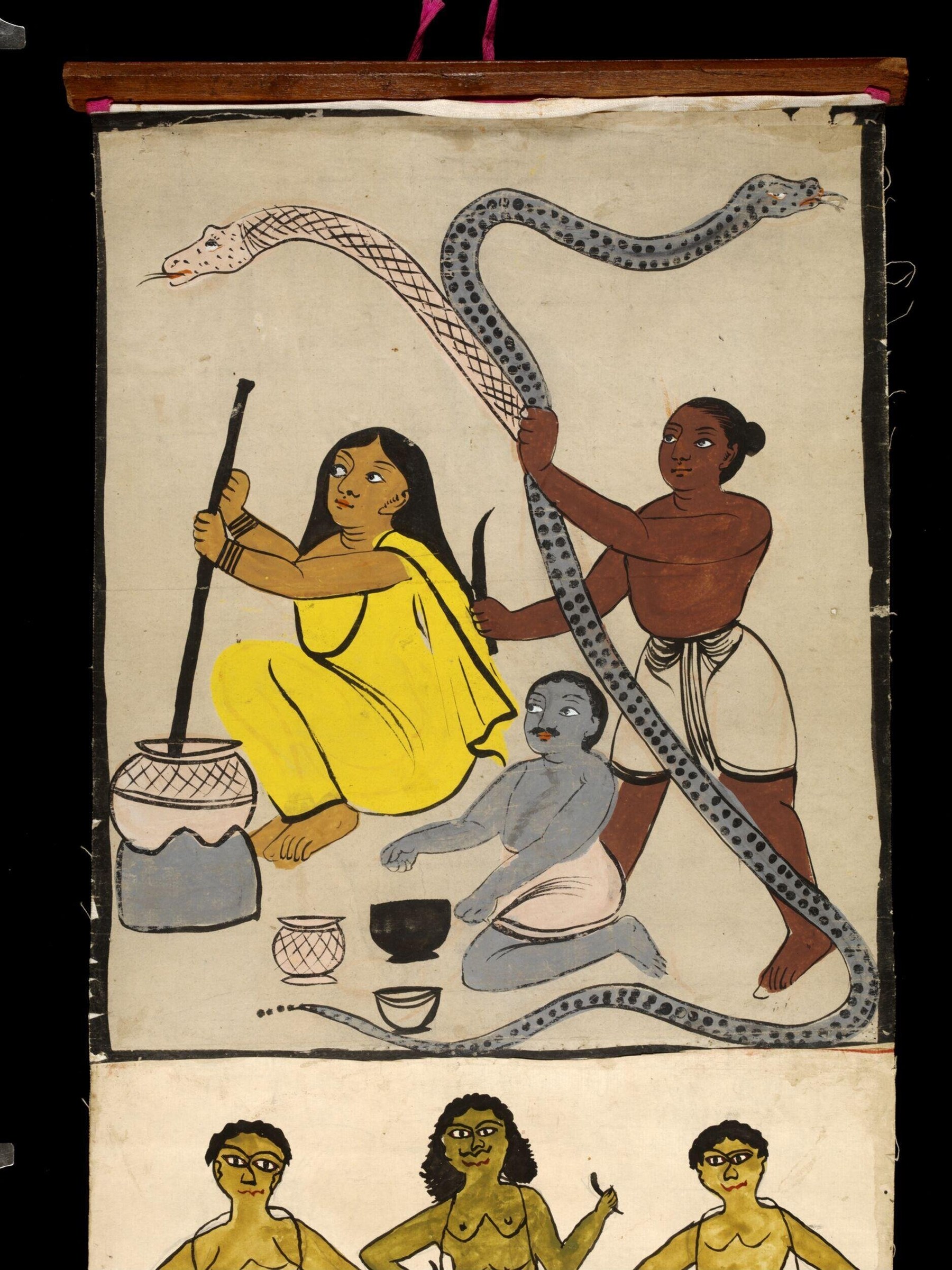
A domestic scene rendered in watercolor or gouache on paper mounted on a wooden scroll. Three figures occupy a modest interior: a woman in a bright yellow garment sits at left holding a staff or pole; a young child in gray sits center; a man in brown skin-tone with minimal clothing stands at right. Two large serpents, rendered in profile with scale patterns and spotted detail, dominate the composition—one coils from upper left descending toward the woman, the other curves from the child upward to the right. Several ceramic vessels and bowls sit on the ground. The palette is restrained: ochre, gray, black line work, and touches of yellow. The figures are rendered with naturalistic proportion but stylized features. The bottom register shows three additional female heads in ochre tones, their function unclear—possibly a study sheet or separate register of types.
The dancing
The figures are posed in stillness rather than active movement. The woman sits upright, her gaze directed upward toward one serpent, her posture calm and alert. The child sits passively in the center ground. The man stands with one arm raised, appearing to grasp or steady one of the serpents. The bodies are modeled with subtle shading and anatomically coherent, suggesting the artist had observational skill. There is no indication of dance positions, holds, or movement vocabulary—the composition reads as narrative tableau rather than choreography.
The dance depicted
This does not depict dance. The scene appears to document a moment of snake handling or domestication in a non-Western context, likely Mesoamerican or South Asian in origin based on artistic convention and iconography. The serpents may carry ceremonial or symbolic weight, but the figures' postures and the composition's static nature indicate narrative documentation rather than ritual movement or performance. No hold, frame, or weight transfer characteristic of any dance tradition is evident.
How it was made
Watercolor or gouache on paper, mounted on a wooden scroll with fabric binding strips (visible at top in magenta/pink). The technique employs flat color fields with fine black line work for detail—scale patterns, facial features, and vessel outlines are drawn in ink. This medium and mounting format are consistent with 19th-century ethnographic or travel documentation, often produced for European collectors or scientific societies studying non-European cultures. The scroll format suggests circulation as a collectible art object or reference specimen rather than a single framed work.
About this work
This scroll painting documents a domestic scene involving serpent handling in a non-Western cultural context, dated to circa 1900 and held in a collection focused on visual anthropology or travel art. While the work is compelling for its ethnographic content, artistic skill, and historical interest, it does not depict dance and should not appear on dance-centered pages. The composition is a static, moment-specific tableau—a woman, child, and man in the presence of large serpents—rendered with the observational detail typical of early-20th-century ethnographic illustration. Its inclusion in a dance archive appears to reflect cataloging error or overly broad subject classification.
How to look at it
The viewer should attend to the compositional balance created by the two serpents as framing devices, curving around the three figures. The artist has chosen a moment of apparent calm—not flight or struggle, but controlled presence. The fine black linework on the serpents' scales contrasts with the flat color of the figures' skin and garments, suggesting a visual hierarchy. The inclusion of the three heads below may represent a study or inventory of human types; their meaning is unclear without textual context.
The period
Circa 1900 marks a period of intensive European ethnographic collection and illustration of non-Western cultures, often undertaken through colonial expansion or travel documentation. The watercolor-on-paper scroll format reflects the hybrid conventions of late 19th and early 20th-century travel art—combining Western artistic training with non-Western mounting and display traditions. At this time, dance itself was rarely a primary focus of visual ethnography; scenes of domestic, ritual, or labor life were more commonly recorded. The presence of serpents and the domestic interior suggest documentation of belief systems, animal handling practices, or social structure rather than performance.
Where it lives
The work is recorded as a scroll painting held in a collection marked 'va' (likely Virginia). The wooden roller and fabric binding suggest it was mounted for Western collection and display. No accession number, donor, or acquisition context is recorded in the catalogue.
Questions about this work
Is this a dance scene?
No. While the figures are rendered with skill and the composition is visually engaging, there is no movement vocabulary, choreographic structure, or bodily engagement with a partner or with rhythm. The scene is a static narrative tableau of snake handling in a domestic setting, not a performance or ritualized movement tradition.
What culture or region does this depict?
The artistic style, the presence of serpents as central elements, the domestic interior setting, and the rendering conventions suggest a Mesoamerican, South Asian, or African origin, but without inscription, artist attribution, or collecting history, this cannot be stated with confidence. The watercolor technique and scroll mounting reflect early-20th-century European travel-art conventions.
Why is this in a dance archive if it is not a dance?
This appears to be a cataloging error or the result of overly broad subject classification. The work may have been included because it depicts human movement or cultural practice, but neither the image nor the artist's evident intention supports categorization as dance documentation.
More dance artwork





