49 works in this view — arrow keys or swipe to move between them.
Dance in Art
"The Village Fête"
Outhwaite, J
- Collection:
- Source:
- Victoria and Albert Museum
- Rights:
- Rights vary by item — check the source record before reusing this image. Source record ↗
- Recorded as:
- V&A — check rights per item
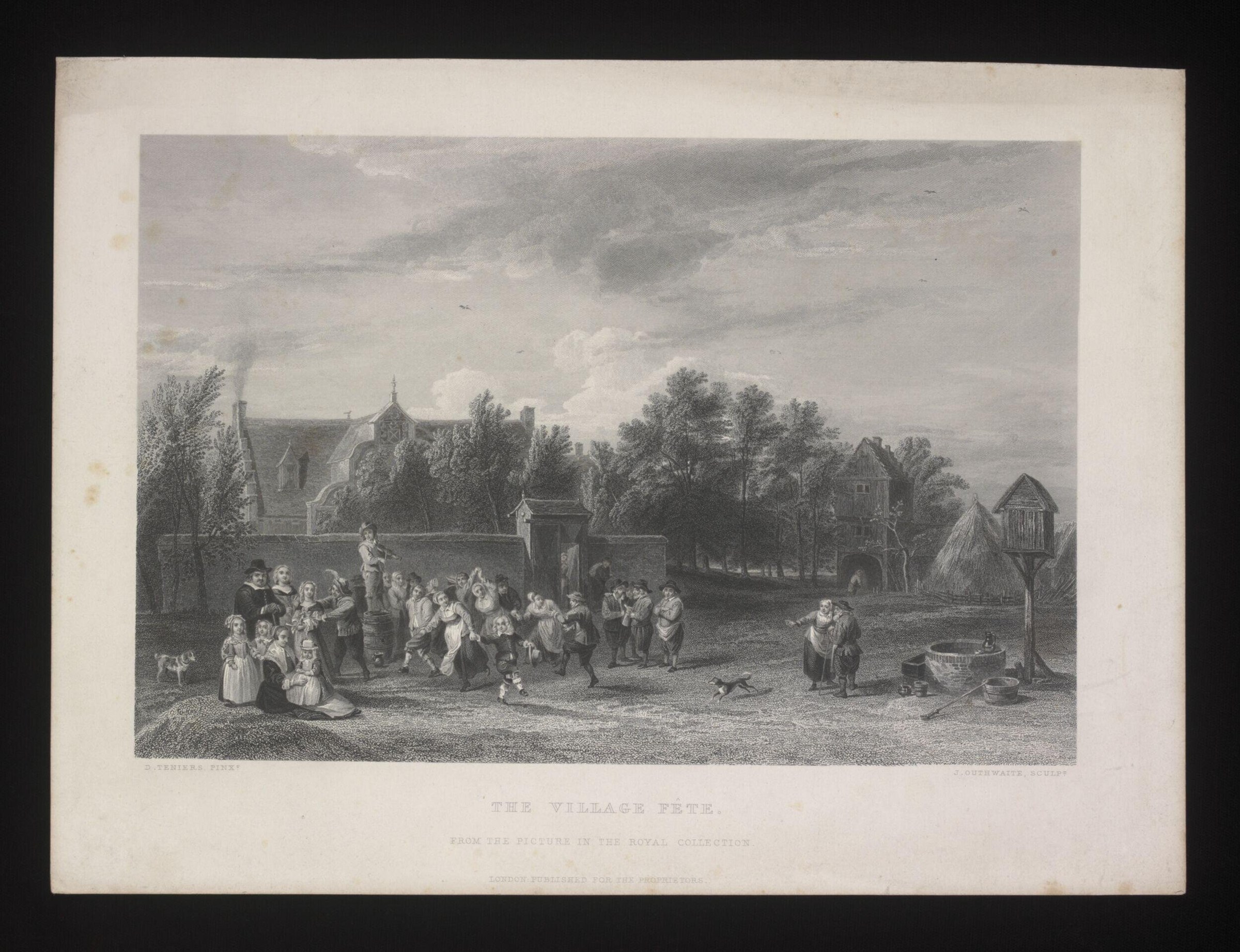
This work documents the social organization of village festivity before dance industrialization—the costumes, the mixed gathering, the integration of food, fire, and community. For historians of vernacular dance, it provides context for understanding who danced, how they dressed, and what occasions prompted dancing. It also shows the reproductive print as a tool for circulating knowledge of regional customs to distant audiences.
What you are looking at
A village green hosts a community celebration in what appears to be a Dutch or Flemish setting of the 17th or 18th century. A walled village with church spire rises in the background; half-timbered buildings and trees frame the scene. In the foreground, two groups of figures occupy the space: a large gathering of men, women, and children in the center, many dressed in formal dark coats and long skirts typical of the period, and a smaller domestic scene at right where figures tend a fire or prepare food. The light is soft and overcast, with billowing clouds above. A dog occupies the left foreground. The composition suggests a moment of pause or assembly rather than active movement—this appears to be documentation of how a village community organized itself for festivity.
The dancing
The figures stand upright, mostly stationary or moving slowly through the gathered crowd. No closed holds or formal dance postures are visible. Postures are naturalistic: people stand in conversation, some lean slightly, children cluster near adults. The grouping is loose and organic rather than arranged in lines or formations. No apparent footwork, weight shifts, or partnering characteristic of structured dance.
The dance depicted
This engraving depicts a village fête—a community gathering or market day—rather than a dance scene proper. While rural celebrations of this era typically included dancing, the moment chosen here shows the assembly and social congregation before, between, or after dancing. The figures are dressed and gathered, but no active dance is visible. The work documents the social structure and dress codes of village life rather than choreography or movement technique.
How it was made
This is an engraving, executed with fine parallel lines and cross-hatching to model form and suggest atmospheric depth. The technique allows precise detail in costume and architecture while creating a broad, legible narrative scene. The print's relatively large format and finished character suggest it was intended for a cultivated audience—not ephemeral broadsheet but a work meant to circulate among collectors and to document or commemorate a particular place and moment. The soft sky and careful gradations indicate skilled reproductive work, likely after a painting or drawing.
About this work
This engraving shows a village fête—a community social gathering in a Dutch or Flemish village, probably 17th or 18th century. The catalogue identifies it as derived from a painting in a royal collection, indicating it held documentary or commemorative value. The work belongs in a dance gallery not because it depicts active dance, but because it shows the social and festive context in which vernacular dance occurred—the gathering, the dress codes, the mixed-age and mixed-gender assembly that made village celebration possible. It is a record of the occasion and costume that framed dance rather than of dance itself.
How to look at it
Attend to the dress: the formal coats, long skirts, and hats indicate this is not a scene of poverty or purely rural labor, but of community members in their formal or market clothes. The spatial organization—the clustering, the presence of food preparation and domestic activity alongside socializing—shows that a village fête combined multiple functions. Look for the absence of formal arrangement or spectacle; this is how community festivity actually organized itself before it became a performed tradition. The engraver's choice to show the gathering rather than the dance moment suggests documentary intent: to preserve how villages looked when they assembled.
The artist
J. Outhwaite is credited as the engraver. Beyond the catalogue record, no further biographical information is provided. The work appears to be a reproductive engraving—that is, made after a painting or drawing by another hand—which was a standard and valued form of art production in the 18th and 19th centuries. Reproductive engravers were skilled technicians whose work circulated images widely.
The period
Village fêtes were traditional occasions for community gathering, commerce, and entertainment across northern Europe in the 17th and 18th centuries. They combined markets, feasting, and social ritual. Dance at such gatherings was largely participatory and improvisational, led by musicians and organized informally by participants. This was the period before folk dance was systematized or performed for audiences; it was lived social practice. Contemporary prints and paintings documenting such scenes served to record regional customs and to circulate knowledge of them to urban or distant viewers.
Where it lives
The print is held in a collection designated 'va' (likely a museum or archive abbreviation). The catalogue notes that it is derived from a picture in the Royal Collection, suggesting it had official or courtly provenance and was valued as a record of manners and regional character.
Questions about this work
Is this actually a dance scene?
Not primarily. It shows a village gathering or market day in which dancing may have occurred, but the moment chosen here is the assembly, not the dancing itself. It documents the social occasion, costume, and gathering that framed vernacular dance.
What is a village fête?
A traditional community gathering in northern European villages, combining market activity, feasting, socializing, and often dancing. These were occasions when work stopped and the community assembled in formal or market dress. They were frequent enough to be recognizable occasions but significant enough to warrant documentation.
Why was this engraved and printed?
As a record of regional customs and manners. Reproductive engravings of village and rural scenes circulated widely in the 18th century to urban audiences interested in understanding how different regions and classes lived. This work served documentary and curiosity functions.
How do I know this is Dutch or Flemish?
The architecture—the walled village layout, the church spire, the half-timbered buildings—and the style of dress and gathering are consistent with 17th–18th century Dutch or Flemish practice. However, the catalogue does not specify the location, so this must remain an informed reading rather than a confirmed fact.
More dance artwork





