49 works in this view — arrow keys or swipe to move between them.
Dance in Art
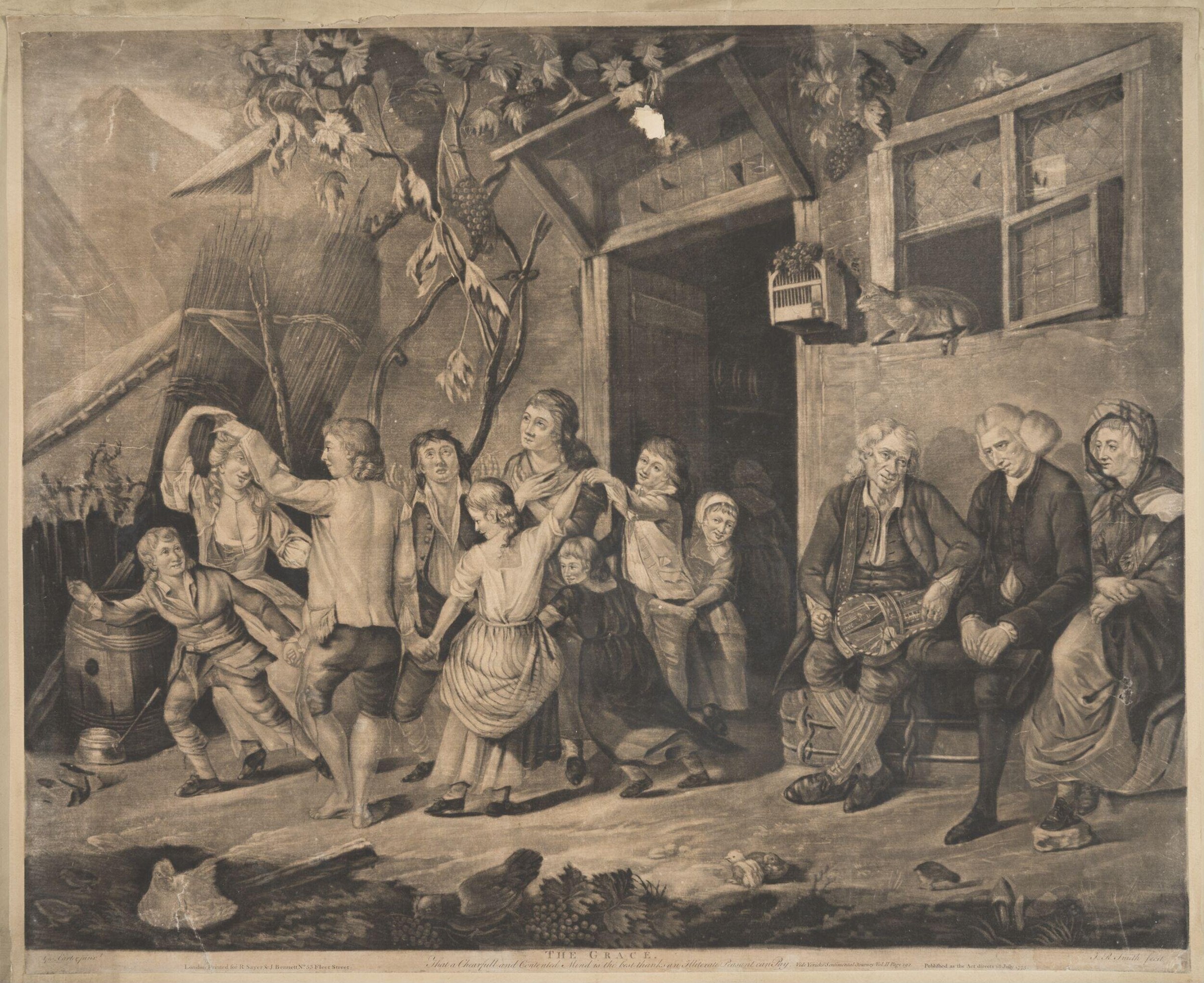
The Grace
John Raphael Smith
- Collection:
- Source:
- Victoria and Albert Museum
- Rights:
- Rights vary by item — check the source record before reusing this image. Source record ↗
- Recorded as:
- V&A — check rights per item
For dancers and historians, this work illustrates the visual grammar of the body in formal domestic space during the neoclassical period—the posture, stance, and spatial relationships that defined 'grace' and propriety in eighteenth-century conduct. It shows how the female body, in particular, was positioned as an object of aesthetic and moral attention, and how stillness and composure could be as eloquent as movement. The work is also a valuable document of interior space, dress, and family arrangements of the period.
What you are looking at
A domestic interior scene of the late eighteenth century, with figures arranged in two distinct groups. On the left, children and young people gather around a fruit tree bearing hanging produce, some reaching upward in playful gestures, while adults supervise. On the right, three older men sit or stand in conversation—their postures relaxed, their dress formal in dark coats and breeches. Between these groups, in the middle ground, a young woman in a white dress with dark trim stands at the center of attention, her body poised in an elegant, composed stance. A birdcage hangs from the window of a modest cottage behind her. The foreground is scattered with fruit and vegetables, establishing the rural or semi-rural setting. The light is even and clear, typical of a satirical or morality print of the period.
The dancing
The central woman stands in an upright, dignified posture with arms positioned gracefully at her sides or subtly raised, her weight balanced and her body arranged to command the viewer's attention without obvious movement. Her companions—children reaching, adults observing—form a tableau of varying attitudes: some in motion, some still, all oriented toward or aware of her presence. The three seated or standing men on the right maintain formal, static poses appropriate to their age and station. The composition suggests a moment of social performance or display rather than active dancing, though the woman's bearing and the gathered attention around her suggest a kind of social choreography.
The dance depicted
No active dance appears to be represented here. The title *The Grace* likely refers to a blessing or saying of grace before a meal—a domestic ritual of the period—rather than a dance. The woman's composed, elegant stance and the arrangement of figures around her suggests a moment of social ritual or ceremony. The subtitle or context may clarify whether any movement is implied, but the static quality of the composition and the presence of food, the cottage setting, and the watching adults all point toward a domestic or moral scene rather than a ballroom or theatrical dance. The 'grace' may be the young woman herself—a figure of virtue or propriety—as much as a verbal prayer.
How it was made
This is an engraving or stipple engraving, evident from the tonal modeling, fine parallel lines, and the reproductive quality of the work. The technique allows for subtle gradations of light and shade and was well-suited to the narrative and satirical prints popular in late eighteenth-century Britain. Engraving of this refinement and finish required significant skill and was produced for a broad but educated audience—the work would have been published and circulated as a print, making it accessible to middle-class households. The date of 1775 and the artist John Raphael Smith place this within the heyday of the British print trade.
About this work
This is a narrative engraving from 1775 depicting a domestic scene of social ritual and family life in late eighteenth-century Britain. The central figure, a young woman in elegant dress, is the focus of attention from family members gathered in a modest interior. Although the title *The Grace* might suggest dance to a modern reader, the composition and setting indicate a moment of domestic ceremony—likely the saying of grace before a meal—rather than choreographed movement. The work belongs in a gallery about dance in art because it documents the visual culture of the period and the representation of the body in formal, socially charged moments, even when the body is not in motion. It speaks to the way bodies were arranged and displayed in social life, and to the expectations of propriety and display that governed the period.
How to look at it
Attend to the arrangement of figures around the central woman: the viewer's eye is drawn to her by the directed attention of all the other figures, even though she stands still. Notice her posture and the elegance of her dress, which mark her as the moral or aesthetic center of the scene. Look at the details of the cottage interior—the window, the birdcage, the scattered fruit—which ground the scene in a specific time and place. The engraving technique allows for fine gradations of tone that model the figures and create a sense of depth and atmosphere. The stillness of the central moment, emphasized by the static poses of the onlooking adults, contrasts with the playful movement of the children and suggests a social ritual being observed and honored.
The artist
John Raphael Smith (1751–1812) was one of the most accomplished and prolific printmakers of the late eighteenth century, specializing in stipple engraving and mezzotint. He was known for narrative and genre scenes drawn from contemporary life, as well as reproductions of paintings by Old Masters and his contemporaries. Smith was a founding member of the Royal Academy and enjoyed considerable commercial success; his prints were widely distributed and collected. He worked in a tradition of British satirical and moral prints, contributing to the visual culture that shaped public taste and discourse.
The period
The 1770s saw a flourishing of narrative and genre prints in Britain, driven by rising literacy, growing middle-class patronage, and the development of new printing techniques such as stipple engraving. Prints on domestic and moral subjects were particularly popular, reflecting Enlightenment interest in virtue, conduct, and the proper ordering of family life. Dance itself was undergoing transformation during this period: the formal minuet and other court dances were giving way to country dances and quadrilles, and there was increasing interest in dance as a subject for visual representation. The representation of the female body in formal, composed attitudes—as seen here—reflects broader cultural anxieties about female virtue and the proper display of the body in society.
Where it lives
The work is held as a print in the Virginia collection (according to the catalogue record). The source designation 'va' suggests it may be part of a larger collection or series of British prints from the period.
Questions about this work
Is this a dance scene?
No. The title *The Grace* refers to a domestic ritual—the saying of grace before a meal—rather than a dance. However, the work is valuable for documenting the visual language of the body in formal social moments, and the composed, elegant posture of the central figure reflects the aesthetic ideals of the period. Dance and formal social gesture were closely related in the eighteenth century, and this print shows how the body was arranged and displayed in everyday life.
Who was John Raphael Smith?
Smith (1751–1812) was one of the leading printmakers of his generation, celebrated for his technical skill in stipple engraving and his ability to capture narrative and character. He was a founding member of the Royal Academy and produced hundreds of prints—both original compositions and reproductions of paintings—that were widely distributed and collected. His work shaped public taste and visual culture in late eighteenth-century Britain.
What technique was used to make this print?
This is an engraving, likely a stipple engraving, which uses small dots or flicks of the engraving tool to build up tone and shadow. The technique was labor-intensive but allowed for subtle effects of light and shade and a highly finished appearance. Stipple engraving was popular for narrative and portrait prints in the 1770s and 1780s because it could convey fine detail and a sense of polish.
More dance artwork





