49 works in this view — arrow keys or swipe to move between them.
Dance in Art
Theatre costume
Unknown
- Collection:
- Theatre costume
- Source:
- Victoria and Albert Museum
- Rights:
- Rights vary by item — check the source record before reusing this image. Source record ↗
- Recorded as:
- V&A — check rights per item
The survival of theatrical costume pieces like this gives material evidence of how dancers dressed, what ornament signaled status and expense, and what craftsmanship was considered necessary for court and classical performances. It also documents the intersection of dance, theatre, and the decorative arts in cultures where costume was integral to the meaning of movement.
What you are looking at
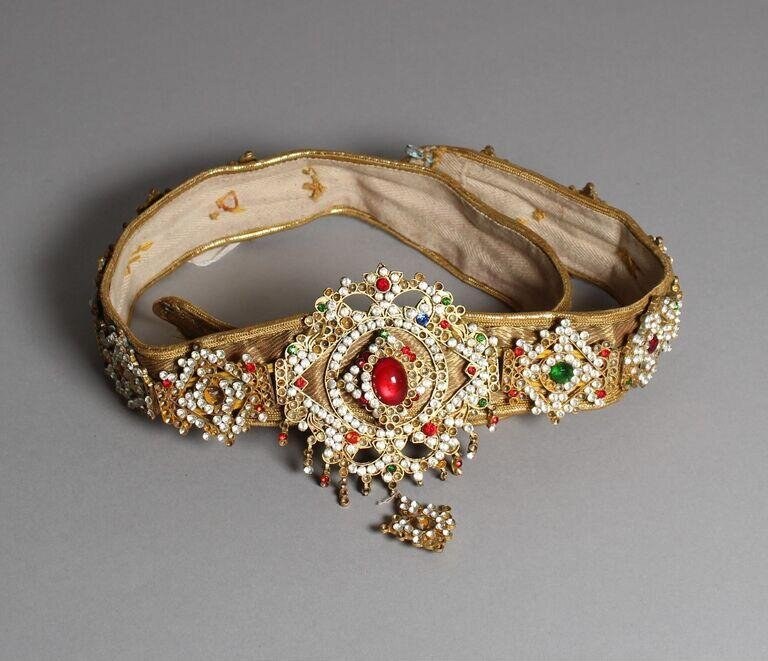
A jeweled belt or girdle displayed flat against a neutral background, photographed from above. The ornament consists of a broad band of cream or pale gold silk fabric, bordered and densely embellished with gold metalwork. At the center hangs an elaborate medallion featuring a large faceted ruby cabochon in an openwork gold frame studded with seed pearls, surrounded by smaller rubies, emeralds, and sapphires in a symmetrical pattern. From the lower edge of this central piece hangs a single pearl drop. The remainder of the band is covered in regularly spaced jeweled plaques in gold filigree, each set with pearls and colored stones arranged to catch light. The silk backing shows wear consistent with age and use.
The dancing
This is not a depiction of dance or human movement. It is a three-dimensional costume ornament: a court or ceremonial belt designed to be worn at the waist. The belt itself is an object, not a representation of dancers or gesture.
The dance depicted
While this object is described as a theatre costume, it is a decorative accessory rather than a garment that would determine or depict a specific dance style. Such jeweled belts were worn in court dances and formal ceremonial contexts across multiple traditions—most notably in Indian classical dance (Bharatanatyam, Kathak) and Middle Eastern court dance. Without additional context such as the accompanying garment or the theatre for which it was made, neither the dance form nor the regional tradition can be determined from the belt alone.
How it was made
This is a jeweled belt or ornamental girdle (likely 19th or early 20th century) constructed from silk ribbon as a ground, with gold metalwork—possibly filigree or granulation—as the setting for gemstones and seed pearls. The technique required skilled goldsmiths to create the openwork frames and secure hundreds of small stones and pearls without adhesive, using only mechanical settings. The density of ornament and the quality of materials suggest a commission for high-status theatrical or court wear, with circulation limited to wealthy institutions or performers.
About this work
This is a jeweled belt or girdle, identified as a theatre costume accessory in the holding collection but not securely dated or attributed. It is characteristic of court dress and formal ceremonial costume in South Asian and possibly Middle Eastern dance contexts of the 18th–20th centuries. The object speaks to the material value invested in dance costume among elite audiences and the craft knowledge required to produce such pieces. The belt would have been worn at the waist to define the silhouette and to demonstrate wealth and status through the brilliance of its ornament.
How to look at it
Attend to the concentration of craftsmanship at the center of the belt: the hierarchical arrangement of the main jeweled medallion, which would draw the viewer's eye to the dancer's waist and center the body during movement. Note how the regular spacing of smaller jeweled plaques across the rest of the band would create a shimmering line as the dancer turned or gestured. The technical precision—the uniformity of pearl sizes, the regularity of the filigree cells—speaks to the value placed on the object and its wearer.
The artist
The maker of this belt is unknown. It represents the work of goldsmiths and embellishers who produced costume pieces for theatre, court, and ceremonial contexts—craftspeople rarely credited in theatre records but essential to the visual spectacle of performance.
The period
Jeweled theatrical costume pieces of this kind flourished in the 19th and early 20th centuries, during a period when court dances in India and the Middle East were being staged for elite audiences and, increasingly, in formal theatre contexts. The ornamental vocabulary—filigree, cabochon gems, seed pearls—reflects both traditional craft practices and the economics of imperial courts where dance was an art of display. European theatre also adopted jeweled costume accessories for historical, oriental, and fantasy scenes.
Where it lives
Held as a theatre costume accessory in a collection identified as VA (likely the Victoria and Albert Museum, London). The belt is catalogued as a theatre costume but lacks secure dating, attribution, or documentation of its use history.
Questions about this work
What dance would this belt have been worn for?
Without additional costume context or documentation, the dance form cannot be determined from the belt alone. However, such jeweled belts are characteristic of classical Indian dance (especially Bharatanatyam and Kathak), Middle Eastern court dance, and 19th-century European theatrical orientalism. The style of ornament and setting would help narrow the tradition if the belt could be examined by a specialist in costume of a particular region.
Why are there so many pearls and gems on a single belt?
In court and classical dance traditions, costume ornament served multiple purposes: to display the wealth and status of the patron or dancer, to catch light and make movement more visible to audiences seated at a distance, and to create rhythm through visual shimmer that complemented the music and footwork. The belt would have been one of many jeweled pieces worn during performance.
Is this belt still wearable?
The object shows signs of age and use, and the silk backing has deteriorated. It would require specialist conservation before any handling or wearing. Museum pieces like this are typically preserved as evidence of historical craft and costume practice rather than restored to use.
More dance artwork





