49 works in this view — arrow keys or swipe to move between them.
Dance in Art
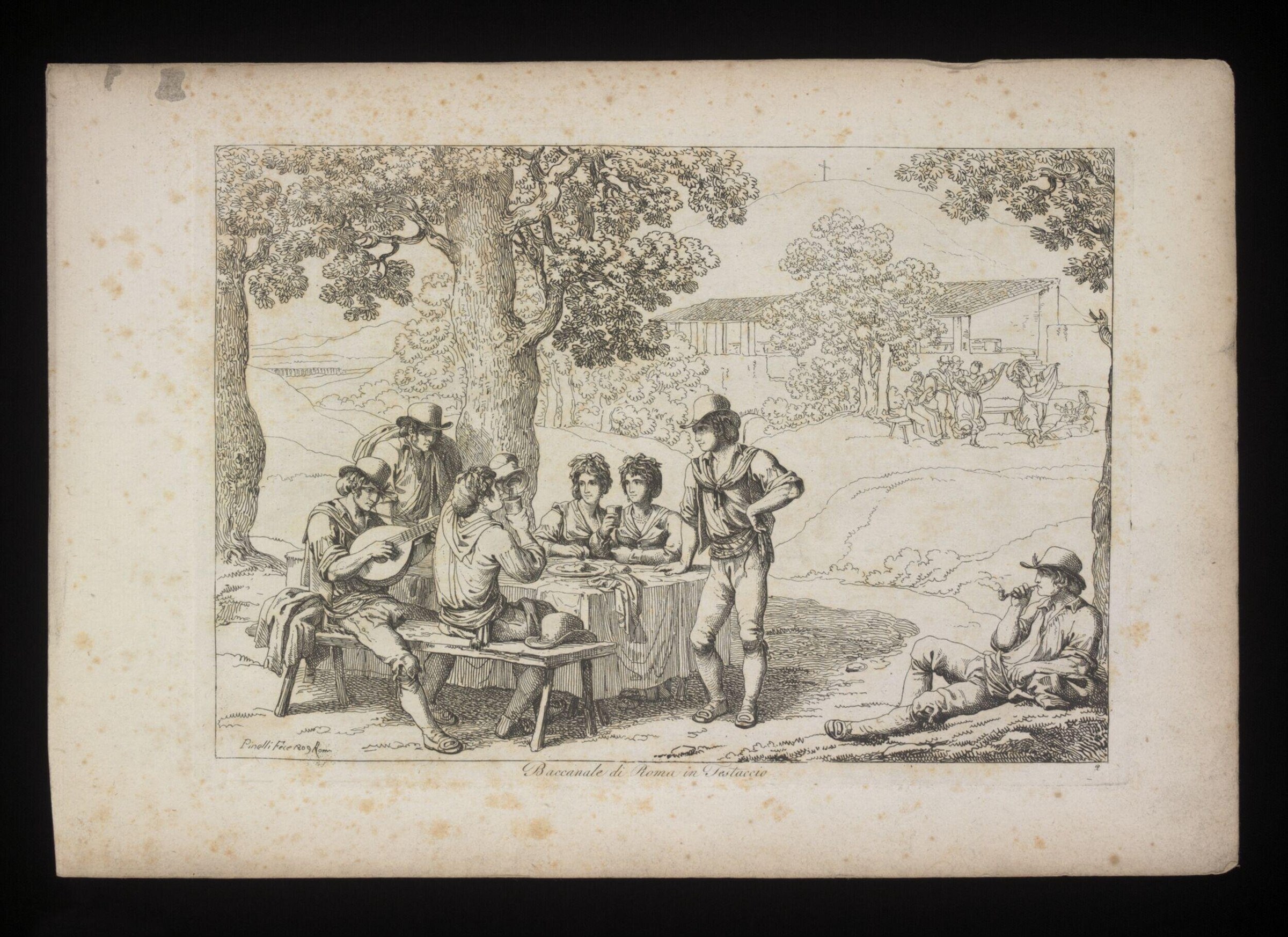
"Baccanale di Roma in Testaccio".
Pinelli, Bartolomeo
- Collection:
- Source:
- Victoria and Albert Museum
- Rights:
- Rights vary by item — check the source record before reusing this image. Source record ↗
- Recorded as:
- V&A — check rights per item
For dance historians, this print documents the lived context of popular music-making and sociability in post-Napoleonic Rome, showing the kinds of occasions and social groupings in which vernacular dancing occurred. The presence of the stringed instrument and the composition around shared pleasure and music make it valuable evidence of how dance was embedded in rural and working-class festivity. Pinelli's careful observation of posture and dress preserves details of how bodies and clothing actually moved in such gatherings.
What you are looking at
A rural feast or celebration unfolds beneath a massive oak tree in the foreground, with a company of eight figures gathered around a low wooden table laden with food and drink. The central group includes musicians—one plays a stringed instrument (possibly a mandolin or guitar)—while others eat, drink, and converse in animated poses. Two young women in high-waisted, neoclassical dress sit at the table; men in broad-brimmed hats and simple tunics stand and gesture around them. In the middle distance, a substantial house or villa with a colonnade overlooks the scene, and further figures can be seen enjoying themselves in the background. The composition is structured around the tree and the gathering, with a landscape receding to the horizon. The print captures a moment of convivial leisure, with the figures' relaxed postures and the abundance of food and music suggesting either a harvest celebration or a romantic pastoral idyll.
The dancing
The bodies are loosely arranged rather than formally partnered. One man plays a stringed instrument while seated; others stand with weight shifted casually, arms gesturing in conversation or raised in toasts. The two women sit with the upright posture typical of neoclassical portraiture but their gazes and body angles suggest engagement with the group rather than formal constraint. One man on the right reclines on the ground in a relaxed pose. The spacing and informal clustering suggest social pleasure and ease rather than choreographed movement, though the overall composition is carefully balanced.
The dance depicted
This image does not depict active dance, but rather a moment of social festivity—music-making, feasting, and courtship ritual in a pastoral setting. The stringed instrument and the gathering suggest the context in which social dancing would occur, but no figures are actively dancing. The title identifies this as a 'Bacchanal'—a feast or revel in the classical manner—which evokes the mythological context of Bacchus and wine-fueled celebration, but the scene is rendered as rural domesticity rather than ecstatic ritual. The print documents the social occasion and convivial atmosphere from which dance might emerge.
How it was made
This is an engraving on paper, executed with fine parallel lines and crosshatching to create tone and shadow, a technique characteristic of late 18th and early 19th century reproductive printmaking. The signature 'Pinelli sculpsit' (Pinelli engraved it) at lower left confirms the artist's hand. The precision of line and the density of detail suggest this was produced for wide circulation as a print—affordable, portable, and reproducible—making it likely aimed at an educated middle-class audience interested in picturesque rural scenes and classical allusion. The technique allows for subtle modulation of light across the figures and landscape.
About this work
This engraving by Bartolomeo Pinelli depicts a festive gathering in the Roman countryside (Testaccio, a district of Rome), titled as a 'Bacchanal' in classical allusion but rendered as a scene of contemporary rural sociability. Though not a representation of active dance, it documents the social, musical, and festive context in which social dancing was embedded in early 19th-century popular life. The print exemplifies the romantic, picturesque interest in peasant and rustic life that dominated European visual culture of the period, combined with neoclassical reference and Pinelli's characteristic attention to the particulars of dress, posture, and social relation. It belongs in a dance archive as evidence of the occasions, instruments, and social protocols that framed dancing in this era.
How to look at it
Attend first to the central gathering and the tree that frames and anchors it—Pinelli has chosen to freeze a moment of repose and conviviality rather than active movement. Notice the varied postures: the contrast between the seated musician, the standing gesturing figures, and the reclining man on the right creates rhythm and naturalism. The engraving technique allows Pinelli to render the fall of light across the tree and figures, drawing the eye inward to the feast. Look at the details of dress—the women's high-waisted gowns and the men's simple tunics and hats—which anchor the scene in a specific social and geographical reality. The composition is carefully balanced around the table and tree despite appearing casually observed.
The artist
Bartolomeo Pinelli (1781–1835) was a Roman printmaker and painter who specialised in picturesque scenes of Roman popular life, rural customs, and banditti subjects. He worked in engraving and etching, producing prints that combined romantic and satirical observation with neoclassical composition. His work was widely circulated and admired across Europe for its combination of documentary detail and poetic sentiment. He was particularly known for depicting peasant life, festivities, and historical subjects, and his prints were produced for a broad commercial market.
The period
In the early 19th century, Romantic interest in folk life, peasant customs, and the 'natural' or 'picturesque' rural subject was at its height across European visual culture. At the same time, neoclassical references—here the title 'Bacchanal'—provided intellectual legitimacy and literary resonance. In Rome specifically, this was the era of the Grand Tour, when educated Europeans sought picturesque views of Italian rural life as evidence of an authentic, pre-industrial, poetic world. The consolidation of printmaking as a medium of mass circulation meant that such scenes could reach a wide audience. Social dancing in this period was increasingly codified into formal ballroom styles (the waltz, quadrille, cotillion) among the urban middle and upper classes, while rural and working-class dancing remained more improvisational and embedded in festive occasions like this one.
Where it lives
The work is recorded as a print in an institutional collection (source: VA, likely the Victoria & Albert Museum). It is one of Pinelli's many prints of Roman life, which were widely collected and distributed in the 19th century.
Questions about this work
Is this actually a scene of dancing?
No—this is a feast or celebration in which music is being made and people are eating, drinking, and socialising. However, it documents the kind of occasion and social context in which dancing would have taken place in rural or popular settings. The presence of the musician and the festive gathering show the conditions that framed social dancing.
What is a 'Bacchanal'?
In classical literature and art, a bacchanal is a feast or revel in honour of Bacchus, the god of wine, often depicted as ecstatic or orgiastic. Pinelli's title invokes this classical reference, but the actual scene is a sober and sociable gathering of rural people—a romantic, picturesque version of peasant festivity rather than mythological excess.
Why would this be in a dance archive if there is no dancing?
This print is valuable as evidence of the social, material, and musical contexts in which vernacular dancing occurred. It shows the kinds of occasions, instruments, clothing, and body language associated with popular music-making and festivity. It documents how dancing was embedded in broader social practices of commoning, eating, and celebrating together.
Where is Testaccio?
Testaccio is a district of Rome, traditionally a working-class and popular quarter. The location in the title suggests Pinelli's interest in documenting contemporary Roman life and customs as part of the broader Romantic fascination with picturesque rural and popular subjects.
More dance artwork





