49 works in this view — arrow keys or swipe to move between them.
Dance in Art
Theatre costume
Unknown
- Collection:
- Theatre costume
- Source:
- Victoria and Albert Museum
- Rights:
- Rights vary by item — check the source record before reusing this image. Source record ↗
- Recorded as:
- V&A — check rights per item
For historians of classical Indian dance and costume, this object is evidence of the material standards and aesthetic priorities of historical performance practice. The quality of the goldwork and gemstones demonstrates the investment in costume as a crucial component of the dancer's presence and meaning.
What you are looking at
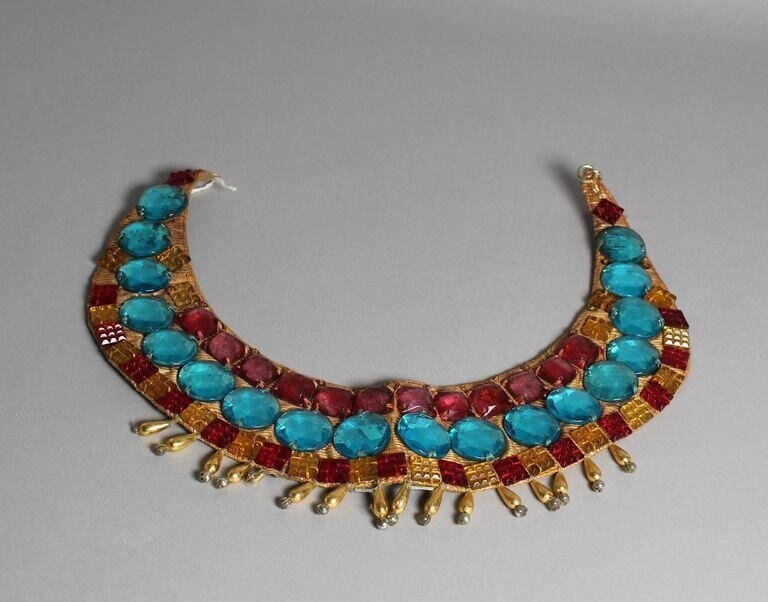
A curved ornamental collar or pectoral ornament lies against a neutral grey background, photographed from above. The piece is constructed as a broad crescent that would sit across the chest and shoulders, composed of alternating cabochon turquoises and deep red stones (likely rubies or garnets) set in a gold filigree framework. The stones are arranged in two principal rows running the length of the crescent. Below the main body, small tubular gold elements hang like fringe or tassels, creating a delicate linear descent. The photograph is lit evenly to show the jewel-like surface and the three-dimensional form of the metalwork.
The dancing
This is not a depiction of dancers or human figures in motion. It is a decorative object—specifically, an ornamental collar or chest ornament that would have been worn as part of a costume. The piece is designed to sit symmetrically across a wearer's upper body and shoulders, with the curved form suggesting an elegant, upright posture in the wearer.
The dance depicted
This object does not depict dance itself but is a component of theatrical costume, presumably designed for classical Indian dance forms such as Kathakali, Odissi, or Bharatanatyam, where such ornamental collars are essential to the formal dress code. The piece itself is stationary; it belongs to costume history rather than documenting the movement or gestures of dance.
How it was made
This is a jeweled metal ornament, likely from South or South Asia, created using traditional goldsmith techniques: filigree work (fine wire decoration), stone-setting (cabochon cutting and bezel mounting), and hollow casting for the pendant elements. The photograph documents the object as a museum artifact, making visible the craftsmanship and material value that would be worn during performance.
About this work
This is a theatrical costume ornament—a jeweled pectoral collar designed for a classical Indian dancer. The piece represents the material culture of dance practice and performance: the careful construction and precious materials reflect both the status of the wearer and the ritual solemnity of classical dance forms. It belongs in a dance gallery not because it shows dance in action but because it is part of the apparatus through which dance was and is embodied and presented.
How to look at it
Observe the balance and symmetry of the design: the alternating colour rhythm of turquoise and red creates visual movement across the static form. Notice the weight the pendant tassels would add and how they would move with the dancer's torso. The filigree detail, visible in close inspection, demonstrates the invisible labor of the jeweler that enables the dancer's visible labour.
The artist
Unknown. This is a craftwork, likely commissioned for or owned by a professional dancer or dance company. The maker's identity is not recorded.
The period
The catalogue record provides no date. The style suggests South Asian goldsmith work of the 19th or 20th century, when such ornaments were standard in Kathakali, Odissi, and Bharatanatyam performance. Classical Indian dance traditions maintain continuities in costume that can span centuries, making precise dating difficult without additional documentation.
Where it lives
Held in a theatre costume collection, source marked 'va'. The catalogue record provides no accession number, date of acquisition, or prior ownership history.
Questions about this work
What would a dancer wear this with?
This collar would be part of the formal costume of a classical Indian dance form. In Kathakali, worn by male dancers, it would accompany an elaborate silk skirt (mundu), a tunic (kacha), and a tall headdress (mukhathezhuthu). The ornament would rest across the upper chest and shoulders, visible throughout the performance.
Why would a dancer wear something so heavy and precious?
In classical Indian dance traditions, costume is not separate from the dance but integral to its meaning. The weight and luxury of the ornament embodies the dancer's skill and status, grounds the performer's body in ritual formality, and signals the sacred or courtly context of the performance.
How do you date something like this?
Without maker's marks, inscriptions, or documented provenance, precise dating is challenging. The style of the filigree, the types of stones used, and the construction technique could place it anywhere from the 19th century onward. Comparison with dated examples in museum collections or consultation with South Asian jewellery specialists would be necessary.
More dance artwork





