49 works in this view — arrow keys or swipe to move between them.
Dance in Art
North West Morris costume
Cutting, Olive
- Collection:
- Costume
- Source:
- Victoria and Albert Museum
- Rights:
- Rights vary by item — check the source record before reusing this image. Source record ↗
- Recorded as:
- V&A — check rights per item
North West Morris is a regionally distinct form of English folk dance, and surviving costumes from the 20th-century revival are scarce documentation of how it was actually performed. The accumulated badges on this costume are an irreplaceable record of participation and community belonging within the Morris world. The object shows how a revived folk tradition reconstitutes itself materially, and how individual dancers marked their presence within it.
What you are looking at
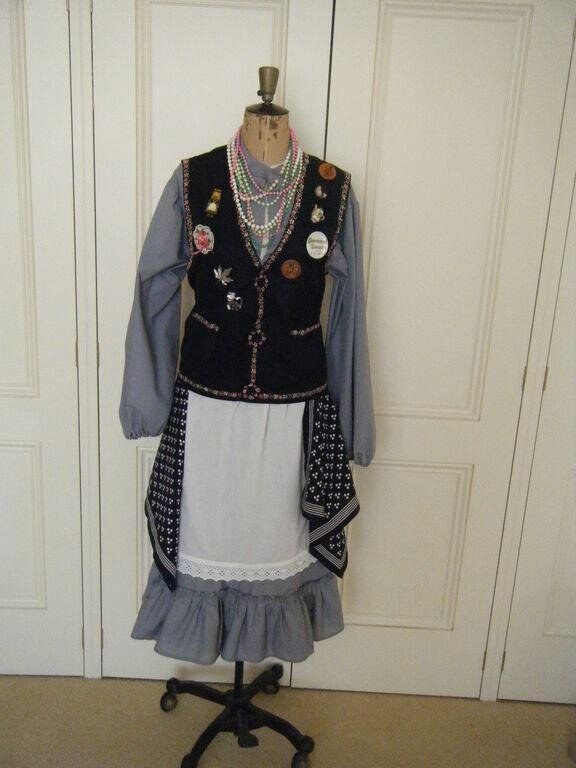
A costume ensemble is displayed on a dress form against a plain white panelled background. The outfit comprises a sleeveless black velvet waistcoat embroidered with floral motifs in bright colours—notably red roses and white flowers—and adorned with a collection of decorative badges and brooches pinned across the chest and shoulders. Beneath this, a pale blue long-sleeved shirt with gathered sleeves is visible. The lower garment is a white linen apron with lace edging, worn over a grey skirt with a deep ruffled hem. An asymmetrical triangular black shawl or scarf with white spot patterning and decorative edging drapes from the shoulders. Multiple strands of pearl beads are looped around the neck in traditional style. The overall effect is of a complete folk costume ensemble, meticulously preserved and formally presented for documentation.
The dancing
No dancers are present; this is a static display of costumed dress on a mannequin. The form is upright and neutral, showing the costume from the front in its fully assembled state. The arrangement allows clear visibility of the embroidered details, the badge collection, the drape of the shawl, and the construction of the skirt and apron.
The dance depicted
This is a North West Morris costume, documented as made or collected by Olive Cutting in 1980. Morris dancing is a form of English folk dance traditionally performed by men in regional variations across England, with the North West tradition centred on Lancashire and Cheshire. The costume elements—the embroidered waistcoat, the decorative badges, the white apron, the patterned shawl, and the pearl beads—are typical of female Morris costume from this region, though Morris was historically male-dominated. The specific badge collection suggests this costume belonged to a particular Morris side or dancer, with the badges likely recording participation in competitions or festivals. The 1980 date places this in the post-revival era when Morris dancing had been revitalised from near-extinction in the mid-20th century.
How it was made
This is a three-dimensional textile object: an assembled costume of embroidered velvet, linen, cotton, and beadwork, presented as a mounted dress form display. The embroidery appears to be hand-stitched, with the floral motifs worked in contrasting coloured threads. The badges are individually sewn or pinned attachments. As a museum costume documentation, the display uses the standard archival method of a dress form to show construction, scale, and the relationship of component pieces while preserving the object from handling damage. This type of presentation became standard museum practice from the mid-20th century onwards and serves both preservation and educational purposes.
About this work
This is a complete North West Morris costume from 1980, documented by dance enthusiast or collector Olive Cutting. Morris dancing is a vernacular English folk tradition with regional variants; the North West style centres on Lancashire and Cheshire and carries its own costume conventions. The object demonstrates the full material culture of Morris performance: the embroidered waistcoat and shawl bear the decorative logic of the tradition, while the accumulation of badges on the chest is a distinctive feature recording this particular dancer's participation history. The costume sits at a moment when Morris dancing—nearly extinct in the mid-20th century—had been substantially revived and was being actively danced, documented, and celebrated.
As a museum piece, this costume is valuable evidence of how Morris was actually dressed in the late 20th century, and of the regional variations that persisted within the revival. The badge collection in particular is a unique historical record; each badge represents a specific performance or event, and the collection as a whole tells the story of one dancer's participation in the Morris community. For dancers and historians, the costume also documents the material standards and aesthetic choices of the revival era, and the role of women in a tradition that had historically excluded them.
How to look at it
Pay close attention to the badges pinned across the chest and shoulders—these are the most individual and historically specific element of the costume. Each represents a particular performance or competition, and their arrangement and accumulation tell the story of this dancer's active participation. Notice how the embroidered waistcoat and patterned shawl are the focal points of visual display, designed to catch light and attention in outdoor performance. The white apron and ruffled skirt hem are functional elements that also contribute to the visual silhouette. The costume as a whole is designed for visibility and movement in a social context; it is not decorative alone but functional dress for active folk dance.
The artist
Olive Cutting documented or collected this costume in 1980. No further information about Cutting's practice, affiliations, or archive is recorded in the catalogue. The name suggests a possible connection to the Morris revival community or to dance documentation practice in England during this period, but this cannot be confirmed from the available record.
The period
By 1980, English Morris dancing had undergone a remarkable revival. The tradition had nearly died out in the early-to-mid 20th century but was revitalised from the 1960s onwards, sustained by enthusiasts, academics, and folk music revivalists. The late 1970s and 1980s saw Morris dancing flourish in its modern form, with regional sides reforming, festivals multiplying, and women's participation expanding significantly. The North West tradition, with its distinctive costume and performance style, was part of this broader revival of regional English folk dance. Documentation and collection of costumes became more systematic during this period as folklorists and enthusiasts sought to preserve and understand revival practice.
Where it lives
This is a museum textile and costume object, held in a costume collection. It was documented by Olive Cutting in 1980. The source is listed as 'va', which may indicate a specific archive or institution, though this cannot be confirmed from the record provided.
Dance in this work
Questions about this work
Why does a Morris costume include so many badges?
In Morris dancing tradition, badges and brooches are earned or collected to mark participation in competitions, festivals, and special events. A dancer pins these badges onto their waistcoat or chest over time, creating a visible record of their involvement in the community. The accumulation of badges is a source of pride and represents years of active dancing. This particular costume shows a substantial collection, indicating an experienced and committed dancer.
What is North West Morris?
North West Morris is a regional style of English folk dance, primarily associated with Lancashire and Cheshire. Like other regional variants, it has its own distinct steps, formation patterns, costume conventions, and music traditions. The North West style is characterised by its particular embroidery motifs, the use of patterned shawls, and the aesthetic choices visible in this costume.
Was Morris dancing performed by women in 1980?
Morris was historically an all-male tradition, but the revival era (from the 1960s onwards) saw women's participation grow substantially. By 1980, women's Morris sides were established and active. This costume, documented in 1980, may represent a female performer in what had become an increasingly inclusive tradition, or it may show how the costume conventions adapted as the tradition evolved.
Why is this costume in a dance gallery?
This costume is primary material evidence of how English folk dance was performed and understood in the late 20th century. It documents the material culture of Morris dancing—the colours, embroidery, construction, and personal ornamentation—and shows how revived traditions reconstitute themselves. The costume also reveals the individual, social, and community dimensions of folk dance participation through its accumulated badges and wear.
More dance artwork





