49 works in this view — arrow keys or swipe to move between them.
Dance in Art
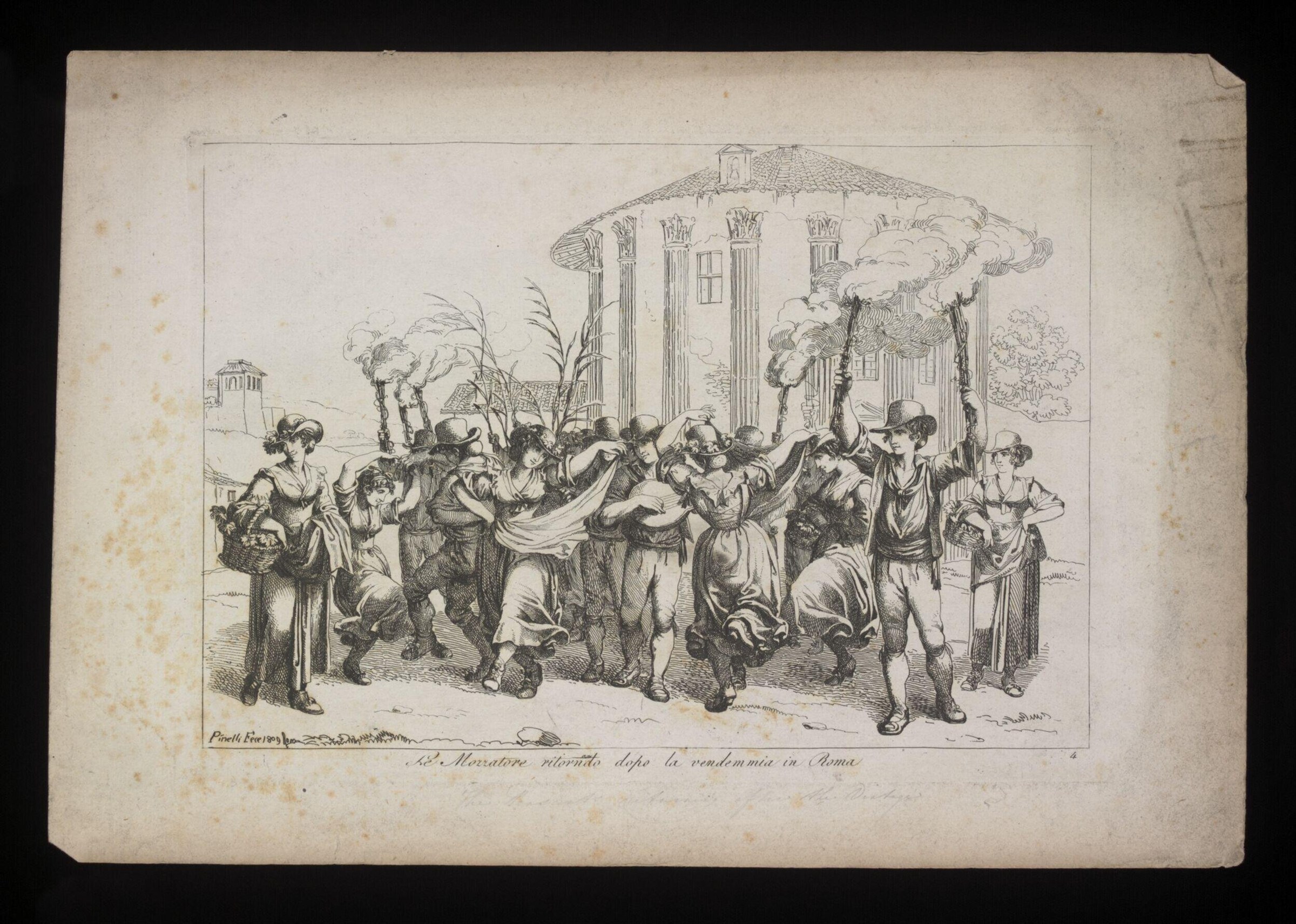
"Le Mozzatore ritorn(an)do dope la vendemmia in Roma"
Pinelli, Bartolomeo
- Collection:
- Source:
- Victoria and Albert Museum
- Rights:
- Rights vary by item — check the source record before reusing this image. Source record ↗
- Recorded as:
- V&A — check rights per item
This work documents a historical form of community celebration that left few other visual records. For dance historians, it is valuable evidence of how bodies moved together in festive settings before the codification and professionalization of dance in the 20th century. Pinelli's precise observation of gesture and posture makes this a rare window into the physicality of popular celebration.
What you are looking at
A crowd of peasants and laborers gathers in a classical Roman setting, centered before a monumental temple with fluted columns and a domed roof. The figures are animated and celebratory, many with raised arms and animated postures. The scene depicts a harvest festival or vintage festival (vendemmia in Italian), with baskets of grapes visible among the figures. The composition is crowded and dynamic, with figures distributed across the foreground at varying depths. The architectural backdrop—rendered with careful perspective—emphasizes the monumentality of Rome and suggests this is a scene of popular festivity within a grand civic or religious context. Trees frame the sides of the composition, and the sky is open. The engraving style creates a lively surface of hatching and line that conveys movement and celebratory energy.
The dancing
The figures are rendered in varied poses suggesting spontaneous movement rather than choreographed precision. Many have one or both arms raised in gestures of celebration or exuberance. Some figures appear to be in conversation or physical contact; a few seem to be in motion. The bodies are clothed in period dress—loose shirts, breeches, hats—consistent with early 19th-century Italian peasant costume. The poses do not suggest a formal or codified dance movement; instead, they convey the informal, joyful physicality of festival celebration. No pair or group displays the structured positioning or hold characteristic of ballroom or theatrical dance.
The dance depicted
The title identifies this as a vintage festival (mozzatore ritornando dopo la vendemmia in Roma—harvesters returning after the vintage in Rome). This depicts popular or folk celebration rather than theatrical or ballroom dance. The gathering appears to represent the kind of spontaneous, community festivity that would have accompanied harvest celebrations in rural Italy. The animated poses suggest dancing or dancing-adjacent celebration—the kind of unstructured group movement and physical joy that characterizes folk festivals—but the image does not depict a specific named dance form or technique. It is an ethnographic or documentary record of popular custom rather than a portrait of a codified dance style.
How it was made
This is an engraving, executed in the neoclassical documentary style typical of early 19th-century Italian prints. The technique allows for fine linear detail and considerable tonal range through hatching, visible throughout the composition and especially in the architectural rendering. The careful perspective construction and classical architectural vocabulary suggest this was intended for circulation among an educated audience interested in antiquarian or ethnographic subjects. The signature at lower left reads 'Pinelli'—identifying this as part of Bartolomeo Pinelli's body of work recording Roman street life and popular customs.
About this work
This engraving by Bartolomeo Pinelli documents a harvest festival celebration in Rome, rendered in the neoclassical style that characterizes his detailed ethnographic studies of popular life. The work captures a moment of community festivity and informal celebration, with peasant figures in animated, raised-arm poses before a monumental classical temple. It belongs in a gallery of dance in art because it records the form and spirit of popular festive movement—the kind of unstructured, joyful physicality that precedes or accompanies folk dance, even if it does not depict a specific codified dance form. The print testifies to how dance historians and art historians might document movement across the boundary between everyday celebration and performance.
Pinelli's body of work sits at the intersection of neoclassical aesthetics and ethnographic documentation. His prints of Roman popular life were widely circulated and influential in early 19th-century Europe. This particular work exemplifies how classical architecture and popular custom were brought into dialogue in the Romantic imagination—the harvest celebration is set deliberately against the monumentality of Rome, suggesting that popular festivity and classical civilization were intertwined.
How to look at it
Attend to the variety of arm positions and the way they are raised—this is the chief visual marker of celebration and movement in the image. Note how Pinelli has distributed the figures across the composition, avoiding symmetry or formal rows, to convey spontaneity and crowd energy. The architectural setting is rendered with precision, but the human figures are sketched with looser, more fluid linework, emphasizing their physicality and movement. The engraver has chosen the moment of gathering and celebration rather than any single coordinated dance step, suggesting that the festivity itself—the raised voices and arms—is the subject, not a formally structured performance.
The artist
Bartolomeo Pinelli (1781–1835) was a Roman engraver and draftsman celebrated for his detailed, affectionate records of Roman popular life, street scenes, and customs. His prints circulated widely across Europe in the early 19th century and influenced Romantic attitudes toward Italian vernacular culture. Pinelli worked in a neoclassical manner but was drawn to subjects—beggars, street musicians, festival celebrations, peasant life—that sat at the margins of neoclassical dignity. His work combines archaeological interest in classical Rome with ethnographic attention to the contemporary lives of ordinary Romans. He was prolific and commercially successful; his prints were collected and imitated.
The period
This engraving was made in the early 19th century, during the height of Romantic interest in folk culture, popular custom, and vernacular life. In the same period, dance was undergoing rapid professionalization and codification—the Romantic ballet was emerging as a theatrical form. Yet outside the theater, popular festive dances and community celebrations remained largely unrecorded except by artists like Pinelli. The print reflects a broader early 19th-century fascination with Italy, Rome, and the life of ordinary people, part of the Romantic privileging of authenticity and feeling over classical restraint. In terms of dance history, the image captures a moment before most folk movement was collected, named, and systematized by folklorists and anthropologists.
Where it lives
The work is held as a print (likely an impression from a copper plate engraving). The source is listed as 'va,' which may indicate a Virginia collection or database; full provenance details are not recorded in the catalogue.
Dance in this work
Questions about this work
Is this showing an actual Italian folk dance?
Not a codified, named dance form. Instead, it documents the kind of spontaneous, joyful physical movement that accompanies community celebration. Pinelli has captured the spirit and gesture of festivity rather than the steps or holds of a specific dance. This is ethnographic documentation of popular movement and celebration.
Why is the setting classical Rome rather than rural Italy?
Pinelli deliberately juxtaposed popular contemporary life against classical architecture. The monumental temple backdrop emphasizes Rome as the subject and suggests that popular festivity is part of Rome's identity and continuity. This reflects Romantic-era attitudes toward Italy as a place where classical and popular cultures coexisted.
What can we learn from this about early 19th-century celebration?
The raised arms, animated postures, and loose groupings show that festive celebration involved whole-body, expressive movement without the formality of ballroom dance. Baskets of grapes and the harvest context tell us this was seasonal, tied to agricultural work. The diversity of figures and poses suggests participation across community rather than an elite or professional performance.
Who was Bartolomeo Pinelli?
A highly successful Roman engraver (1781–1835) whose prints of everyday Roman life were celebrated and widely circulated in early 19th-century Europe. He combined neoclassical technique with romantic interest in popular custom, and his work influenced European taste for Italian vernacular culture. He was especially known for his scenes of street life, beggars, and popular celebrations.
More dance artwork





